


Kaine visits Loudoun to talk about Appalachian Trail road crossings
By Grace Bennett
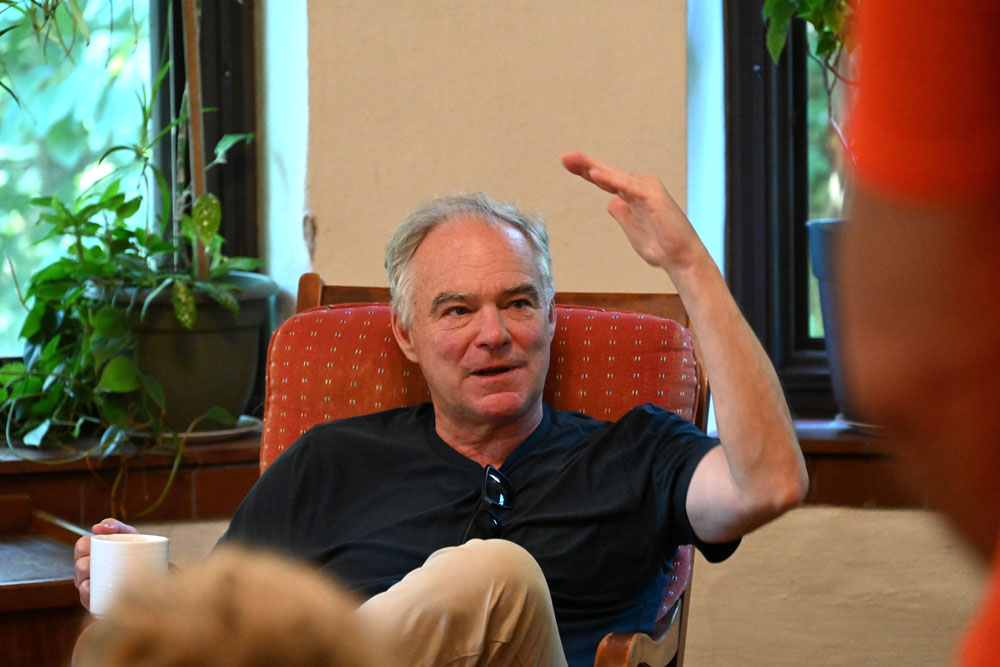
On July 13, Sen. Tim Kaine (D-VA) met with county and Appalachian Trail representatives at the Bear’s Den Trail Center to discuss the dangers of road crossings for hikers. The intent of the meeting was to raise awareness and propose solutions to the safety concerns between traffic and pedestrians.
The Appalachian Trail runs for about 2,200 miles from Georgia through Maine, roughly 544 miles of which are within Virginia—and the highway crossings involved can be perilous. Conditions on Rt. 7, 9, and 50 are especially noted by hikers for having low visibility and fast-moving, heavy traffic. “Rule Number One for hiking the Appalachian Trail,” said one commentor, “don’t get hit by a car.”
Each of the three routes in question has been under consideration for safety improvements. The Rt. 7 Appalachian Trail crossing at Snickers Gap, though, has the largest potential for constructing a bridge or “elevated walkway.” This particular structure would be located in Clarke County near Bluemont, the closest landmark being the Pine Grove parking lot.
The project has garnered much local momentum, but at the moment, it is stuck in the funding stage—it would need to raise enough to cover its $5.4 to $7.2 million design and construction estimate before it moves forward.
The potential Rt. 7 bridge has been given a rendered design proposal. It would likely be constructed of steel, complete with three piers with a ten-foot width and a span of 360 feet across the four-lane highway. This design appears to be the cheapest proposal—having fewer maintenance issues than a tunnel would—and is compliant with the requirements of the Americans with Disabilities Act. It would also be engineered to reduce the length of sharply turning trails along steep slopes, called switchbacks, on the highway’s north side. The design would necessitate a slight realignment of the trail on the south side and the construction of a 450 square foot retaining wall.
Since the property on which the bridge would be built is government-owned, construction costs and time would be reduced to a potential four to five years. Short-term improvements to the crossing have been proposed in the meantime.
Representatives have listened to feedback from hikers on the nerve-wracking experience of crossing the highway. “I remember that crossing and several others that were pretty perilous, especially with fog or less-than-optimal visibility,” said one.
Paved footpaths along the highway’s shoulders, a raised concrete island in the median, and high-visibility trail crossing warning signs are a few of the suggested improvements until funding can be obtained by the Virginia Department of Transportation and the Clarke County Board of Supervisors for the Rt. 7 bridge.
The Appalachian Trail crossing at Rt. 7 is not the only crossing in question, however—hikers need to make their way over the two-lane Rt. 9 at Keys Gap about five miles north of Hillsboro, too. Heavy traffic and low visibility define the experience. “Be extremely careful crossing Rt. 9 at Keys Gap,” one hiker warned. “There are no sightlines for either you or the motorists.”
Advocates hope to also construct a bridge across Rt. 9 as well as establishing a safer path for hikers to resupply at the Sweet Spring store nearby. If a bridge cannot be developed, the community has suggested at least implementing a marked crossing with lights.
The final major Virginia road causing concern for hikers is the Rt. 50 crossing at Ashby Gap. Similarly to Rt. 7, this highway is four lanes at the point of the Appalachian Trail crossing, but bridge construction there would be more difficult. The road has limited right-of-way for one. And the higher potential need to reroute the trail in accordance with a bridge would make construction more challenging.
Other improvements supported by the VDOT include narrowing the view of the roadway with lane delineators to slow traffic and adding pavement markings and flashing light arrays to identify crossings.
Senator Tim Kaine—committed to the issue since he has hiked Virginia’s portion of the Appalachian Trail—expressed optimism about the financial concerns with improvements. He believes that it would not be difficult to gain federal funds from the National Parks Service, supported by the Great American Outdoors Act and the Infrastructure Bill. The US Department of Transportation, the Federal Highway Administration, and the Department of the Interior could also make contributions to the various projects.
Having received much trail funding from appropriators in a recently completed budget plan, Kaine points out that many monetary sources are available—and community funding by individual representatives would bolster the project.
Sandra Marra, the president and CEO of the Appalachian Trail Conservancy, agreed with Kaine’s optimism. She and Kaine remarked on the possibility of state funding to round out the budget since many small businesses and local towns are oriented around the trail.
The communities of Round Hill, Hillsboro, and Bluemont—along with the Appalachian Trail Conservancy and the Potomac Appalachian Trail Club—are working with representatives to mend the conditions of Virginia highway crossings. Hikers can hope to see improvements to visibility and pavement markings in the near future with a potential bridge under way.
Continue reading in this news section
Comments
Any name-calling and profanity will be taken off. The webmaster reserves the right to remove any offensive posts.