

“I am hearing double talk back and forth here” – Mayor Kwasi Fraser
By Valerie Cury
At the March 8 Purcellville Town Council meeting, Council Member Tip Stinnette was the swing vote to end discussion on a proposal to create a Historic Preservation Overlay Zone. Despite his claims to support historic preservation, Stinnette tried to end the proposed ordinance by adding three last minute conditions which required funding, then saying he would not fund them.
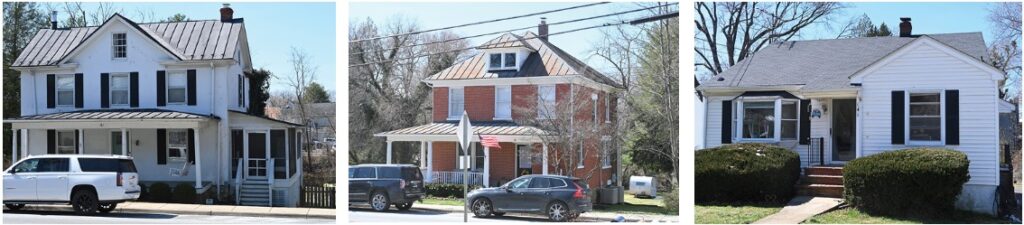
It was with Stinnette’s original support and advisement that the Planning Commission drafted a proposed ordinance to define a process for the demolition of primary structures in Purcellville. These are structures that the Department of Historic Resources has listed as historic or as contributors to a historic district – outside of the already existing Historic Corridor Overlay District.
The Planning Commission proposal responded to the Comprehensive Plan negotiations under Stinnette’s chairmanship of the Commission. It passed with the support of six of the seven Town Council votes.
Council Member Joel Grewe was the lone vote opposing the adopted Comprehensive Plan. He has also consistently voted in opposition to related ordinance changes. On the date of the vote, Stinnette sided with Council Members Joel Grewe, Erin Rayner, and Mary Jane Williams.
It is worth noting that Williams was elected on a platform of slow growth and the preservation of Purcellville’s small-town character. Mayor Kwasi Fraser, Vice Mayor Chris Bertaut, and Council Member Stan Milan – with whom Williams ran on a slow growth platform – voted against ending discussion on the Planning Commission’s proposal.
Stinnette’s swing vote undermined the effort to fulfill the Comprehensive Plan’s aspiration to “consider amending the town’s Historic Overlay District to be more inclusive of all historically contributing structures …”
Reading from a prepared statement, Stinnette first claimed that the HPOZ was “a seriously flawed regulation.” He said it contains errors but “rather than correct it before legislating it, we are considering regulating it knowing it contains errors.”
Stinnette was referring to several homes that should no longer be on the list as contributing structures because they have either been torn down, or renovated entirely, and thus are no longer considered contributing.
A new survey doesn’t change the homes’ historic nature, unless the owners have dramatically altered them. The survey could be done at any time, and towns commonly have surveys that are over a decade old.
Stinnette noted that Town staff had proposed a way to update the survey “at a minimal cost, while minimizing the legal risk …We have a witches’ brew here that will create significant liability for the Town if we don’t get it right before we sign onto the ordinance.”
Council Member Stan Milan responded that, “Council Member Stinnette said he wanted the HPOZ to be a different district than the Historic Corridor Overlay District … and that was the creation of the HPOZ. He agreed to that.
Milan continued, “He was on the Planning Commission as the chairman for a substantial period of time, He knew of the 2006 survey … So what is it? You want the ordinance? You want the HPOZ, or you don’t want it? It is to preserve the character of the Town.”
Mayor Kwasi Fraser weighed in and said he sees the HPOZ as “a tool or an instrument to prevent demolition.” Adding that, “today we don’t have a process in place. So I welcome this ordinance that would put a process in place, so we don’t wake up to see a historic structure demolished.”
Fraser noted the historic structures are limited to 283 properties “give or take some of those properties … over time may have changed. The Planning Commission has made allowance for us to also address that.”
“I heard Council Member Stinnette’s statement about updating the survey, so I would expect Council Member Stinnette to vote on it because his only issue is the updated survey, and I look forward to that,” Fraser said.
The cost of updating the survey ranged from $13,000 to $50,000, depending on the Council’s choice of survey methods.
Council Member Grewe said there was “a significant aspect of the Town’s population that is opposed to this – the whole idea.”
During the 16 months the Planning Commission had been working on the ordinance, they incorporated citizen input through two public hearings and a town hall style meeting. There was also one meeting at the Town Council level.
While both supporters and detractors attended these meetings to express their views, a small group of people continued to oppose the ordinance throughout the process. However, an overwhelming majority in the proposed district, however, expressed no opposition.
Grewe said that doing a survey would cost the Town money, and the ordinance “frankly isn’t going to get us more money.”
Council Member Erin Rayner accused the Planning Commission of being activists. “They have moved from a body of advisors to activists, and that is not their role,” she said. However, she provided no evidence or explanation of this characterization.
Rayner and Grewe both criticized the March 3 Planning Commission meeting as being outrageous, but provided no evidence.
The March 3 meeting members discussed the cost and process of redoing the survey, as well as its utility. They concluded that the survey should be separate from adopting the proposed HPOZ.
Stinnette said he supported “the concept of maintaining our small-town charm,” and claimed that regulating the demolition process was “one of those ways.” He pointed out that Winchester, Middleburg, and Leesburg all have ordinances similar to “what the Planning Commission is proposing.”
Out of the blue, he mentioned that the Design Guidelines should also be updated. “This would be another cost with this overlay zone,” Stinnette said.
There are also 193 homes that could have, since the survey, aged into the HPOZ district as well.
Stinnette said, “So to be blunt and direct, the proposed ordinance before us right now, at a minimum, needs an updated survey before I will support the ordinance … I do not support this ordinance as currently designed. It is not right, and fixing it is not a financial priority.”
Milan said the sequence of doing the survey can be accomplished expeditiously, but he noted that the majority on Council did not want to fund it.
Stinnette had not raised these issues during any of the numerous earlier opportunities with the Planning Commission. He had also previously acknowledged that the Commission had in fact addressed any concerns he had raised.
Milan pointed out that redoing the survey would entail adding and removing some properties from the list.
“The HPOZ ordinance is only addressing the demolition of historically contributing or historical structures … we have adjusted the ordinance to Council Member Stinnette’s request … Updating the historical registry does not affect the ordinance and Council agreed. So I don’t understand the delay,” he said.
Vice Mayor Chris Bertaut said that he thinks the survey update and the creation of the HPOZ are both necessary, and they can be worked on as distinct projects. “Any survey is going to be outdated the day after it is issued. It’s something that has to be refreshed on an occasional basis …”
Fraser noted that the cost of doing a reevaluation could be $42,450 at $150 per home. He said that the Town has $900,000 left in ARPA [American Rescue Plan Act] funds, and the Design Guidelines update could be done as well.
“We have the money from the Federal Government in the form of grants, so we can have a process, so we don’t wake up and see homes being demolished.
“Council Member Stinnette told me,” said Fraser, “he has no problem with this ordinance. The only problem he has with this ordinance is the lack of survey – he wants the currency of data, but my question is how can we get there on a schedule?
“What I am hearing tonight Council Member Stinnette, is that you have more issues with it. It’s not just the survey … Then the question becomes, do you want to spend the money?
You needed a survey and the survey will bring it current and you are ready to support it. What I am hearing now is the cost. I didn’t hear that before.”
Fraser then addressed the Planning Commission at large. “I do not think you folks are activists. I think you are dedicated committed citizens trying to do the best, and trying to advance our Comprehensive Plan … and I am sorry you had to hear that you are activists and you have lost your objectivity, without anything to substantiate that. That’s not fair for you folks to hear, and it’s frankly insulting …”
‘The way I am hearing double talk back and forth here, I think this is going to pass probably in the next five years,” Fraser commented.

Continue reading in this news section
Comments
Any name-calling and profanity will be taken off. The webmaster reserves the right to remove any offensive posts.