


FERC Commissioner urges reform of federal transmission planning and financial incentives
By Audrey Carpenter
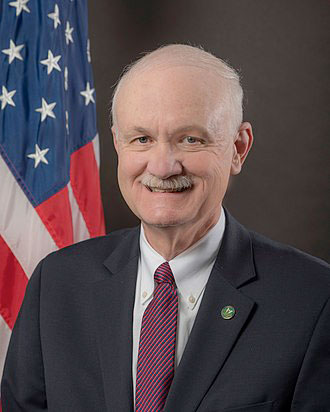
At its monthly meeting Dec. 19, Federal Energy Regulatory Commission (FERC) Commissioner Mark Christie supported reform of FERC’s planning and cost management rules, and its incentives policy related to electrical transmission projects. FERC is composed of five commissioners who vote on regulatory matters in the electric, oil, gas and hydropower industries. Before joining FERC in 2021, Christie was the chairman of the Virginia State Corporation Commission for nearly 17 years.
The SCC regulates utilities in Virginia. Construction and operation of transmission lines and/or facilities above 115 kV in Virginia usually require the issuance of a Certificate of Public Convenience and Necessity from the State Corporation Commission.
The controversial electrical transmission Project 853, known as MidAtlantic Resiliency Link (MARL), was approved by PJM Interconnection on Dec. 11 to be built. It is a 130-mile transmission project that would build 500-kilovolt (kV) transmission towers and lines from Southwestern Pennsylvania, through West Virginia and Maryland, to Virginia. The project, which has received wide scale criticism from homeowners, farmers and conservationists, must now get approval from the SCC before construction can begin.
However, NextEra, one of three contractors selected to build Project 853, has already been approved by FERC for reimbursement of its pre-construction costs. In a Nov. 22 letter sent to FERC, NextEra asked to be granted certain additional transmission rate incentives for Project 853, including the ability to collect interest on its project costs during construction and the ability to recoup costs it expends on the project if the project gets shut down.
Christie objects to many of the incentives as overly generous, and he has a long-running dispute with other commissioners about how transmission planning rules should be revised in order not to create long-term projects that are paid for by ratepayers, but later become unnecessary and are canceled before construction.
“First, the Commission’s incentives policies for years have been ridiculously generous to transmission developers while inflicting an ongoing victimization of consumers. I have repeatedly criticized these incentives – particularly the CWIP Incentive, Abandoned Plant Incentive, and RTO participation adder – in numerous cases since I joined the Commission,” Christie said.
“Second, the Commission’s formula rate structure – which confers a presumption of prudence to transmission developers when they file for cost recovery – facilitated this assault on consumers, as it does regularly. As I have done with incentives, I have frequently spoken out on the need to reform and revise those formula rate processes,” Christie added.
$250 million of electricity consumer money spent without any construction on PATH
FERC has opened several proceedings to investigate and update its transmission planning and incentive rules since 2020, but has not completed any of them or issued final orders. And while Christie spoke of the need for reform at the Dec. 19 meeting, none of the other Commissioners added comments in support of reform.
The meeting approved a settlement that brought to a close the 15-year Potomac-Appalachian Transmission Highline (PATH) case, issuing a $9.5 million refund to electric consumers for costs associated with the project which never was built.
Christie used PATH as an example of bad planning and financial incentives run amok to burden electric consumers with costs of nearly a quarter billion dollars for a project that never put a single ounce of steel in the ground.
The PATH project was approved and added to PJM’s transmission plan in 2007. Although PATH was never vetted by the states involved, and never received permits to construct in any state, its inclusion in PJM’s plan and the granting of financial incentives by FERC allowed the developer to begin collecting its costs to advance the project starting in 2008.
PATH subsequently created a firestorm of citizen opposition in Virginia, West Virginia, and Maryland and was eventually canceled by PJM in 2012, citing changing projections. However the collection of costs continued via PATH’s Commission-approved formula rate until it was finally closed on Dec. 19.
“Attention must be paid to the PATH example because of the major lessons – and warnings – it holds for long-term regional transmission planning driven by policy goals, the substantial costs that go with such projects, and how FERC’s policies inflate those costs to consumers,” Christie said.
Christie urged more involvement for states in regional transmission planning processes, stating, “it is absolutely essential that state regulators have the authority to approve – or disapprove – the construction of these lines and how they are selected for regional cost allocation and what that cost allocation formula is, if their consumers are going to be hit with the costs.”
Western Loudoun citizens who participated in PJM’s recent planning meetings were dismayed to see that attempts by states to weigh in on or influence PJM’s planning process were ignored. They also noted that Virginia abstained from a letter to PJM from the Organization of PJM States asking that the projects be further examined before approval. https://www.pjm.com/-/media/about-pjm/who-we-are/public-disclosures/20231128-opsi-letter-re-grid-reliability.ashx .
The Commission expects to complete its new transmission planning rules next year. New rules will not apply to projects currently in PJM’s plan, such as the MARL project planned to run from the Ohio Valley to Loudoun’s “Data Center Alley.”
The MARL has created a growing storm of opposition in Western Loudoun and although many concerned citizens sent comments and objections to PJM, and even attended one of its meetings in person, PJM moved ahead with approval of the project on Dec. 11.
MARL recently launched a project website, which contains a form to submit comments at: https://www.nexteraenergytransmission.com/midatlantic-resiliency-link.html.
MARL has said that it will begin consulting with the community early next year.
See the companion article here.
Continue reading in this news section
Comments
Any name-calling and profanity will be taken off. The webmaster reserves the right to remove any offensive posts.

UNDERGROUND!!!!!!!!!!!!!