


What’s up with broadband in western Loudoun?
By Laura Longley
If you drove down Lincoln Road south of Purcellville in mid-April and saw crews running fiber underground to several homes, did you think—hope, perhaps—that this was the launch of the long-awaited Loudoun County-All Points Broadband high-speed internet installation for western Loudoun?
Sorry. Those homes were getting fiber from a small, local, privately funded company called Cladded Glass, named for the silica strands and covering we know as “optical fiber.” According to co-owner Warren Van Der Mewre, Cladded Glass has installed fiber 100 percent underground to some 200 homes in an area between the village of Lincoln south to Snickersville Turnpike and from Mt. Gilead west to Silcott Springs Road.
For 8,629 other rural homes unserved or underserved by broadband and designated as part of the County’s western project, it will be summer of 2024 before they are expected to have fiber service, with the lines strung to their homes from nearby utility poles. A final 180 homes, missed in the original count but due to be added to the project through a County RFP, should see their service installed by July 2025.
As Dave Friedrich, Loudoun County Assistant Director of Information Technology, told the Board of Supervisors on April 18, the All Points Broadband (APB) project essentially breaks down into two parts: (1) the Make-Ready Construction (MRC) process and (2) the fiber installation. During Make-Ready, Dominion Energy or NOVEC must visit 10,600 utility poles to generate individual applications and permits for attaching the fiber. By April, they had completed 4,944 poles. But because of the increasing number of statewide projects awarded grants in 2022 through the Virginia (VA) Telecommunications Initiative, or VATI, Friedrich pointed out that the volume of requests for this labor-intensive field work by the utility companies is now at unprecedented levels. As a result, APB is experiencing greater variance in the Make-Ready Construction (MRC) process but expects much less in actual fiber construction once the poles are approved. So, fiber construction vendors now prefer to have more Make-Ready done before they release fiber construction crews.
Supervisor Caleb Kershner (R-Catoctin) agreed that the two-step approach made “economic sense.” He asked whether the project would still come in on its contractual deadline—July 2024; Friedrich assured him it would. Supervisor Tony Buffington (R-Blue Ridge) added, “Love it.”
Less likely to love this news are the homeowners who, according to the original VATI grant proposal, would have had fiber broadband installed as their neighborhood poles were approved. On that schedule, service was to reach rural residents sequentially, beginning now.
As for supply chain issues, Loudoun staff noted, “APB reports that its inventory levels and lead times for Outside Plant (OSP) fiber and electronics are consistent with planned levels.” They cautioned, however, “while supply chain risk is currently under control, it will remain an area of focus throughout the network deployment.”
How the west won fiber
Curiously, it was COVID that ultimately launched a western Loudoun broadband initiative.
In the early fall of 2020, as children in rural Loudoun went “back to school” online and parents worked remotely, several residents in the west with experience in cable and fiber came together to form the Loudoun Broadband Alliance (LBA). According to their early mission statement, none of the available providers of FTTH—Fiber to the Home”—”offers an affordable and widely available service that meets the federal definition of Broadband Internet access … All of the options are expensive compared to the options available in a suburban area. The typical rural home is paying twice as much as a suburban home but receives one half to one third of the download speed compared to the suburban home, and the reliability of the rural options is much lower.
“The impact of this situation,” LBA concludes, “is that rural residents pay more for substandard service and are forced to seek out alternative options for Internet access.”
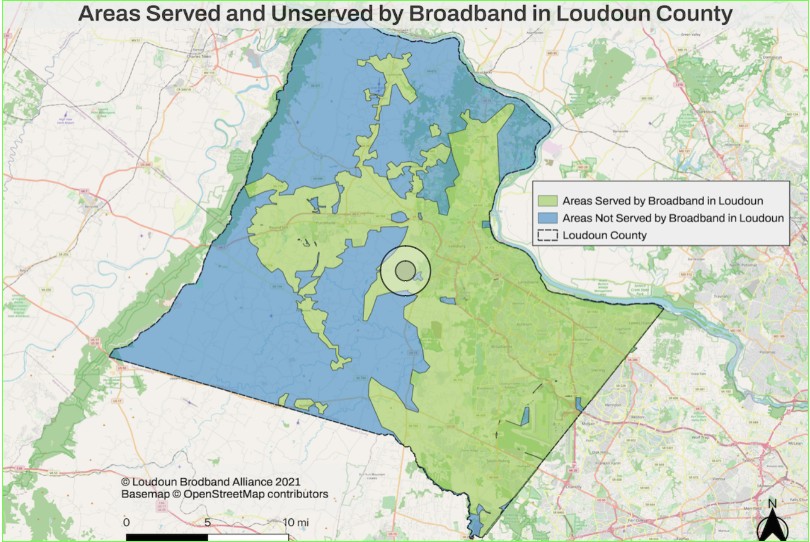
The LBA group got to work, and on November 17, 2020, the two western Loudoun supervisors, Buffington and Kershner, brought forward a Board Member Initiative to take steps to move delivery and expansion of broadband service forward in areas identified as unserved and underserved. The County and LBA followed up by jointly surveying area homes to determine which were wired by Comcast, Verizon, or another provider and which were not. Their final count of homes needing service: 8,629.
By December of 2021, the Virginia (VA) Telecommunications Initiative—a new Fiber-to-the-Home grant program—awarded Loudoun County more than $17,524,000 based on its VATI application with contractor All Points Broadband. Loudoun, which serves as the grant administrator, also committed to a contribution of $12,425,000 in American Rescue Plan Act (ARPA) funding. All Points Broadband is to contribute more than $20,000,000.
In July 2022, Virginia issued the final VATI grant award, which kicked off the 24-month project period. According to the grant application and award, Loudoun’s rural residents would start seeing “last mile” construction to utility poles at the end of the first quarter of 2023 and fiber installations in the second quarter of 2023. By July 2024, All Points Broadband would have reached substantial completion of the network.
That was the general understanding of rural residents until the April 18 Board of Supervisors meeting when the staff report explained the new, two-part timetable, making it clear the Cladded Glass installations south of Purcellville were not part of the APB project.
Another 180 homes left out of the original count for the VATI grant have been identified by staff, but according to VATI grant guidelines, they cannot be added to the existing project. However, the Board of Supervisors has approved ARPA funds to connect them. It remains for County staff to release an RFP and identify an internet service provider that can meet requirements for funding compliance, service, cost, and completion.
According to All Points Broadband, the installation charge, or “customer contribution,” for the main project will depend on how many customers register. (If an address is currently served by another wired provider, it is not eligible for this project.)
The greater the customer interest, the lower the upfront cost. APB says the monthly service fees are expected to approximate those of other cable and fiber-optic internet service providers, such as Comcast and Verizon FIOS. Cladded Glass, for example, provides monthly fiber service for 100Mb/s at $99, 500Mb/s at $125, and 1Gb/s at $145.
Although Loudoun County government serves as the rural fiber project administrator, it is not responsible for providing the broadband services or for determining, revising, and collecting fees.
Each of the 8,629 homes originally counted as prospective APB FTTH customers must be registered so their locations are included in the fiber network. The only way to register is to go online and submit your information at fiber.allpointsbroadband.com. That website feeds directly into APB network design. Look for more details and updates at Broadband Expansion | Loudoun County, VA – Official Website.
Continue reading in this news section
Comments
Any name-calling and profanity will be taken off. The webmaster reserves the right to remove any offensive posts.

Ten months into a 24 month project with no homes installed. When will the first customer be served?
Are we to believe that the project will install over 8600 homes between that date and the contracted project end on June 30 2024?
Do the county people charged with monitoring this project really believe that it will deliver as promised?
When will western Loudoun get broadband?
Is this another government handout to telecom firms for broadband promises that are never met?