


Just like nothing (else) on earth: Burial Ground for the Enslaved at Belmont
By Tim Jon
Next time I stop in, I want to hear the birds sing, as I took an early morning stroll around the land set aside as the Burial Ground for the Enslaved at Belmont. I found the silence broken only by the nearby traffic on Route Seven – with the motorists – understandably – oblivious to the spiritual tenor of the tree-covered hill just off the highway.

I’d also like, when I return, to enjoy the greenery of the Loudoun County summer in full swing. The somber colors of late winter easing into early spring did little to lift the mood as I navigated through a trail that led in and among the (as far as I could tell) unmarked gravestones (essentially flattened rocks that seemed convenient to the purpose).
It took little to imagine the brevity of the proceedings involved in the interment of an indentured worker on a Virginia plantation some two hundred years ago; no neatly separated plots with carefully managed, grass-covered graves marked by clearly-noted inscribing. Professional ceremonies? Hard to tell. I thought of my own family members, passed on, and tried to draw a connection between these two lines of humanity (or did I try NOT to?).
I allowed my emotions range freely during the tour – finding solace in the fact that the small cemetery had existed at all, back in that day, and that sufficient care (in recent times) led to its re-discovery and preservation until today.
I gravitated toward a small wetland area, lying adjacent to the walkway through the plots, and I couldn’t help thinking, “I’ll bet a little later on, in spring, the nesting birds will really bring this place to life.” Some may think this sentiment in bad taste; I prefer to feel as much in common with the spirits of those here laid to final rest; I would like to think I’d have such natural music keeping such a place company – if the situation were reversed. I also wondered which varieties of forest wildflowers – if any – would be coming into bloom in and around the graves and the well-marked trail that guided visitors through the shrine.
My morning’s visit covered the entire – roughly – circular walkway through the cemetery, and I noted signs of recent offerings of memorial: piles of coins, hand-written notes, even an unopened bottle of wine lying amid some artificial flowers, left in a thoughtful (to my finding) basket arrangement. If I took comfort in these gestures of respect, I also hoped they provided the same for those who had come before – living and otherwise.
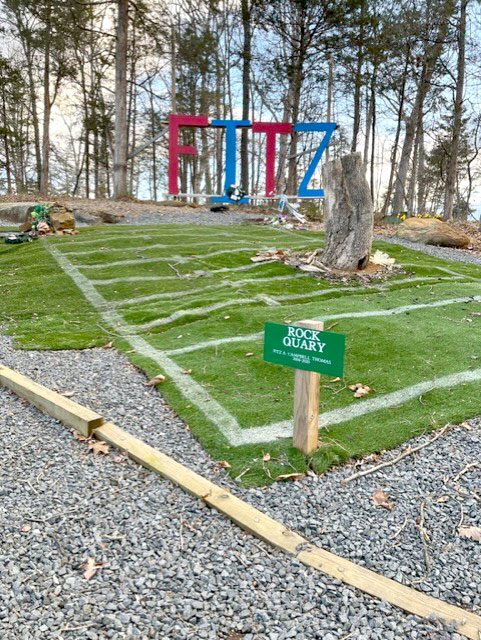
As I neared the end of the trail, I came upon an obviously recent gravesite; the professional work done on the gravestone revealed the identity of the interred individual: a 16-year-old boy who lost his life by drowning a mere three years prior to my visit. The remains of Fitz Alexander Campbell Thomas found a resting place adjacent to a miniature football gridiron – a token of love and respect from a community that took enjoyment in watching him play the game.
A further irony in the tragedy comes in the family link to this site: Fitz’s mother, the Reverend Michelle Thomas of the Loudoun Chapter of the NAACP – spearheaded the rediscovery and preservation of the very site we’re examining today.
Michelle also serves on the Virginia Commission on African American History Education in the Commonwealth. Family ties, indeed. Something tells me that the spirit of her son will help see to it that people in Virginia continue to learn about the past, present and future experiences, beliefs and dreams of those involved in that ongoing timeline. And the stories of those interred in the Burial Ground for the Enslaved at Belmont? The saga of their lives may remain hidden for now, but the past has a remarkable way of coming to light in the most unexpected ways, at the most surprising times.
Belmont (located in what’s now Ashburn, Virginia – some six miles east of Leesburg –) wasn’t the only plantation in Virginia, or even in Loudoun County; I’ll bet there are some riveting stories in all those individual timelines.
I can almost hear the birds singing, and see the trees and flowers in full swing. I’ll bet you can too.
Continue reading in this news section
Comments
Any name-calling and profanity will be taken off. The webmaster reserves the right to remove any offensive posts.
e-edition