


Climb baby, climb!
By Liz Tenney Jarvis
Steph Littenberg is the female tree climbing champion in the Mid-Atlantic for three years running, is currently ranked second in the nation (missed being number one by one point) and she is number six in the world. Appropriately, Littenberg’s day job is with Treelife arborists where she has worked for the past seven years.
Littenberg was born and raised outside of Lincoln, VA and says that as a child, she was “climbing everything – bed frames, countertops.” However, her climb to the top had a totally different start. She was studying to be a paleontologist and happened to be doing a little tree work in between classes. When a full time position opened up at Treelife, Littenberg said she could definitely see herself pursuing her career as an arborist.
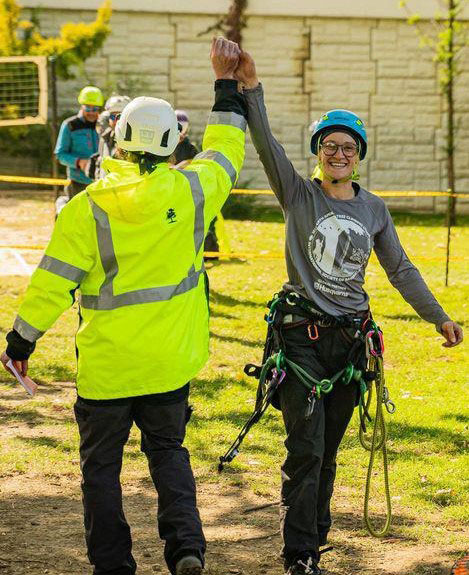
There is a big difference between the tree work that is the “hack and whack,” as Littenberg calls it, and that of professionals who are promoting the care and sustainability of trees. She has no interest in and is not someone who works in the take-down of a tree (though co-workers can do that when necessary).
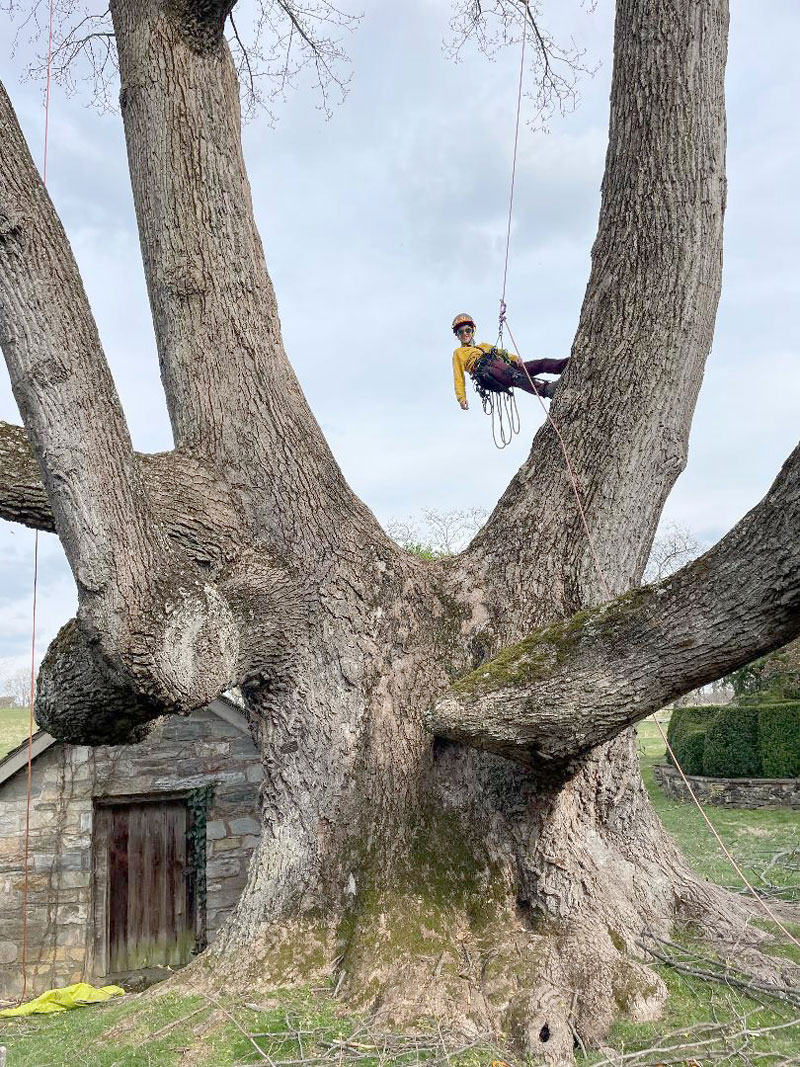
Littenberg says that she specializes in high value, high stress prunes and what brings her joy is to restore what has been forgotten or neglected. “Restoration and helping a tree be the best it can be is what drives me,” she said. As Littenberg describes it, the thrill of working in a large tree for example, is that one must have total trust in one’s gear and call upon all of the available skills and knowledge in tree work.
Then there are the occasional unexpected aspects of working in the trees. Encountering a nest of baby squirrels, raccoons “who don’t want you to be there,” bugs, wasps, hornets and poison ivy are all a part of the challenge. Littenberg indicates that Treelife goes above and beyond when it comes to safety, so the aforementioned elements and the condition of the tree are well assessed before work commences.
Littenberg does not have a fear of heights and in fact when it comes to climbing, the higher the better. She has only experienced vertigo once, in the extremely steep ice canyons approaching the largest frozen waterfall in Iceland.
“It’s easy not to have a fear of heights at the trunk of a tree but that is not where most of the work is done – so in limb walking, for example, imagine a balance beam but 100 feet up,” she says. Again, the trust in the gear, skills, knowledge and “your brain” are what Littenberg says comes into play on the job and when tree climbing on the competitive level.
Through the unwavering support from her boyfriend and the encouragement of Treelife owner/fellow champion climber, Flint Anderson, Littenberg has channeled that love of a challenge and her natural agility to become the tops in competition. A peek into the world of tree climbing competitions reveals a series of incredibly physical and mentally demanding tasks. Littenberg describes these as follows:
“Speed belay: It’s like rock climbing but on a tree. The goal is to get the fastest time.
“Work climb: Designed to emulate a typical work day. There are five different stations throughout a tree. You have five minutes to complete the climb and points are given based on skills, grace, and time among other technical things.
“Typical: If for some weird reason there were only five things needed to be done in a tree, lol.
“Ascent: Literally get up a rope as fast as possible. There are two judged portions. Getting your system on as fast as possible and ascending as fast as possible. I am currently the second fastest woman in the world.
“Throw Line: The goal is to set your throw line in the highest marked location and pull your rope in for max points. You can score up to two times and have a max of five minutes to complete. Sounds way easier than it is.
“Aerial Rescue: There is a scenario in which an accident has occurred and the person (simulated by a life size and weight dummy) must be rescued by the competitor. You have five minutes to complete the task. You are judged on many things but primarily victim assessment, handling, and emergency response/preparedness.
“Finally, there is the master’s challenge. This is used to delineate between 1st through 3rd place. It is the culmination of all of the events in one single event. All climbers are sequestered and may not watch the other climbs until they have completed theirs. There are typically four stations in the tree and the time limits range from 25-30 minutes depending on the difficulty of the climb/size of the tree.”
As it turns out, Loudoun County and the surrounding area is home to many competitive tree climbers. Littenberg says that it is a supportive community of not only certified arborists such as herself and Anderson but others who love the thrill and challenge of the climb.
Continue reading in this news section
Comments
Any name-calling and profanity will be taken off. The webmaster reserves the right to remove any offensive posts.