

200 years of Snickersville Academy
By Melissa Hess
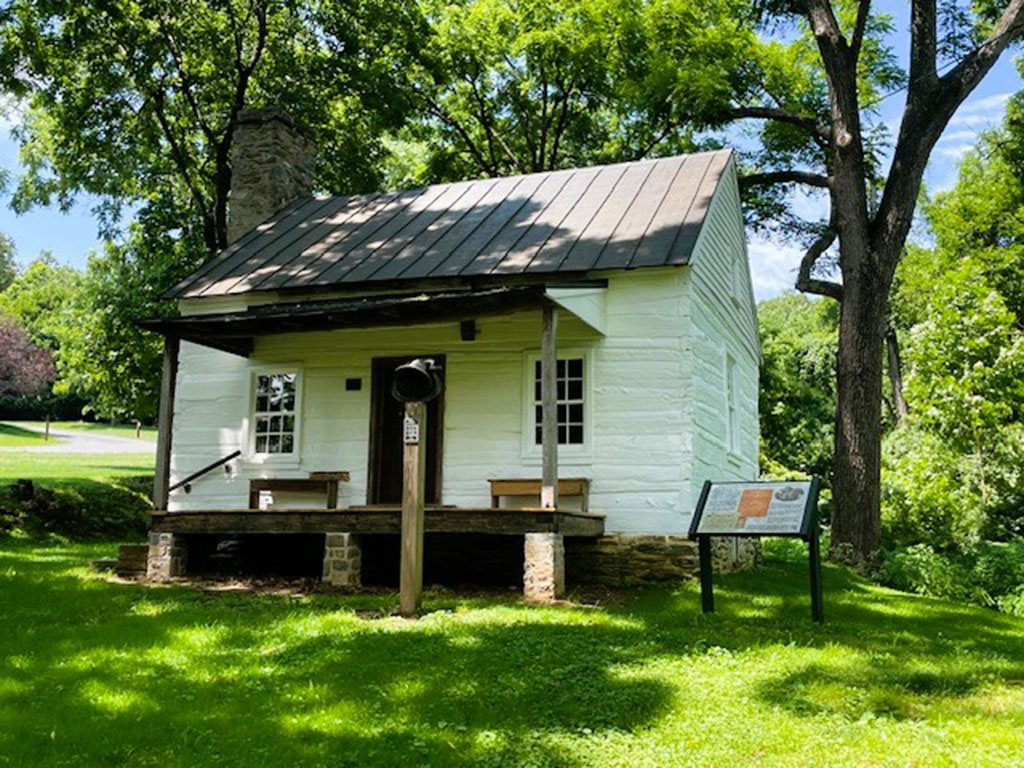
This year marks the 200th anniversary of one of the oldest known surviving schoolhouses in Loudoun County—Snickersville Academy. A look at its history reveals how this humble log cabin helped shape Bluemont’s history and contributed to the development of the village.
In the 19th century, Loudoun County was mostly family farms and small villages, with a local economy largely built on agriculture. Snickersville (now Bluemont) was one of these villages. Daily life centered on familiar places such as the general store, the church, and the schoolhouse. These community landmarks served as locations where people could meet one another, worship together, pick up supplies, or share the latest news.
Built in 1825, the Snickersville Academy occupied a central place in the life of the community. It was the village’s first school and church. Built on a half-acre of land donated by Amos and Elizabeth Clayton, this modest one-room cabin provided generations of farm children with an education to help build their knowledge and develop practical skills. On Sundays, it was one of the earliest nondenominational or “free” churches in the area.
In rural Virginia, opportunities for a formal education were limited, so having a school in the area was important to farm families. In those days, children often walked long distances—sometimes two or three miles—to get to class. Being a student in the one-room Snickersville Academy meant learning side by side with children of all ages.
A single teacher taught the students, whose ages ranged from 6 to 16. Instead of paper, students used slates. Subjects focused on the three Rs—reading, ‘riting, and ‘rithmetic, spelling, geography, history, and lessons in civic and moral development. Tuition was $3 per semester.
Without a formal church in the village, the Snickersville Academy served as a place to gather for Sunday services and community fellowship. This continued for over 25 years. Later, in 1851, the village built a dedicated stone church that is now the Bluemont United Methodist Church, located a short distance down the road from the Academy on Snickersville Turnpike.
When the Civil War came, life in the village changed. Children had greater responsibilities at home and had less time for school. In 1864, a conflict broke out on Snickersville Turnpike—one in which some of the local students took part. After the Civil War, Virginia set up public schools, and Snickersville Academy became one of them in 1870. This lasted until 1872, when the multi-room Mountain Shadow School opened on Snickersville Turnpike.
No longer used as a school, from 1872 until the 1940s, the building was converted into rental housing. In the 1940s, the Academy transitioned into a private residence and the home of Susie Neal, who raised her family there. Her descendants continued to live in the house into the 1970s.
The Hatcher family, who were the owners of the mountain farm that included the Snickersville Academy, generously donated the cabin to the Friends of Bluemont in 2010. Founded as Friends of Bluemont in 2003 and established as a 501(c)(3) nonprofit, the organization was rebranded in 2018, and is now known as Bluemont Heritage at www.bluemontheritage.org.
With its rich history, Snickersville Academy is more than just a building. The Academy helped lay the foundation for the village of Bluemont we know today.
Remember, when you are driving in the area and pass by Snickersville Academy take a look and you can reach it from Snickersville Turnpike (Rt. 734) just west of Clayton Hall Road (Rt. 760) on the left when traveling west. There is a historic marker near 33685 Snickersville Turnpike, in Bluemont.
Continue reading in this news section
Comments
Any name-calling and profanity will be taken off. The webmaster reserves the right to remove any offensive posts.