


Purcellville business seeks downtown apartment expansion
By Valerie Cury
On Sept. 10, the Purcellville Board of Zoning Appeals considered a request from Nichols Hardware for a zoning variance to exceed the number of by-right apartments allowed at its property at 131 N. 21st Street, located in the Historic Downtown C-4 District.
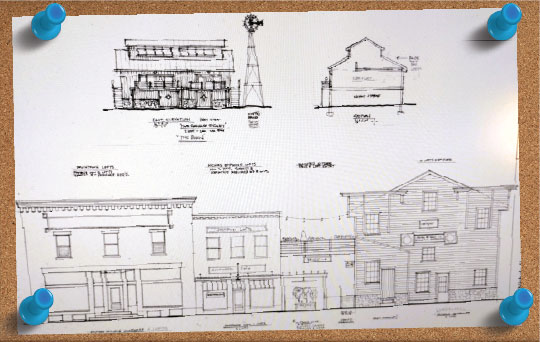
Nichols is proposing to redevelop the unused second floors of two buildings—Nichols Hardware and the adjacent Hardware Cafe—into income-producing residential space. Under current C-4 zoning regulations, two apartments are permitted per building by-right.
In the first phase of the proposed redevelopment, the applicant is seeking to create four apartments in the Hardware building and three in the Hardware Cafe building, exceeding the allowed limit by three units total.
Architect Gaver Nichols—no relation to the Nichols family—said the proposed four apartments in the Hardware Store would each range from 700 to 1,000 square feet. If only two units were built, as permitted by-right, they would each be approximately 1,800 to 2,000 square feet. The adjacent Hardware Café building would house smaller units.
“Our plan is to renovate the unused upper floors of the Hardware structure,” said Gaver Nichols, who added that the plan includes four loft rentals in the Hardware building and three smaller units in the Cafe building—intended for business employees.
In future phases, the team plans two apartments in each of the rear structures bringing the total number of apartments to 11, including the three additional not currently allowed. They also envision creating a music venue and a water feature near the Livery Mill structure, with two lofts on the second floor. A salvaged windmill, up to 45 feet tall, will be installed as an architectural feature, said Nichols.
Nichols said that strict enforcement of the zoning code would create a hardship by restricting the reasonable adaptive reuse of existing buildings that contribute to the town’s architectural character and historic fabric.
Purcellville Planner Jordan Andrews said the first question is whether a variance is the appropriate mechanism for the request, as the Board of Zoning Appeals cannot permit a use that is not allowed within a zoning district. He also noted that it’s unclear whether the inability to build the additional apartments would constitute a true hardship.
Andrews added that anything over 2,000 square feet would not be viable, as it would be comparable in size to a townhouse. He also said in the C-4 District, existing structures on 21st Street are exempt from parking requirements, and are not required to provide parking.
Nichols said even though parking isn’t required, “we think we have 20 spaces,” noting that they currently have six spaces in front. He said the parking would most likely be shared parking.
Purcellville resident Dan Reed said that although he was not there to oppose the request, “it is an upzoning and you’re being asked to upzone, and once you do that—you’ve made the decision.”
On the parking issue, Reed questioned whether the Town should give a “blanket approval” for the project. On the idea of shared parking he said, “I have watched it fail miserably—the daytime and nighttime uses collide.”
He also suggested that the applicant consider using water-charged fire suppression systems, given the age of the structures.
“Once you approve it, the other people in the area will come up and say ‘Hey, I like that, I’d like to do the same thing or something on the same nature.’
Developer Casey Chapman who manages the former Vineyard Square project and envisions 36 apartments on 21st Street, said he was supportive of whatever the property owner wants to do.
Mayor Chris Bertaut said, “This is a wonderful plan for downtown, however the application you have before you tonight is not coming to the right venue. This request does not meet the legal standards for a variance.”
He explained that a variance is only appropriate when the strict application of the zoning ordinance would cause an unreasonable restriction due to the size or physical condition of the property—not because of economic concerns or a preference for a particular use.
“This is an economic argument, not a physical hardship. It does not address other potential uses for upper stories like office space.
“A variance is not a tool to change land use policy or circumvent zoning rules. The proper step is a zoning amendment, not a variance,” said Bertaut.
Board of Zoning Appeals Chair Eric Zimmerman said, “I am not sure if a variance is the right venue for what they [Nichols] want”—or the appropriate remedy.
“This is the wrong venue. They can put two units in there. It might not generate the amount of cash they want—but they can put two units in there—so where is the denial?
This should be more of a rezoning effort. I know there are a lot of reasons why getting a rezoning could be difficult, not the least of which is an allegation of spot zoning.”
Zimmerman was referring to the R-15 District, which allows for more apartments, unlike the C-4 District where the buildings are located. In this case, the Hardware Store would have to cease operation, and the property would need to be rezoned for use as an apartment building.
Nichols postponed the application to a possible further date.
Comments
Any name-calling and profanity will be taken off. The webmaster reserves the right to remove any offensive posts.