



What will it cost? Who will pay for it? How many cars are from Maryland? Commissioners raise key questions on Rt. 15
By Laura Longley
Imagine if the seven Planning Commissioners who attended the Jan. 11 Planning Commission Work Session, had not insisted on answers to those questions. What if they’d just nodded their heads and, without further information, sent a highly controversial Comprehensive Plan Amendment [CPAM] forward to the Board of Supervisors for their approval. The fate of Rt 15, rural northeastern Loudoun, the Village of Lucketts, and a whopping tax increase for current and future County residents would have been sealed.
Such an outcome from this single meeting would have advanced the massive project to widen U.S. 15 from Montresor Road to a point just shy of the Potomac River. The plan calls widening the road from two to four lanes, building a bypass around Lucketts, installing median strips up and down the corridor, and, most likely, increasing the speed limit to 50 mph. And yet none of that would solve the core problem: the merger at Maryland’s two-lane Point of Rocks Bridge, which that state has no intention of widening or replacing within a decade or more.

Still, the Planning Commissioners were left with the job of wrestling with County staff to suss out the information they believe they need to reach an informed decision for their Board recommendation.
As Roger Vance, Blue Ridge District Commissioner, and Mayor of Hillsboro, explained, “It would be irresponsible of us not to take the time to understand this in detail. I’ve asked questions that I can’t seem to get an answer to tonight: What’s the funding source for this project? And “We have to look it up”? I don’t think we have to look it up. I think we all know it’s local money. I think that’s a question in and of itself. And I think there are things we can get answers to in a relatively quick period of time. I’d like to make sure we get those questions answered in a timely fashion … I think we need much more information, and if this is the place where we’re going to shed light on things that maybe we don’t really know, I think it’s worth the effort.”
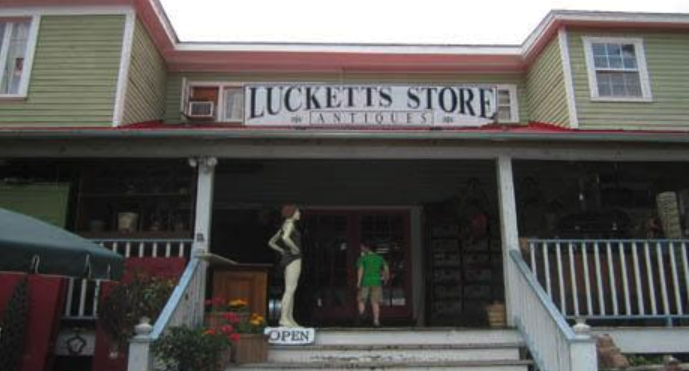
Jane Kirchner, Algonkian District ticked off more key questions: “I’d be interested in [a report] from the Economic Development Department that would give us an overview of what the overall impact would be on those businesses. I just heard a mention about fair market value for property. There are some businesses you just couldn’t put anywhere else. I mean Lucketts Store—I don’t know how you could ever move or replace that.”
She also wants to see a comparison of the widening/bypass plan with Ian Lockwood’s 2018 traffic calming plan: “I’m very familiar with Ian Lockwood”—the internationally recognized transportation planner known in Loudoun for his award-winning work on Rt. 50 from Aldie through Upperville—”and it was just fantastic … I know what he presented is very different and also looks to me much less expensive.”
“The third thing has to do with the 2018 traffic modeling analysis done by Smart Mobility. I understand that [study] raises the issue of induced traffic, and I think that’s a real concern with whatever’s done here.”
Kirchner then asked about cost—in recent meeting minutes at approximately $300 million.
A County staff member replied, “I think our DTCI [Department of Transportation and Capital Infrastructure] colleagues are pulling that number up.”
“Sorry, I thought that would be an easy one,” Kirchner said. Waiting for a number she never got, Kirchner went on to raise questions about funding the corridor project. “I’d like to know why federal funds are not being pursued, especially as we have needs in other parts of the County.”
Eric Combs, Ashburn District, brought up his thinking about making just safety improvements. “Maybe there’s shoulder widening but not two-to-four lane widening.”
Eventually, Daniel Galindo, lead staff for the Planning Commission, responded to the members, speaking more to priorities of process and timelines than to those of County’s people and purse.
“Obviously, there’s a lot of concern about the decision being asked of you.” Galindo began.
“However, I’m a little afraid … the Commission can go beyond the scope of what was asked for by the Board … The Commission still needs to act on the Board’s request …
“I do not want to try to limit your debate,” Galindo continued. “I’m just concerned that we’ve talked about a lot of potential work products here. That is a lot of time for staff to put into something that is answering a question that’s not what the Board originally asked … Whatever motion you make as laid out in the alternatives … is what you want to do about the three parts of this CPAM.
“I think that is your baseline decision,” he advised, “and then if there’s additional recommendations you want to make, if there are additional questions you want to have the Board to direct staff to look into and answer, I think that’s the most appropriate way to look at those things so we can fit it into the overall work plan, and we can bring in anybody else from other departments we might need to do this.
“The original work plan for this got approved by the board,” Galindo pointed out, “and we’re behind on it …This was supposed to start in June, believe it or not. Let’s say we started it in November when we first brought the briefing to you. We’re three months into that seven-month window already … Given the questions that have come up tonight, I find it hard to believe that we could try to answer all of these different things and be back even next month … for a work session. So, we’re prolonging this,” he concluded, “and I don’t know that’s necessarily necessary to respond to the Board.”
Chair Forest Hayes broke in, “Okay, so Dan, you are not going to be able to direct the Commission in this way. The Commissioners are going to request the information that they think they need to make the decisions that they need to make. Everyone here has been appointed, and they can read, and they know the decision they have to make. We appreciate your point of view, and in a moment Mr. Miller [Mark Miller, Catoctin District] is going to make a motion, and we’re going to vote on it. Okay?
“Yes, sir.”
After more back and forth, the Commissioners came to agreement on the staff’s homework assignment.
Hayes summed up: “Please don’t take all the requests for information and questions from this body as being combative. It’s more an eager and sincere desire to know more about the process, and I think we all understand that it is our charge to render a recommendation related to an amendment to the Comprehensive Plan. I, for one, take amendments to the Comprehensive Plan very seriously.”
The Commission’s vote, Hayes believes, could have consequences far beyond the current CPAM decision. “Not to ask as many questions as I need to and understand every factor would be irresponsible. I have never knowingly been irresponsible since I’ve been a Commissioner and won’t start today.”
With that, the Commissioners reviewed the staff’s checklist. The team has a month, maybe more, to fill in a lot of blanks. It might be time to burn the midnight oil.

Comments
Any name-calling and profanity will be taken off. The webmaster reserves the right to remove any offensive posts.
I am amazed at the lack of knowledge demonstrated by this commission, made evident by their questioning. The community has been debating this issue for a decade. The community might have the answers the commission is searching for. You gotta know who to ask.
Let’s just keep asking questions and pricing one solution so nothing ever gets done? Where has been the management discipline to bluntly define the problem? Route 15 north of Leesburg has multiple problems:
1 It is surrounded by under-maintained secondary roads forcing locals to use the highway for even local traffic. This remains an issue as our BOS continues to refuse to put widening and paving local roads in their capital budget as they fixate on road name changes and statue removal.
2 Even though interstate commutation is jurisdictionally a federal issue our federal representatives have ignored direct requests to put planning meetings together with Maryland, Fed.Dept. of Transportation and VA authorities.
3 Widening or bypassing projects will always inconvenience someone so perhaps the best long term solution would be most appropriate than just oscillating between one or another lobbying groups. This is an interstate connection point which can be compared to the Veteran Bridge not just a highway in the middle of a state so perhaps VDOT is being directed to not support the ability for more Maryland residents to be able to commute to Va located jobs but rather make them relocate and pay income tax to Richmond?
4 Is it possible that instead of fighting over how two owners can profit off of a ferry; a bridge could be built to diminish some of the volume coming across the Point of Rocks bridge with an appropriate sized circle at the Rasberry Falls intersection? Until that happens isn’t it conceivable that VDOT could fix the light so it does not hold up hundreds of north/south vehicles even when nobody is trying to cross or to allow 45 seconds of stoppage time for the one car trying to cross from west to east?
Finally, for all the rhetoric about how this may not be an interstate commutation problem primarily lets consider making Route 15 a time of day one way with 6am to 9am only going toward Maryland over the Point of Rocks Bridge and from 4pm to 7pm only one way int Virginia and see who creams the loudest!