



Philomont Firehouse: Renovate or Build Brand New?
By Laura Longley
It happens all the time: Someone decides they want to “improve” a place in western Loudoun—pave a scenic gravel road, turn a rural park into a lighted sportsplex, build a massive new house across from an 18th century Quaker meetinghouse. No sooner are these projects approved with a 5-4 vote of the Board of Supervisors than a small but significant part of our sense of place disappears forever.
That’s what could happen in the 19th century village of Philomont, which sits at the crossroads of Jeb Stuart Road (renamed Philomont Road), and Snickersville Turnpike, a beautiful winding road from Aldie to Bluemont that Visit Loudoun calls one of the greatest drives in Loudoun.
At that crossroads, residents and visitors alike will drop in at the 1913 Philomont General Store to post a letter or pick up local farmers’ produce. Next door is the Philomont Volunteer Fire Department, which years ago counted 60 volunteer firefighters in its ranks. Today, only seven volunteers remain, tasked with maintaining the station while career—paid—firefighters from the Loudoun County Fire & Rescue System now serve there.
Organized in 1955 after several blazes broke out around Philomont, a group of residents realized the community needed a fire company and raised the funds to construct a two-bay fire station, and they donated $18,500 for a fire truck.
From 1956 to 1961, they held a horse show on Bob Griffith’s farm off Colchester Road. But as luck would have it, in 1962 a seven-acre field in the village of Philomont became available for the horse shows.
So, with money raised by the Ladies’ Auxiliary, the fire department bought that land from Frank and Mary Pierce for $6,000. Ever after, it’s been called the “Horse Show Grounds,” the place where the community congregated for baseball games, barbecues, turkey shoots, and the annual spring horse show that kept the fire department afloat until 2019.
During this time, the volunteer firefighters were appealing to the Loudoun County Fire & Rescue Department to replace their existing station with a new firehouse. Their preferred location: the Horse Show Grounds, half a mile east from the original fire station on Snickersville Turnpike.
This proposal ran counter to the community’s hopes to work with the county to restore the Horse Show Grounds for field sports and equine activities. The residents envision a restored grass ring for horse training with a trail connecting to the area’s gravel roads.
But it soon became clear that government and elected officials, along with career and volunteer firefighters, county planning and capital infrastructure staffs, were committed to the new station concept as opposed to renovation of the existing fire station.
Meanwhile, the community made the case for renovating and adding on to the existing station.
They pointed to the track record of the county’s contracted architects, Lemay Erickson Willcox, now part of FGM Architects. The firm won numerous gold medals for renovations. They are also known for achieving superior results on parcels as small as half an acre, for staying well within budget, and for meeting specifications for state-of-the art health and safety requirements.
Several years ago, FGM Architects won a “Firehouse” gold medal for their renovation of the Middleburg fire station—a renovation accomplished without costly temporary quarters.
In 2022, they again won the gold medal for the Fairfax County Fire & Rescue Station 25. The 17,386 square-foot station sits on one acre. Designed to meet LEED Gold Certification, it was completed at a total cost of $9,887,000.
In 2021, they completed the City of Fairfax Station 33, which occupies a half-acre. The 22,000 square-foot Firehouse gold medal winner cost $11,148,438.
Replacing a 1970s-era station in Fairfax on just one acre, the firm designed a three-bay station that accommodates up to eight firefighters per shift with room for 14 in the future. It includes a fitness center, kitchen, dining room, dayroom, outdoor terrace, and administrative offices. Most importantly, it incorporates the latest Hot Zone principles to support the decontamination of personnel and equipment after operational events.
The firm did explore renovation and addition options for the existing Philomont station and found them doable. Their focus, however, shifted to designing a new station on the Horse Show Grounds. At several community meetings, it became evident that the decision makers wanted their new building at the location on the seven-acre property—this despite overwhelming community input to the contrary.
Each presentation for the new station on the Horse Show Grounds met with requests by members of the Philomont community for a renovation study. To no avail.
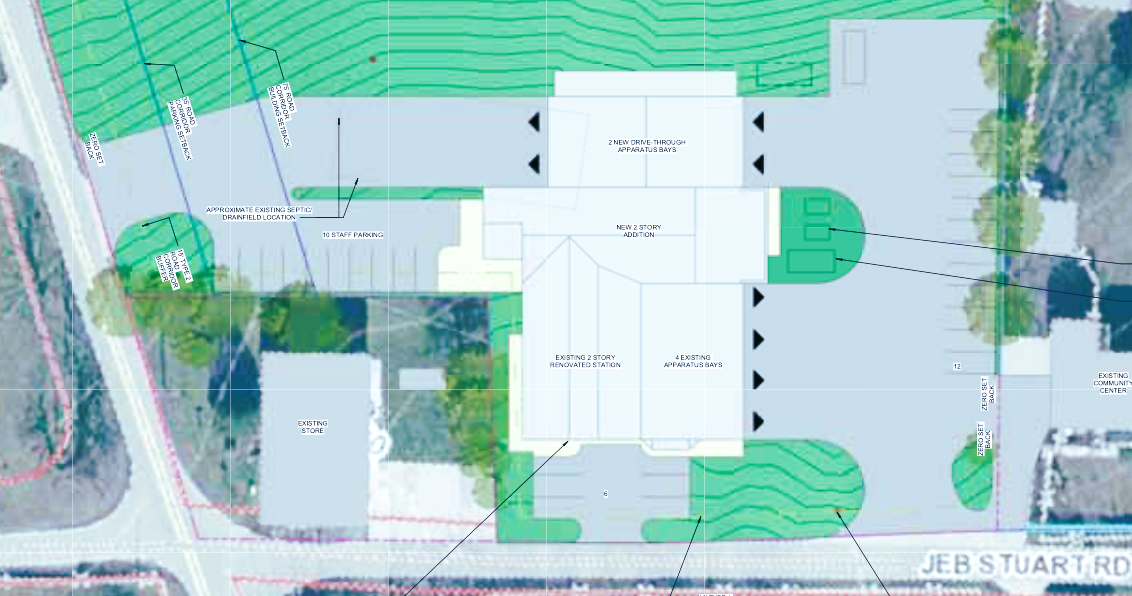
Finally, a group of Philomont residents enlisted a neighbor and highly qualified architect, Bill Ridge, to design a renovation of the existing station on its 2.2 acres. Ridge, who earned his bachelor’s degree at Stanford University and his master’s in architecture at Harvard University Graduate School of Design, served as senior lead architect and chief of Architecture, Engineering and Asset Management at the EPA for more than 30 years.
He developed two plans for renovation. He submitted them to Loudoun County Fire & Rescue Chief Keith Johnson. They were also reviewed by FGM Architects and by Scott Worrest, then acting deputy director of Loudoun’s Department of Transportation and Capital Infrastructure. Worrest discussed the designs briefly with Ridge, and FGM Architects had no questions.
Instead of Worrest and FGM Architects going back to Ridge for follow-ups and more details, they bypassed him and prepared the second feasibility study.
FGM Architects hired a company to estimate the project. These cost estimates are on top of contractor price estimates, including 20 percent added to design cost, 22.59 percent added to cost escalation, 5 percent added to the estimated contractor’s fee, 2.5 percent added for insurance and bond increases, and itemized general conditions.
With such high estimates based on insufficient detail, Ridge’s bottom line ballooned. His two renovation designs measure 20,624 and 23,769 square feet and cost $22,749,138 and $24,018,161 respectively. For the smaller project, take away the $12,441,756 in additional estimates over contractor price, and the price is closer to $10,300.000.
The new station design at the Horse Show Grounds is 18,500 square feet; it was estimated in 2020 at over $20 million. The proposed new firehouse construction in the Rural Historic Village of Philomont disregards the county’s 2019 Comprehensive Plan for the Rural Policy Area, as it is not compatible with surrounding smaller historic structures now under the Virginia Historic Landmark Register and pending for the National Register for Historic Districts. Philomont is also in the Village Conservation Overlay District.
If a new fire station were to be built at the Horse Show Grounds, which is on Snickersville Turnpike, it would require turn lanes on this historic road.
Complicating the estimates is the Philomont Volunteer Fire Department’s ownership of the existing fire station, to include its 2.2 acres, and the seven-acre Horse Show Grounds.
A nonprofit corporation, the Volunteer Fire Department wants to give the Horse Show Grounds to the county—but only if the county builds the big new firehouse on it. The volunteer unit will not give the existing firehouse and land to the county. As Rick Pearsall, Philomont Volunteer Fire Department board chair, told Blue Ridge Supervisor Tony R. Buffington (R) a few years ago, for Loudoun County to buy the existing firehouse property the cost would be upwards of $2 million.
The Philomont community is still asking for the renovation of the existing fire station. They have submitted a petition with 451 signatures from Philomont residents served by the fire department service area. This petition was done by walking and driving to neighborhood homes and includes 10 percent from former Philomont Fire Department volunteers.
Board of Supervisors Chair Phyllis J. Randall (D-At Large) toured the fire station and the Horse Show Grounds on Aug 31.
The plan to build the new station continues to move forward in the process with the submission of Special Exception documents. Members of the public can also provide input at these upcoming meetings, tentatively scheduled for the fall with Special Exceptions and Commission Permits needed from both the Planning Commission and the Board of Supervisors.
Comments
Any name-calling and profanity will be taken off. The webmaster reserves the right to remove any offensive posts.
This article is full of words that betray the writer’s opinion. Anybody who reads this without also reading a counter argument will inevitably believe the writer. If you could make a logical argument without the loaded vocabulary, you might not have to write an article to convince your readers. It makes more sense to build a new fire station equipped to handle the fires that the modern world has to deal with (bigger fire trucks, space to accommodate people and equipment, 24/7 staffing). Old fire stations didn’t have space for people to sleep, train, workout, decontamination, etc. and trying to fit everything a rural fire station needs in a smaller footprint will lead to the need for expansion in the future. Do it right the first time.
The existing building was built in the 1950’s and has been in constant use since, not preserved and respected like an antique or historical society building, but put to use with daily wear and tear. My suggestion to preserve the memory/legacy would be to build the new firehouse, set back off the road and possibly hidden behind a field and trees that can still be used for community outdoor activities, but then start a project to preserve the original building and put some thought into how best to bring into focus the history of the old firehouse in its new role as a community center with pictures and pieces of it’s history that can be seen and shared by all. Possibly even change the external facade of the new firehouse to show homage to the history of the community. The new firehouse shouldn’t need turn lanes, as there is enough property to create a wide enough entry/exit driveway to accommodate the modern vehicles. and as a closing comment, I’d also like to know how often those horse show grounds have been used over the past 20 years or so. once per year maybe?