



LAWS – helping those who are suffering; Wexton visits non-profit in Feb.
Rep. Jennifer Wexton (D-VA10) visited to the Loudoun Abused Women’s Shelter in mid-February. She, along with Rep. David Joyce (R-OH) recently introduced the Domestic Violence Public Health Emergency Guidance Act, which addresses similar issues.
Families of all income levels are suffering greatly from the ongoing effects of COVID-19, as they try to hold on to their homes, jobs, and kids. And, for families torn apart by domestic violence and/or other unsafe situations, the suffering is particularly severe.
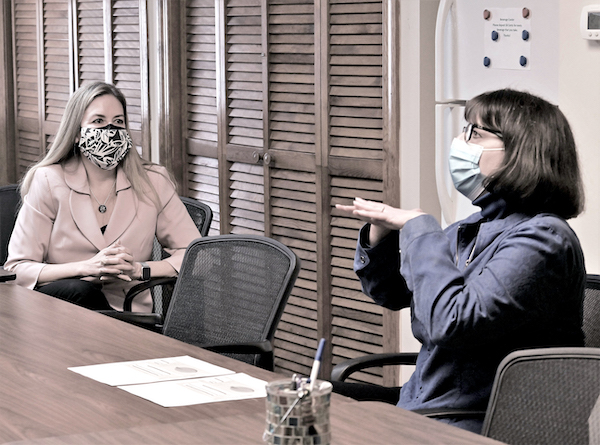
With the onset of COVID, LAWS and other groups have seen dramatic increases in people needing help. They are also straining under other hardships related to social distancing, the dangers of COVID in their facilities, and funding.
Said LAWS Chief Executive Officer Judy Hanley: “Staying home is safer for COVID, but it is not safer for victims.”
Legislative action can help
As Wexton noted in a recent press release, “In Virginia, and across the country, we’ve seen a spike in calls to domestic violence hotlines and police …”
Noted Rep. Joyce, “When I was a prosecutor, I saw my fair share of terrible crimes, but none haunt me more than those of domestic and sexual violence … Unfortunately, the threat these crimes pose to our communities has grown exponentially as we’ve worked to rein in the COVID-19 pandemic.”
Hanley has been fighting day and night to help her organization adapt to the realities of COVID.
LAWS shelters that could provide a safe place for many people before, have been forced to “remain empty,” said Hanley. As a “communal living center,” they had three bedrooms with 12 beds. This is not OK under COVID. So, they had to use alternative housing paid for by grants, and others have helped fill the gap. But, “it is not easy,” said Hanley. Continuing, she noted that the numbers of those in need have, literally doubled, or more – overnight.
“At the height of the pandemic, LAWS was sheltering over 30 victims at one time. That is well beyond our 12-bed capacity, [but], as the designated Domestic Violence and Sexual Assault Crisis Center, we do not turn anyone away who is fleeing imminent danger,” Hanley said.
According to the Virginia Sexual and Domestic Violence Action Alliance, beginning just about a year ago, Virginia’s statewide hotline saw a 73 percent increase in contacts. LAWS reports that their shelter caseload increased by over 647 percent within a similar timeframe. Numbers are back down, now, but still two-and-a-half times what they were prior to COVID.
The Loudoun Abused Women’s Shelter – the pebble in the pond fighting for victims of crime
LAWS is fighting both the problem of violence in the home, and the issues that arise from these horrific crimes.
As is the case for many organizations of their kind, a national funding program called the Victims of Crime Act, or VOCA, is their lifeline; as, they are the lifeline for men, women, and children in need.
VOCA monies do not come from the taxpayer. The effort is unique in that regard. VOCA monies are collected as federal crimes are committed, prosecuted, and tried – and include everything from court fees, to settlements.
Thousands of organizations like LAWS get VOCA funds from their respective states. They are known as “victim service providers” – non-profits, prosecutors, state VOCA administration and compensation agencies, “millions of survivors of crime,” and lots more.
In a recent letter to numerous members of the Congress and Senate, these organizations spoke on behalf of these victim services providers in an effort to get VOCA funding restored.
“We, the undersigned organizations representing thousands of victim service providers, prosecutors, and state VOCA administration and compensation agencies, as well as millions of survivors of crime, urge you to include in the year-end Fiscal Year 2021 omnibus spending bill the updates to the Victims of Crime Act (VOCA) that are needed to stabilize the Crime Victims Fund (CVF or the Fund). This is the only way to prevent ongoing, catastrophic cuts to programs that provide services and direct funding to victims.”
VOCA, the group emphasized, takes a unique, non-taxpayer funded approach, based on “… Direct federal criminal settlements [and] deferred prosecution agreements, currently deposited into the General Treasury, into the Fund …” What LAWS and others seek, continues the letter, will provide “$4 to $7 billion of non-taxpayer money available to serve and compensate victims over the next few years; … Increase the percentage that state compensation programs are reimbursed from 60 to 75 percent; … Allow states to apply for a no-cost extension for VOCA assistance grants; … Give states the ability to waive subgrantee match requirements for VOCA assistance grants; and, Provide additional flexibility for state victim compensation programs to provide compensation for victims, even if they do not interact with law enforcement.”
By not acting, say LAWS and others, “Victims across the country, particularly in rural and small jurisdictions, will experience an accelerated loss of services in the coming year … ” In reference to Loudoun County specifically, Hanley said, “Currently, approximately 50 percent of LAWS’ organizational budget is covered by VOCA funding. Any decrease in funding will result in fewer services and fewer Loudoun victims served. LAWS provides safety, hope, and empowerment services to 1,200 victims per year.”
As COVID wanes, LAWS will be ready
The LAWS organization is hoping to build a new shelter and is: “Conducting a study,” said Hanley, “to determine our 2022 readiness to launch a capital campaign …” In reference to a new shelter,” she said, “a feasibility study, developmental audit, and several other efforts will determine if the community has the capability to help us with this specific undertaking, as well as whether LAWS has the infrastructure in place to conduct a capital campaign.”
LAWS CEO Hanley noted that donations are “up” due to COVID. But, reductions in VOCA funding are a real threat. February was National Teen Dating Violence Awareness Month. It is an issue, professionals in the field note, that impacts everyone, including parents, teachers, friends, and communities.
An organization called 100 Women Strong has issued a challenge grant to the community to help LAWS raise funding to continue to provide free legal services to victims of domestic violence, sexual assault, and child abuse.
Every little bit helps. Like the proverbial “pebble in a pond,” every voice, every grain of awareness has meaning. Said Wexton as she met with the group, “I am thankful to have you in the community … [even though] it’s still going to be a rough year.”
Comments
Any name-calling and profanity will be taken off. The webmaster reserves the right to remove any offensive posts.