

Just Like Nothing (else) on Earth: Newvalley Church Road Farm Site
By Tim Jon
One of the coolest toys I got to enjoy as a kid was a farm set; it came in a box from Sears Roebuck and had pretty much everything I could imagine (as a five- or six-year-old) one would need to get set up in the agricultural business: a two-story barn, of course, tractor, fencing, a few strands of corn, a variety of animals (even some chickens, as I recall), and a hand-cranking bale elevator – with little bundles of hay to load into the barn loft.

Oh, to give me a couple of hours, a clear flat surface, I was content to farm away the afternoon. Or so my memory tells me.
Now, some 10 years later, when I got to help out on my Uncle Carl’s real, honest-to-goodness working farm, just north of our town, I learned about some of the difficult realities of this business: pulling weeds by hand in the fields of soybeans – and, yes this meant walking the entire acreage – covering two, four or six rows in one pass, driving a tractor – worth as much as many people’s homes, and remembering to take the emergency brake off, and my most vivid memories of mowing, raking, baling and loading hay.
And what, really, is this substance? To my uncle it generally meant alfalfa – a valuable crop rich in nutrients as feed for his herd of prize milk cows. These bales usually weighed about 60 pounds.
If I remember correctly, a five-hundred-bale day was considered a good day’s work for the two of us. Or maybe it was a thousand. It felt like millions. He also had a few smaller fields of what he called ‘wild hay’ which was easier to harvest (less, and lighter bales).
My introductory instructions here included: always wear leather gloves and a long-sleeve shirt (the baling twine is incredibly rough, and the hay itself is indescribably itchy – especially on a hot, humid Southern Minnesota afternoon.
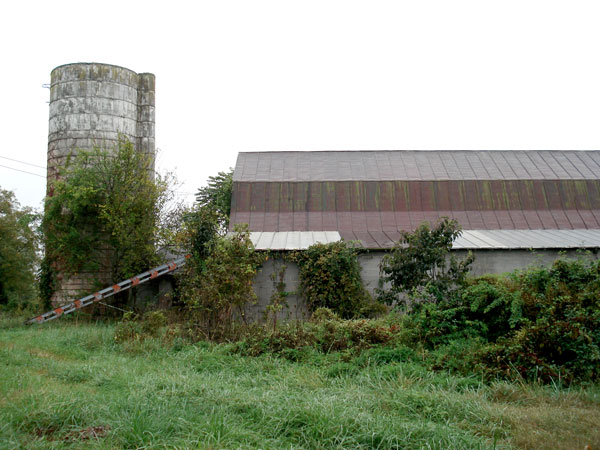
All these memories and many more returned as I surveyed an abandoned farm site north of Leesburg on a recent field trip. Virtually all the pieces from my original farm set were there, except the animals, of course: the now-empty, two-story barn, with – to my delight- an antique hay elevator still standing in place to load bales up to the second floor, silo (for storing a cow herd’s favorite treat), corn crib (an obligatory shed to keep field corn dry and out of the elements after harvest), a possible chicken-coop or pig shed, other nondescript out-buildings – most likely for storing machinery and other farm implements), a farm ‘yard’ now overgrown with cockleburs, goldenrod and other, less savory vegetation, and open fields in a present state of dereliction.
As I walked the overgrown farmyard, I was – at least part of the time – back with my childhood farm-set, loading hay bales into the loft, setting up fencing for the cows and pigs, maneuvering the tractor between buildings and dreaming about next year’s crop yield; I was also – a good deal of the time – back on Uncle Carl’s acreage – baling in the hot sun, loading the bales into the even hotter hay loft (he used a tin shed for this- mighty warm in summer), and maybe even pulling rocks from a former pasture area – never turned by a plow. A ‘virgin field’ in that part of the country can yield some behemoth-sized rocks. We needed a back-hoe for the largest, a living-room-sized beast, which we’d originally tried to wrench free with a simple rock pick and tractor.
Now, I’m not really sure how long this particular acreage in today’s story had stood unused and untenanted but I’d guess a few years, at least. And, I wouldn’t be too surprised if I see “For Sale” signs – or even housing units under construction – the next time I get up that way.
Loudoun County has a way of converting vacant land into more commercially viable real estate. And for the folks who move in, or set up business, that’s a wonderful thing.
But, as I drive by the same acreage in 10 or more years, if I happen to recognize it as the place where I walked the abandoned farm site and took a few pictures, and spent some time in recollection of old times, I just may wander off a bit and daydream about that fascinating set of farm toys I had as a kid, and those now-wonderful memories of the hard work and practical learning I experienced as a teenager on Uncle Carl’s farm. And for me, that too will be a wonderful thing.
Continue reading in this news section
Comments
Any name-calling and profanity will be taken off. The webmaster reserves the right to remove any offensive posts.
e-edition