

Just like nothing (else) on earth: Mountain Gap School
By Tim Jon
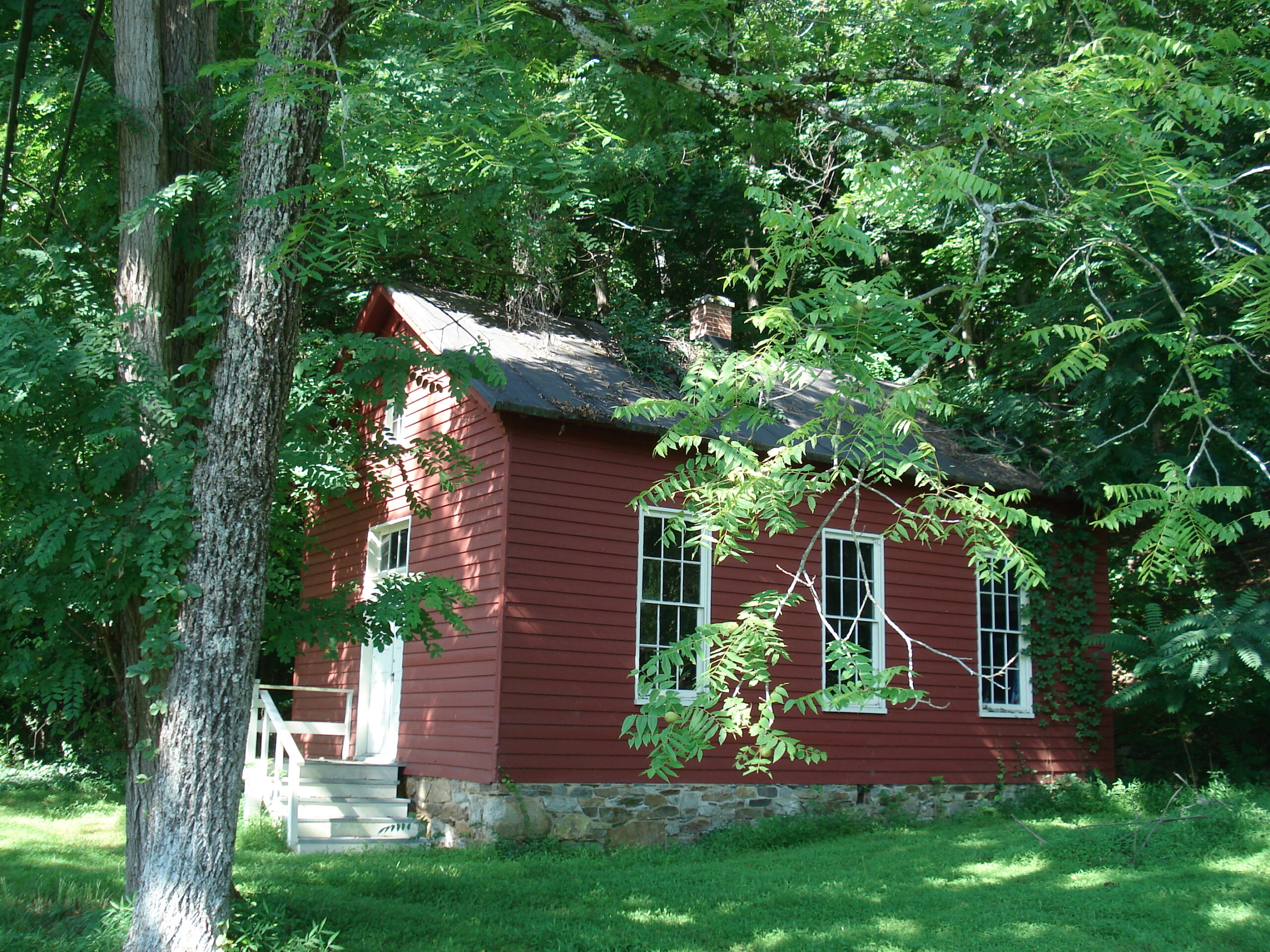
I remember the blackberries; it was ‘high summer’ when I visited this little piece of local history, but I could almost feel the winter wind that must have howled in coming down the steep western slope, which leveled off a few, mere feet from the building. That towering hill at the back of this historic site represents the easternmost section of the Blue Ridge Mountains, and having myself toiled many a ‘snow day’ up at the heights, I could just about imagine the drifting that must have occurred during the years of use at this—today’s subject of exploration.

Small wonder, then, that this one-room shelter took the name of Mountain Gap School, erected in the 1880’s—during segregation—open only to ‘white’ students. The attendees, ages five to 15 or so, reportedly came from the surrounding hills, farms, and small communities. I’m told they all studied together, which must have been quite an interesting and educational (in many ways, I’m sure) experience.
Now, the day of my visit, I could still see some of the historic artifacts through the windows (desks, flag, blackboard [this may have been part of the original interior], school bell and pot-bellied stove), placed inside by an individual (actually a graduate of the facility, Wilbur C Hall) who bought the School building after it formally closed its doors in the early 1950’s. The National Trust for Historic Preservation assumed ownership some 20 years later, and nearby Oatlands Plantation (one of the biggest visitor draws in the Commonwealth) currently uses the site for educational purposes.
I know, the data trail of years and names—even in the study of local history—can make the head spin; you can be thankful that we’re not in Mesopotamia. But, for those who need a better geographical perspective on the School building site, motorists along Route 15, James Monroe Highway, have undoubtedly noticed the deep red-colored wooden structure with white trim—a scant number of yards west of the roadway, between Oatlands and Gap Road. And the James Monroe reference: the Presidential estate, Oak Hill, lies just a few miles south on Route 15.
But to our story: what struck me about the place was the close proximity to nature that the little schoolhouse enjoyed: those berry brambles ran along the entire length of the wooded hillside, which, as I already indicated, pretty much came to a rest at the back of the building. The activity of birds and insects accompanied my entire visit, and I imagined, back in the day, that a curious deer (or bear) may have sometimes interrupted the arduous studies on the interior.
And speaking of industriousness, I’m told that the pupils at Mountain Gap School took part in maintaining the building and its operation. Duties included carrying fresh water, hauling wood and stoking the stove for the boys, and cleaning the interior facilities like windows, lamps and blackboards for the girls. I imagine the attendees must have had intermittent assignments in snow shoveling and floor cleaning (most of us locals well know the properties of the omnipresent, reddish, and very stubborn Virginia clay) as well.
I said toward the beginning of today’s program that Mountain Gap School served only ‘white students;’ not to leave out their counterparts (or perhaps, the mirrors of themselves), I’ve read that during those times, African American students in that area attended a separate facility named Mountain Gap Colored School, which I’ve yet to come across.
In either case, attendance would require walking, or perhaps riding a horse to school, then using the same transportation system on the way home. Imagine the fortitude required to walk a mile or more, or feeding and currying a four-footed beast before and after your lessons. Far removed from waiting in your home for the bus, then running the mere length of a sidewalk to climb onboard (and, yes, I realize for many it’s a bit longer wait and walk outside).
So, I’m gauging that whatever these primitive schools lacked in ‘formal education’ they more than made up in life skills—including socialization (yes, actually forming and maintaining relationships) with a group of prospective pupils of vastly different ages and levels of experience.
How memorable must have been those years of learning for these people. I imagine the determination, patience and multi-tasking abilities of a single teacher in these schools, imparting lessons in mathematics, geography, history, science and literature—for a class of students—some needing help in tying their shoes, others contemplating the choice of a profession, or a lifelong mate. As with today’s educators, each of these teachers truly earned every penny they took home. And from that warm, sunny summer morning’s visit to Mountain Gap School, I’ll always remember, especially, the blackberries.
Continue reading in this news section
Comments
Any name-calling and profanity will be taken off. The webmaster reserves the right to remove any offensive posts.
e-edition