

Just Like Nothing (else) on Earth: Historic Lime Kilns
By Tim Jon
It had to be the coldest day in about three hundred years; at least, that’s what my hands told me. By the time I’d walked the short distance from my car to the site for today’s story, I was almost wishing we could fire up these historic relics and pass around the hot chocolate.
But, no such luck; I was left to enjoy the sub-zero temperatures as I hastily shot a series of photos before I needed to re-don my pair of winter gloves. Not the visit I had been anticipating—for quite some time—to a familiar site along the W & OD Trail in Leesburg—the long-dormant pair of lime kilns abutting the (just as dormant) railroad tracks, running parallel to the walking, running and biking (oh, and I’d better not forget horseback riding!) path (which itself runs from Arlington in the east out to Purcellville in the west).
For the non-historians among us, the quarrying and rendering of the very prolific limestone in our region created an industry running from the latter 1800’s to shortly after the turn of the 20th century—supplying farmers with a viable fertilizer for crops, and builders with plaster compound for the construction of walls and roads.
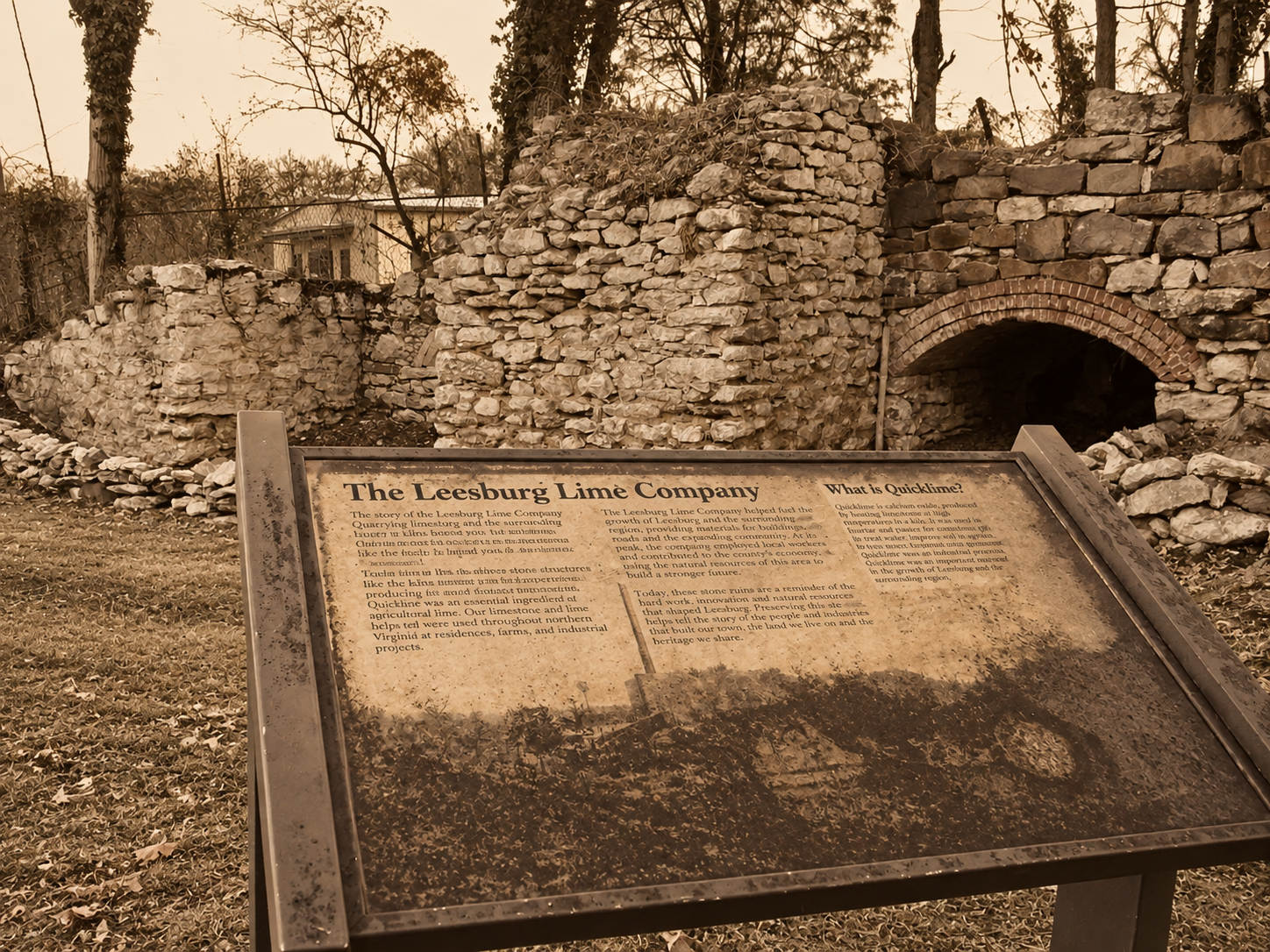
Other materials would eventually replace lime for these purposes, and now—in the 21st century—artifacts such as lime kilns have been relegated to the historic relic category. And, in the County Seat of Loudoun, pretty much smack dab in the center of Town, right along the recreational trail that essentially bisects the community, we can take a short walk from Harrison Street—near Raflo Park (a site we’ve covered in this series roughly a decade prior to this writing) to the official marker set up by the Northern Virginia Parks Authority, which maintains and operates the W & OD Trail.
Now, on the day that I last visited, the historic marker was much the worse for wear due to mildew—with legibility being a major issue; the lime kilns themselves, though, looked to me about ready to be re-fired up—if only to keep warm the extremities of a chronologically-challenged storyteller—with questionable emotional, intellectual and spiritual (may as well throw physical in there too, what the heck) stability.
The stone and brick work of the kilns appeared to have maintained a respectable level of integrity, considering they were installed in just a few years following the American Civil War.
Imagine the timeline of roughly a hundred 40 years, seen from that site: the prosperous railroad line continuing from the 1800’s until the 1960’s, then shutting down, the widespread use of literal horsepower transitioning to that of the combustion engine (and now electric vehicles), air balloons giving way to manned airplanes, rockets and spaceships (and drones), chalkboards being replaced by calculators, and ‘old-fashioned’ crank telephones fading out in deference to wall-mounted, extended corded 1970’s models, then to today’s so-called ‘smart-phones,’ milk being a nourishing liquid issuing from a cow, then from glass bottles delivered to private homes, and now in a supermarket carton. And so on.
At the time of the lime kiln operation, I would have been typing this story out on a manual typewriter and volubly cursing every mistake in my progress. Now I enjoy the luxury of one of the most frustrating computers known to mankind. Thank goodness for progress!
On a brighter note, I would have—at the time of the installation of the beloved lime kilns along the W & OD—most assuredly been listening to recorded music on the then recently-invented phonograph record player (obviously not yet electric), which would have graduated to an electrified device with turntable & LP (long player) disc, amplifier and speakers.
Our lime kilns could have watched your storyteller moving through time—while he and other audiophiles fiddled around with reel-to-reel, cassette, and of course the dreaded eight-track tape formats, then onto the CD (compact disc) era, and finally to today’s industry standard (at least for most popular use)—the digital audio file.
I prefer to write most of the stories in this series while listening to music under the mp3 format, generally instrumental, for inspiration without distraction.
And, our lime kilns have seen and heard it all. So, anytime you pass by something you consider ‘old,’ remember the lengthy timeline of things it has ‘witnessed,’ or at least with which it has coexisted.
Comments
Any name-calling and profanity will be taken off. The webmaster reserves the right to remove any offensive posts.