



Community leaders search for solutions to increasing miles of power lines
By Reed Carver
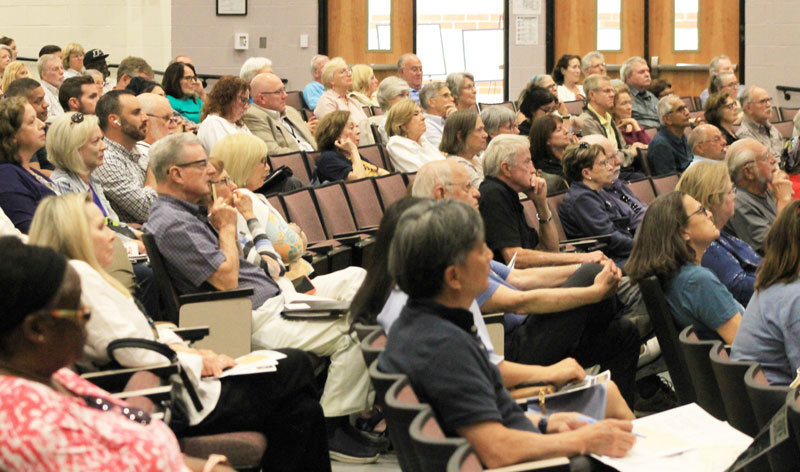
Dominion has announced four new transmission line projects in Loudoun. Speakers representing major associations took turns presenting information on the lines on June 11, in a Piedmont Environmental Council meeting at Heritage High School.
The Loudoun Transmission Alliance and the Lansdowne Conservancy argued for the Aspen to Golden 500 kilovolt lines to be buried, rather than strung at an average height of 160 feet along Rt. 7.
The Conservancy is an umbrella of the homeowners association that represents the residents of Lansdowne. It protects their property values, and seeks controlled development.
A video presentation assembled by the Conservancy, on the Aspen to Golden line featured community leaders, the pastor from Community Church, the large church off of Rt. 7 in Ashburn, just east of Claiborne Pkwy. The Aspen to Golden lines, if installed above ground, will pass by the church.
Undergrounding can provide the same amount of power, Leo Rogers, the County Attorney said in the video. The Director-At-Large of the Lansdowne Conservancy said that this line will negatively impact the property values of surrounding areas and devalues their properties. Maryann Mueller, a member of Lansdowne interviewed in the video, said it “makes Virginia unlivable.”
Bryan Turner is the General Counsel with the Lansdowne Conservancy. He hosted a discussion with Brian Conroy, who spoke about the engineering side of things and the process of how it would be done. They estimate completion in June of 2028 to put lines underground, calling this a hybrid solution. The presentation of expert testimony was hosted by Turner. “From a technical standpoint and an aesthetic standpoint, it only makes sense,” he said.
The State Corporation Commission will consider this undergrounding proposal in the coming months. They urged the community to request the SCC to come out to Loudoun and make their decision so the public can weigh in. On Sept. 18 the case will be heard, and a local hearing will be requested, so citizens can attend. It is very important to testify at that time, he said.
Dominion’s solution is 180-foot towers, the tallest thing in Loudoun County, he said. This will impact all of Rt. 7.
Turner argued that Europe and Asia are already burying lines, and high lines will be a hazard to the INOVA hospital, and vulnerable to storms. He cited that Dominion has said they cannot bury lines, but he believes it is more a statement of preference. “What I would recommend you doing is question them at all times,” he said. “We have to bring in power, there’s no question about that,” but, “we should not have to do your job,” Turner said, addressing Dominion, “bury the damn lines!”
Lines will impact agri-businesses, which in part, depend on aesthetics, said Sue Manchin, president of the Waterford Foundation.
She spoke about the NextEra Line, (mid-Atlantic resiliency link) (MARL) going through western Loudoun. “Our fight is very far away [from Bryan’s],” she said, but nonetheless they need to work together. The power of 6 million homes, is the power that is needed, she said, and it all goes to data centers from coal plants in West Virginia.
Bill Hatch stressed that the way to preserve rural Loudoun is through prime soil conservation. John Adams, a local cattle farmer, said too much growth is drawing away natural resources, and leaving farms lacking. “I’ve been around long enough to form some opinions on data centers,” he said. “The bottom line is there’s too much reliance on data centers, which are 40 percent of our tax base. I say, no more data centers until we solve the energy supply situation,” he said, which elicited full applause.
Cherish Loudoun’s historic places, urged Robert A Pollard, Chair of the Loudoun County Heritage Commission.
There are 200 surveyed historic cemeteries in Loudoun, Pollard said, using a slide from the Loudoun County Mapping Department.
While this is not explicitly planned, Dominion could theoretically bulldoze a cemetery, and move the remains elsewhere, destroying the sense of place. Loudoun even has protected forests, in district overlays. Lines will destroy these resources, he said.
“You can’t go very far without stepping onto natural resources in the county,” said Pollard, citing Gordon Pond, in Sweet Run State Park. There are 300 miles of unpaved roads, which are one of Virginia’s most endangered places. Unpaved roads are a time capsule of “hundreds of years, to a distant past,” he said.
“Where they [Dominion] see empty spaces, we see what you cannot put a dollar sign on,” Pollard said. “The point is, NextEra, that you can’t rip through without disrupting our natural environment … It will deface forever, the things that are worth fighting for.”
Easements are critical, while they are keeping land out of development, they are also land which does not lead to developments that will strain the county budget.
There are three weaknesses of NextEra, said Jim Hanna, Chair of Data Center Working Group, Loudoun preservation and Conservation Coalition. They don’t mitigate the eco impacts, they don’t minimize scenic impacts, and they fail to consider existing right of ways.
Hanna said PJM knows there is a risk of public opposition, which will lead to expensive time delays. They planned to meet with NextEra in June, and will release documents to the public, and hold community meetings this fall. “We will continue to strenuously oppose… [the lines],” Hanna said.
Gem Bingol, Senior Land Use Field Representative with PEC, acknowledged the snowballing effect of data centers. In Virginia, 57 million square feet are already built or under construction. Loudoun has more than double the density of Beijing China, which is the second contender. “Yet, the proposals keep coming,” she said, “there is a realistic potential to triple the amount of centers.” Bingol said that citizens are supporting the data center industry through their taxes.
The 20-year power expectations of PJM have risen every year they were evaluated, due to data growth. PJM is the regional transmission operator for Virginia and surrounding states, Bingol explained. They are responsible for being sure the power is there when the switches are turned on. Dominion is already guaranteeing sharp power demands into 2038. They released a flier, months ago, that says by 2035, they expect the average energy bill to be doubled.
The necessary new lines will require billions in investment, which citizens will pay for, via taxes. “We are footing the bill for this industry,” Bingol said.
Dominion will have public meetings in late July, or early August.
Finally, the US Department of Energy is planning the National Interest Electric Transmission Corridor.
It is overruling SCC’s and state powers, said Bingol. It is planned to come from Ohio, through West Virginia, down through Loudoun. This power will be connecting to coal and gas plants as well, in Fort Martin and Harrison, WV.
People are in the pathway of the NIETC and they have no idea, said Bingol. A study is coming out this fall called the JLARC study, to support regulation of data centers. It is being conducted by the legislature in Richmond.
Power increases in five years may be 340%, said Turner, and A.I. is replacing the old processing. It will use 60-80 kilowatts per rack, 6 times more than cloud storage. “It created enormous power problems. If you stopped tonight, demands will still go up five to six times in coming years.”
Turner recommended attendees to view Buddy Rizer’s lecture on the coming use of micro-grid, which is power generation on site, with gas, and nuclear. “You bring your own power,” Turner said. “Advanced re-conductors, part of the micro-grid, are being used in Europe, it’s existing technology.”
Comments
Any name-calling and profanity will be taken off. The webmaster reserves the right to remove any offensive posts.