



Chair Randall asks at the beginning of the Hiddenwood Lane hearing – in the face of no clear right decision for the supervisors.
By Reed Carver
The problem, and proposed solution
Arcola was an agricultural region that is now changing rapidly. Rezonings as far back as 2014 began to shift the area from farming to industrial/data centers uses. These trends have sandwiched the neighborhood along one-lane gravel road Hiddenwood Lane between data centers, soon to be built data centers, and planned data centers.
Multi-lane road infrastructure is also in the process of being built, connecting to Hiddenwood Lane. The only residential border is in the environs behind Hiddenwood. It is another 72-home subdivision called Briarfield Estates.
Both communities are surrounded on three sides by construction, or current and future data centers. For Hiddenwood, however, their only means to and from home is now through a construction site. The surrounding fields which are open, are in general, approved for future data centers. Substations and power lines for the centers occupy the land as well.
At the July 10 Board of Supervisors Public Hearing, 16 residential owners of the Hiddenwood Lane community, which totals approximately 29 acres, were advocating for the rezoning of their assembled properties. They are seeking to rezone from Countryside Residential to Planned Development-Industrial Park (PD-IP).
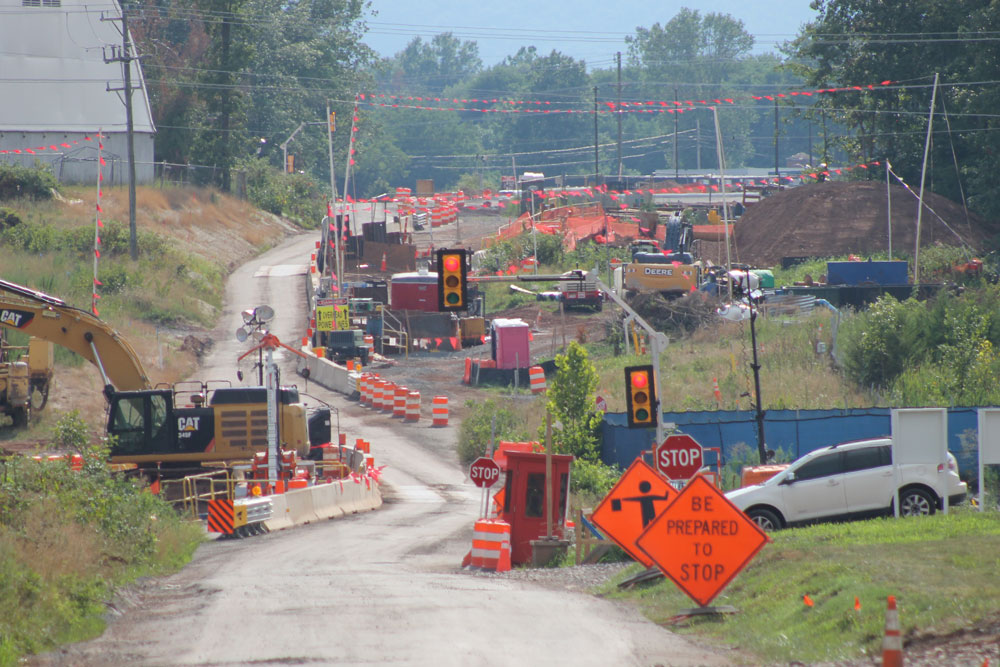
The only road Hiddenwood Lane residents have to access their homes.
The ultimate goal for these residents is to create an “escape route” by selling the Hiddenwood Assemblage for data center development.
Chuck Khun of JK Technology owns a significant amount of the parcels surrounding Hiddenwood Lane. He also owns the two parcels of land in front of Hiddenwood, as well as land near the Briarfield subdivision to the northwest.
According to the July 10 county staff report, there is potential for an interparcel connection with the JK Technology Park #2 parcel to the south, and the Hiddenwood Assemblage, if the rezoning occurs.
Michael Romeo, Senior Land Use Planner with Walsh Colucci Lubeley & Walsh, who represents Hiddenwood, said he could not divulge the offers for the land, when asked for prices by Supervisor Juli Briskman (D-Algonkian).
“But, you can realize that data center property is going for upward of four million an acre in the county,” said Briskman. “You guys say it’s not a windfall,” she continued.
Solution shortcomings
The area is the Suburban Neighborhood Place Type, which means that only 15 percent of the land should be converted to industrial uses. The primary use is residential, with a height for all buildings limited to four stories.
County staff said the proposal is inconsistent with the place type. They recommend denial for two reasons: impacts to surrounding neighborhoods [Briarfield] are too damaging, and the project clashes with the 2019 Comprehensive Plan.
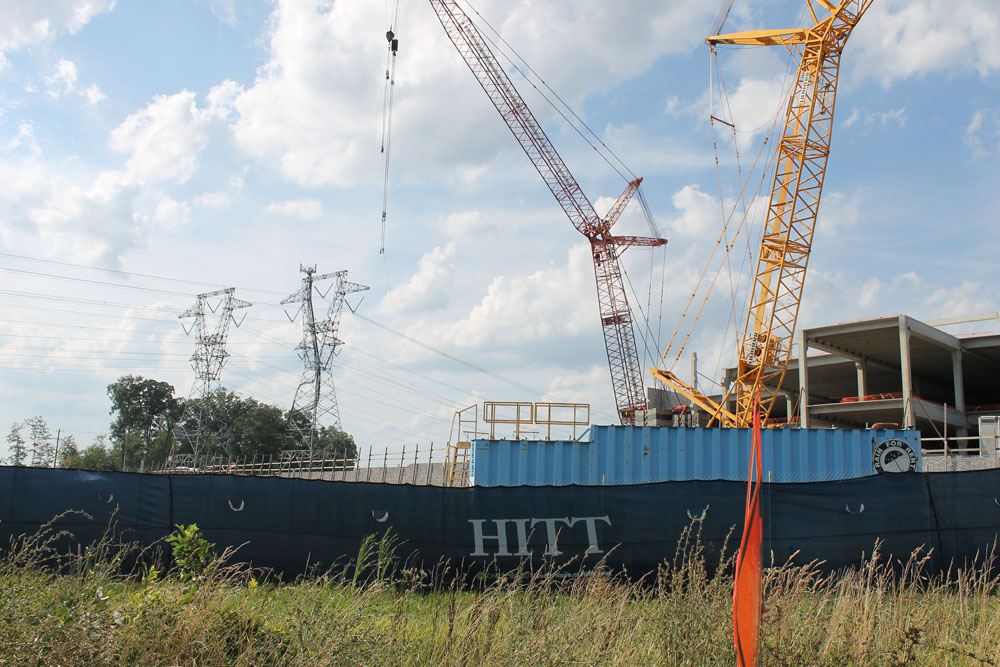
Data center construction as seen from Hiddenwood Lane.
Public comments
Eighty to 90 residents from both neighborhoods spoke at the hearing, those from Hiddenwood advocating for the potential sale to save their quality of life, while those from Briarfield were vocal about their situation getting worse because of the sale.
Twelve-year Briarfield resident, Sheeba Namburi, was concerned about the safety of her children. Recently, in the winter months, a large coil of cable from the construction site appeared on the street. Someone was trying to steal it during the night, but was alarmed by a barking dog and dropped the spool. She said that the data center sites attract people who don’t live in the neighborhood. She is afraid to let her children play outside.
If this project is approved, Briarfield residents said, their singular neighborhood will be surrounded on three sides by data centers. Many of the Briarfield speakers said they constantly hear the air-cooling systems for the data centers, and they are breathing the dust raised by the construction. Blasting used in construction was alarming to many residents, who felt their houses shake at moments they were not expecting it.
“The sound was deafening, you had to be there,” said a resident. “I feel like Carl from the movie Up,” another said.
Several Briarfield children spoke about the loss of open space, and their parents making them go inside to avoid the heavy vehicle traffic and dust. Several of them have asthma. Smoke and heat result from this intense land use, and they also cited radiation from the computers as a poorly understood, but concerning impact.
To a greater degree, the residents of Hiddenwood find their situation unsustainable, with data centers right up to their front doors. They said that rezoning was necessary to allow them to move on with their lives somewhere else.
Kaleb Calhoun, said that a buffer, proposed for the Hiddenwood houses, would be inadequate. “This rezoning is the only release for Hiddenwood, if you have any compassion … ,” another resident said.
The houses on Hiddenwood are worth very little now. “We wanted to sell our homes at the start of this, but let’s be honest, who in their right mind would purchase a home? … It’s the end of the road for Hiddenwood, ” said resident Dannyaal Khan. “We wanted to purchase a home and grow with it, but unfortunately we’ve been pushed out of it.”
“Hiddenwood will forever be in an industrial park. Any other option [than rezoning], would leave them [Hiddenwood] at a significant financial loss,” said another speaker.
In addition, there are tensions between the residents and the workers, as they both vie for the same road spaces, and become irritated with each other. Citing from experience, Lea Bell said a construction worker shouted vulgarities at her.
Music teacher Andrew McGinley said, “This has ruined Hiddenwood as a residence.” He quoted another teacher who said the situation was absolutely dangerous. “The quality of life is appalling,” he concluded.
The HOA president of the Briarfield neighborhood was not comfortable with the solution. “I don’t find it just, if one community alleviates their problems at the expense of another,” he said.
Ankita Kamath said that approval means transferring the problem Hiddenwood faces right onto the Briarfield residents, just pushing the same problem to someone else.
“We don’t want them [Hiddenwood] to be a human buffer. We really want to give them a solution, but that solution is not building a data center. We don’t want the solution to be for us to be the human buffers,” said Ravi Budigelli, from Briarfield. “There’s got to be another solution, no matter how expensive it is. You’ve got to do right by them and right by us.”
“The two communities are really not similarly situated,” said Pam Cave, speaking on behalf of Hiddenwood residents. “They [JK Technology] can build whatever they’re going to build right up to the homes. … It has nothing to do with financial windfalls, it has to do with being similarly situated, somewhere out from under this situation … They only have one way in … because of decisions made by this board they cannot sell their property. No one will buy it. It would be fair and just, under these circumstances, that you all approve the application.”
Board of Supervisors Chair Phyllis Randall (D-At Large) made a motion to move the issue to the Sept. 17 meeting for action. “If nothing else, we should all come away knowing data centers have a cost,” she said.
Supervisor Mike Turner (D-Ashburn) said, “This has been one of my worst decisions on the board,” referring to his vote on JK Technology Park #2, the parcel in front of Hiddenwood. “I want to personally apologize to Hiddenwood residents.”
“I have a hard time believing a data center is the solution to a data center, so it’s tough,” he said. “The whole Board is wrestling with this one.”
The important question to ask in September, according to Chair Randall, is: what other use can the Hiddenwood property have that would not require a rezoning?
Comments
Any name-calling and profanity will be taken off. The webmaster reserves the right to remove any offensive posts.