

“Fight for Us!” Lovettsville residents plead with lawmakers to stop transmission lines
By Valerie Cury
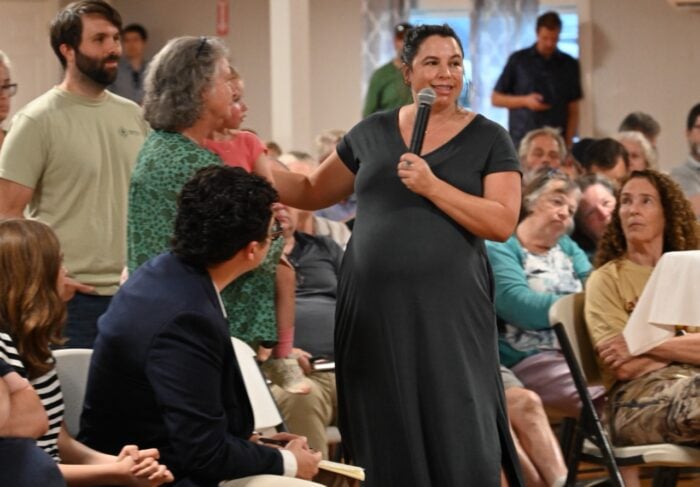
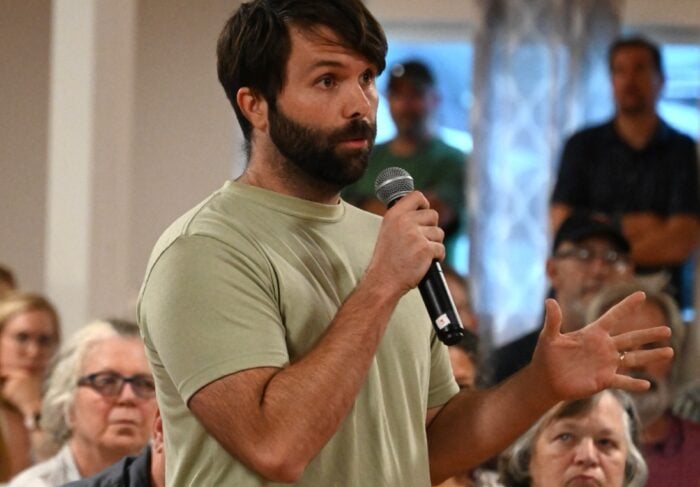
There were no empty seats Monday evening at the Lovettsville Game Protective Association as residents from Lovettsville, Taylorstown, Hillsboro and surrounding communities came to tell two state lawmakers what proposed high-voltage transmission lines could mean for their homes, farms, families and way of life.
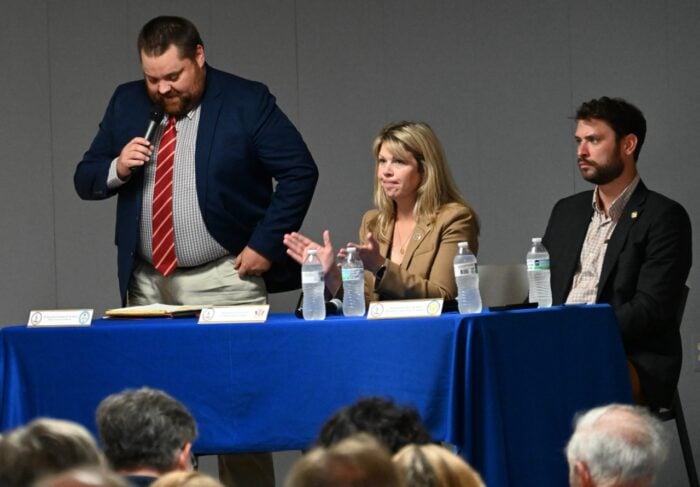
The Aug. 31 listening session, hosted by state Sen. Russet Perry (D-31) and Del. John McAuliff (D-30) and moderated by Lovettsville Mayor Christopher Hornbaker, was not structured as a debate or question-and-answer forum. For nearly two hours, the elected officials largely did exactly what they had promised to do—listen.
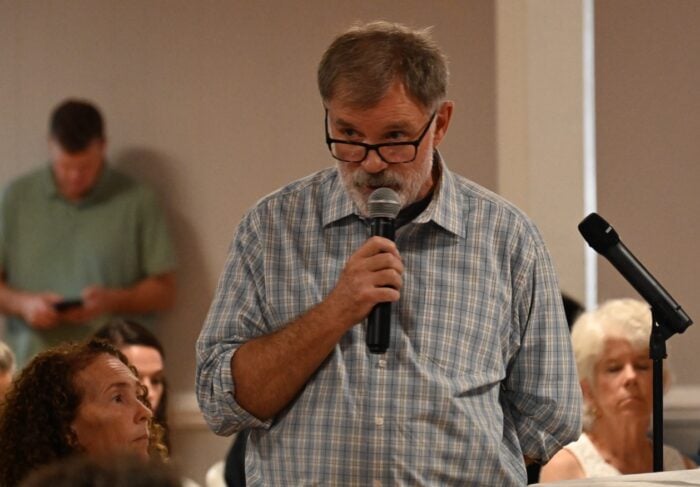
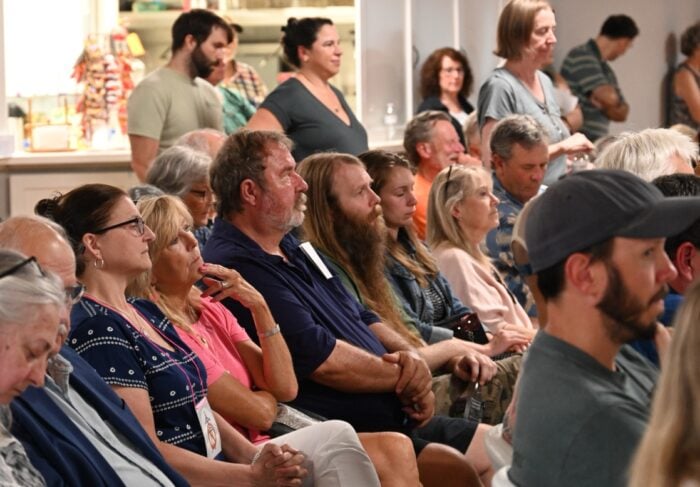
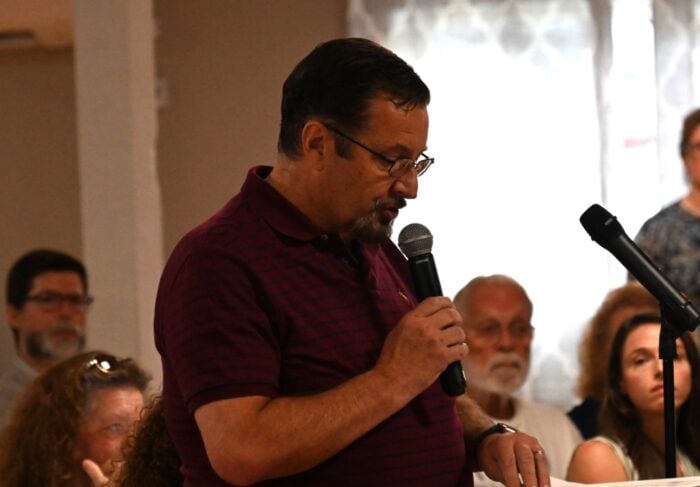
And residents had a lot to say.
They spoke about children and grandchildren, historic cemeteries and Civil War-era barns, conservation easements, streams and wetlands, family farms, wildlife, property values, pacemakers, wells and septic systems.
They spoke about people who had saved for years to buy a few acres in western Loudoun, only to learn that a massive transmission corridor could pass beside or through the property they had believed would be their family’s home for generations.
Again and again, however, the stories returned to one question: Why should western Loudoun sacrifice its land to supply electricity demanded largely by data centers concentrated elsewhere?
Hornbaker opened the evening by making clear that the purpose was not for officials to talk to residents, but for residents to talk to them.
“This is not a question and answer session,” Hornbaker said. “We are here to hear.”
He asked speakers to tell their individual stories so Perry and McAuliff could take them back to Richmond.
McAuliff said those stories mattered because lawmakers needed to understand not simply where lines might run on a map, but what was actually located beneath and around them—homes, businesses, families and natural resources people had spent years protecting.
“Every inch of land in western Loudoun is precious, and we’ve lost a lot,” McAuliff said.
He said he directly opposed the project and drew an explicit connection between the transmission proposal and eastern Loudoun’s data center industry.
“This is not the massive power need of western Loudoun,” McAuliff said. “This is the data centers in Eastern Loudoun that need the power.”
Perry was equally direct.
“We can’t allow the wealthiest companies in the world to run our town,” she said, adding that decisions made to serve those companies should not result in taking people’s property, homes, farmland and investments.
Then Perry sat down. The residents took over.
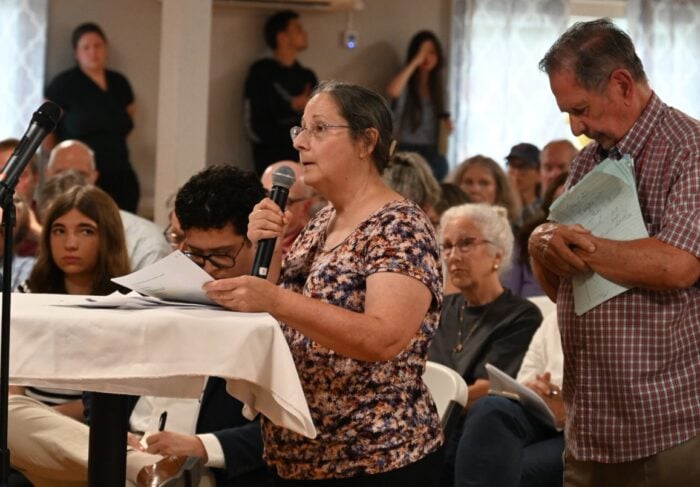
The first resident to speak brought the potential consequences immediately to a deeply personal level. She said she is totally dependent on a pacemaker and fears electromagnetic interference from the proposed transmission lines could disrupt the device.
For her, she said, the concern is not simply about property values or the view from her home—it is about whether she could survive living near the lines. She told the room that if her pacemaker were disrupted, she could die.
Another longtime Lovettsville resident said her greatest fear was that the outcome had already been decided—that public participation was being solicited only after the fundamental decision to construct the lines had effectively been made.
“I feel in my heart that there’s a done deal here somewhere, but I hope there’s not,” she said.
But she rejected the notion that the discussion should become a competition among property owners over whose land should bear the impact.
“I don’t just want to talk about my piece of property,” she said. “I want to talk about everybody’s piece of property.”
“Property is not fungible,” she added. “We can’t just pack up and say we’re going to get the equivalent somewhere else.”
Edward Spannaus said he helped establish the Lovettsville Historic District roughly 14 or 15 years ago, focused not on his own historic home, but on the community’s history.
He explained that Lovettsville’s historic district is unusual because it is non-contiguous. One section encompasses the old town, while another includes New Jerusalem Lutheran Church and two cemeteries.
The proposed transmission line, he said, would divide those historic areas and cross near or through cemetery property. One cemetery includes the graves of 33 Revolutionary War patriots, while Lovettsville Union Cemetery is the final resting place of approximately 4,000 people and remains active.
The consequences, he said, would reach far beyond aesthetics.
“This will do permanent and irrevocable damage to this community,” he told the lawmakers.
Charles Hanson, a co-chair of the Block Valley Link North Coalition, pointed to the packed room as evidence of how quickly the community had organized since a project open house was held at the same location at the end of June.
Residents, he said, had educated themselves, organized and submitted thousands of comments.
He urged Perry and McAuliff to go beyond fighting one particular route and pursue changes to the laws governing how the State Corporation Commission evaluates major transmission projects.
“It’s not just cost, timing and reliability,” Hanson said. “It’s got to be more.”
A resident who lives northwest of Hillsboro and works in the technology industry, framed the dispute differently.
She recalled an engineer warning her decades ago that Northern Virginia was running out of power. In the technology industry, she said, repeatedly postponing a known problem while pursuing the newest innovation is called “technical debt.”
Now, she said, communities are being asked to pay that debt.
“So the question in front of you is: What gets sacrificed now?” she asked. “Us, the people, or somebody’s wealth?”
“Please stop the buck here.”
For one Lovettsville family, the issue was deeply personal.
A woman described buying a multigenerational home in 2018 and never imagining that her family would someday be fighting to protect it. She spoke of young children walking along their private road to reach the school bus and of her husband’s heart condition.
Her daughter, Amy, followed.
A single mother of three, Amy said she had called Loudoun County home since 2008 and felt fortunate to find an affordable house in Lovettsville during a difficult period in her family’s life.
Her children gave the house a name. They called it the “Happy House.”
She described deer crossing the yard, chickens, cats and wild turkeys. Her son hopes to remain in the area as an adult.
“This is really gonna destroy everything that our family has built,” she said.
If the house is lost or its value badly damaged, she said, her son may never be able to afford to remain in the community he considers home.
The comments repeatedly moved between the intensely personal and the environmental.
A resident of the EcoVillage of Loudoun County described a community built around stewardship of approximately 100 acres of organically managed common land. Residents have planted more than 12,000 native trees and shrubs since the community’s founding in the late 1990s, the speaker said, and the property contains multiple conservation easements.
The transmission project, the resident said, would cross a large portion of that land, threatening habitat, wells, septic systems and underground utilities.
The speaker called it an injustice to “industrialize our rural landscape to subsidize commercial data center growth elsewhere.”
Former Lovettsville Planning Commission Chairman Frank McDonough focused on what local and state governments could do.
He urged Lovettsville to strengthen its Comprehensive Plan while it is under review by adding policies discouraging new high-voltage corridors within or immediately adjacent to the town’s planning area and requiring existing corridors and alternative technologies to be considered first.
At the state level, McDonough called for greater formal involvement by local governments when transmission projects exceed 500 kilovolts, including consideration of local comprehensive plans, alternatives proposed by counties and towns, and written explanations when the SCC selects routes conflicting with adopted local policies.
Such reforms, he said, would not necessarily give localities veto power.
They would, however, give “the governments closest to the residents, these residents, a meaningful seat at the table.”
Others called for underground high-voltage direct-current technology and greater scrutiny of whether existing rights-of-way could be used rather than cutting new corridors through western Loudoun.
Dr. Brian Carson said that the transmission lines themselves are only a symptom of a larger problem—rapidly growing energy demand associated with data centers.
“We need you,” Carson told Perry and McAuliff. “We need you to protect the people rather than the corporate dollar.”
Sean Austin described a small cow-calf operation, horses, protected streams and a historic barn on property along one of the proposed routes. His family has invested money—and received County assistance—to fence livestock away from streams and protect water quality.
Now, he said, clearing associated with a transmission corridor could remove trees and vegetation, potentially increasing runoff into those same streams.
He asked lawmakers to find an alternative that would protect not merely his farm, but the larger community.
Brent Faito, president of the Taylorstown Community Association, said he had never seen an issue bring the community together in quite the same way.
Standing before the lawmakers, he pointed out that several people from his community faced losing substantial portions of their properties.
“This is not their view,” he said. “This is not their well-being. This is literally—it’s going to take half their property and it’s going to be gone for good.”
The towers, he warned, would also alter what visitors encounter when they come to western Loudoun for its farms, wineries, breweries, mountains and rural landscape.
“There is no route above ground that will work,” he said.
Nicole Clark, founder of Walk for Mountains, said the beauty of western Loudoun is precisely what draws people to the annual event.
She described driving home as the sun sets over the mountains and looking at her husband with a shared sense of disbelief that they are fortunate enough to live there.
“We just look at each other and go, you know, we live here,” Clark said.
Anna Oakley stood before the lawmakers with her three-year-old child and her mother.
Her family moved to Lovettsville a year ago. She and her husband bought land in western Loudoun and later had an opportunity to purchase the neighboring property, allowing her parents to live next door.
For her generation, Oakley said, simply becoming a landowner was an enormous achievement.
Now the multigenerational arrangement they had dreamed of could sit beside a massive transmission corridor.
She described feeling caught between fear about remaining and the financial impossibility of leaving.
“I don’t feel safe living there, I don’t feel safe raising humans there, but I also can’t afford to leave,” Oakley said. “And so I’m trapped in the home that is my dream home.”
She contrasted the restrictions she faces as a property owner with the scale of what a transmission company could potentially do.
She cannot repair a culvert without consulting Loudoun County, she said, while the family receives assistance to properly construct agricultural fencing.
“But they can build a power line through that,” she said.
Oakley’s appeal captured a theme heard throughout the evening.
“We need someone to advocate for us,” she said. “There’s only so much that we can do.”
Environmental attorney J.W. Glass said residents should not have to return year after year to fight successive transmission projects generated by continued data center expansion.
He cited potential deforestation, pesticide use and impacts to wildlife, but said he was heartened that Perry and McAuliff had openly discussed data centers as the underlying issue.
“If data centers continue to proliferate in Eastern Loudoun, there will be many more to come,” Glass said, “and we shouldn’t have to have a listening session every year to deal with it.”
A Lovettsville resident and mother of eight who said she had canvassed neighborhoods to alert residents about the proposal, described encountering “pain, anguish” and anger—along with people who had no idea how close the proposed infrastructure could come to their homes.
She urged the General Assembly to act quickly.
“It is rapacious. It is egregious. It is inhumane,” she said of the cumulative transmission proposals facing the area.
“The Virginia Senate and House needs to act,” she said. “It needs to act quickly.”
A Lovettsville community member described what one proposed route near Householder Road could mean for the entrance to Lovettsville—massive towers greeting residents and visitors where rural views exist today.
She also described canvassing neighborhoods and discovering that many residents, particularly older residents who were not active on social media, did not know about the project.
Her message to the lawmakers was simple.
“Fight for us.”
A Lovettsville resident said she and her husband purchased their Lovettsville home only a year ago.
She came to the microphone, she said, to protect the things that had made her fall in love with it: mature forest, a headwater stream, wildlife, recreation and a scenic view.
But she urged lawmakers to look beyond individual property boundaries. The landscape near the Potomac River, she said, has environmental and recreational value extending far beyond the people who happen to own the affected parcels.
A massive new transmission corridor, she said, would affect not only adjacent property owners but members of the public who use and enjoy the Potomac River, the C&O Canal National Historical Park and the open spaces of northern Loudoun.
Another Lovettsville resident said she had begun researching historic resources documented by the Virginia Department of Historic Resources and had already identified more than 20 that could be directly affected or fall within the project’s viewshed.
“Please help us to stop this destruction of our heritage, of our farmland, and our property values,” she said.
A Lovettsville resident described himself jokingly as an “import from Sterling,” but his comments quickly became serious.
A disabled veteran married to a veteran, with two sons serving on active duty, Stewart said his family deliberately chose Lovettsville after years in eastern Loudoun because of its “dark skies and pastoral peace.”
He described a small neighborhood where wetlands and trees are protected and where residents face strict limitations on disturbing the land.
Under one proposed alignment, he said, several households could be severely affected.
He invited Perry to come see it herself.
“Come over for a cup of coffee and see what it’s like to live here,” Stewart said.
A resident of the Shady Lane community questioned why a new corridor should cut mature forest and create a new easement across the mountain rather than following existing infrastructure.
He also challenged the idea that compensating a property owner for acreage taken within an easement captures the actual financial loss.
The loss, residents repeatedly said, is not merely the ground directly beneath a tower.
It can be the view from the kitchen window. The forest behind the house. The ability to sell. The quiet that brought someone to western Loudoun in the first place.
Another speaker, who lives near Furnace Mountain, described commuting each day and looking forward to the moment she comes over the hill and sees the mountains ahead.
“My story is that this is our home,” she said.
She had moved from Washington, D.C., she explained, because she wanted a dirt road, wildflowers and ducks—not another industrial landscape.
Another speaker who said she is involved with the National Land and Community Protection Alliance, reminded lawmakers that agricultural land that appears to be an empty green field from a map or aerial photograph may be anything but empty.
“A single agricultural property may support a home, several businesses, livestock, food production, water infrastructure, and family income,” she said.
A community member who said he has a construction background, raised concerns about the area’s limestone geology and the engineering required for towers of this magnitude.
Construction, he warned, could mean deep foundations, disturbance of karst terrain and potential impacts to wells, aquifers and septic systems.
“Who’s going to pay for that if my well goes away?” he asked. “Who’s going to pay to move my septic field if that goes bad?”
Without water, he said, a property can cease to function as a home.
The opposition also crossed state lines.
A Jefferson County, West Virginia, resident said he and his wife drove about an hour to attend because residents there had not been offered a comparable listening session.
He said he works in big technology, acknowledged the enormous demand for computing power created by the race to develop artificial intelligence.
But technological advancement, he said, cannot come without limits.
“We must do this ethically,” he said, in a way “that puts humans first.”
Another Taylorstown resident reminded the room that western Loudoun communities have faced seemingly overwhelming infrastructure proposals before.
She recalled the fight decades ago against a dam proposal that could have flooded Taylorstown.
“Don’t give up,” she told the crowd.
“We can win fights. It is possible.”
By the time the final residents spoke, the evening had become about considerably more than the path of a transmission line.
It was about who bears the physical cost of Loudoun’s extraordinary data center growth. It was about whether conservation easements remain meaningful when major infrastructure is proposed.
It was about whether the economic value of a rural property can be measured simply by the acreage taken. And it was about whether residents living far from the data centers driving new electricity demand should lose pieces of the landscape they deliberately chose to call home.
Perry returned to the microphone after listening to the testimony.
She said she has fought data center-related issues since taking office in 2023 and told the audience she supports a moratorium on data centers in Virginia so policymakers can stop addressing the consequences through piecemeal legislation and instead examine the larger picture.
“A moratorium stops and takes a look at all of this,” Perry said.
She expressed a broader concern about what could happen if growth and infrastructure demands continue unchecked.
“I’m concerned that the wealthiest county by median income in the country is quickly becoming a place that no one wants,” Perry said.
She also reminded the room that she and McAuliff are only two members of a 140-member General Assembly and encouraged residents to take their message beyond Loudoun County and contact legislators throughout Virginia.
And she returned to the fear expressed near the beginning of the evening—that the transmission project was already inevitable.
“I don’t control what happens in this situation,” Perry said, “but I’ll be damned if I’m going to give up the fight.”
McAuliff said the testimony would not simply remain in the room.
“Tonight is going to yield legislative actions,” he said.
He said he and Perry would work with their staffs to determine what could be accomplished in the next General Assembly session.
Then McAuliff looked toward the children who had sat through the meeting.
He spoke of his own grandparents and the generations before them who had preserved the place he was fortunate enough to inherit.
The question now, he said, is whether today’s generation will do the same.
“How do we make sure that this is a place that they live, that they want to live, that they’ll love to live?” he asked.
For McAuliff, the answer to the routing debate was straightforward.
There is no correct route, he said. The only correct route is no route.
Hornbaker closed the evening with a story that could only have come from Lovettsville.
He recalled one of the town’s favorite traditions—wiener dog races—and a small dog named Squid who overcame an early loss and eventually became champion.
“Like Lovettsville, Squid is small but mighty,” Hornbaker said.
Looking across the capacity crowd, he said that was what he had seen that evening: “a unified, small but mighty community.”
For nearly two hours, residents had asked their elected representatives to protect their farms, homes, history and land.
Some came with prepared remarks and research. Others came with children, parents or decades of family history. Some talked about engineering and legislation. Others simply described what they see when they drive home.
Together, their message was remarkably consistent.
They did not want to decide which neighbor should bear the burden. They wanted their representatives to fight so that none of them would have to.
Comments
Any name-calling and profanity will be taken off. The webmaster reserves the right to remove any offensive posts.
1 Comment
I am the “Stewart” mentioned in the article, the disabled Veteran.
I am not a man. I am a woman. The room saw me. It was recorded. Why did you assume otherwise?