

Whose Town Hall Was It?
Randall’s Town Hall drew hundreds
By Valerie Cury
Long before the doors opened Monday evening on July 6, the lobby outside Loudoun County Chair Phyllis Randall’s (D-At Large) data center town hall had filled with mostly data center employees and industry supporters waiting to enter.
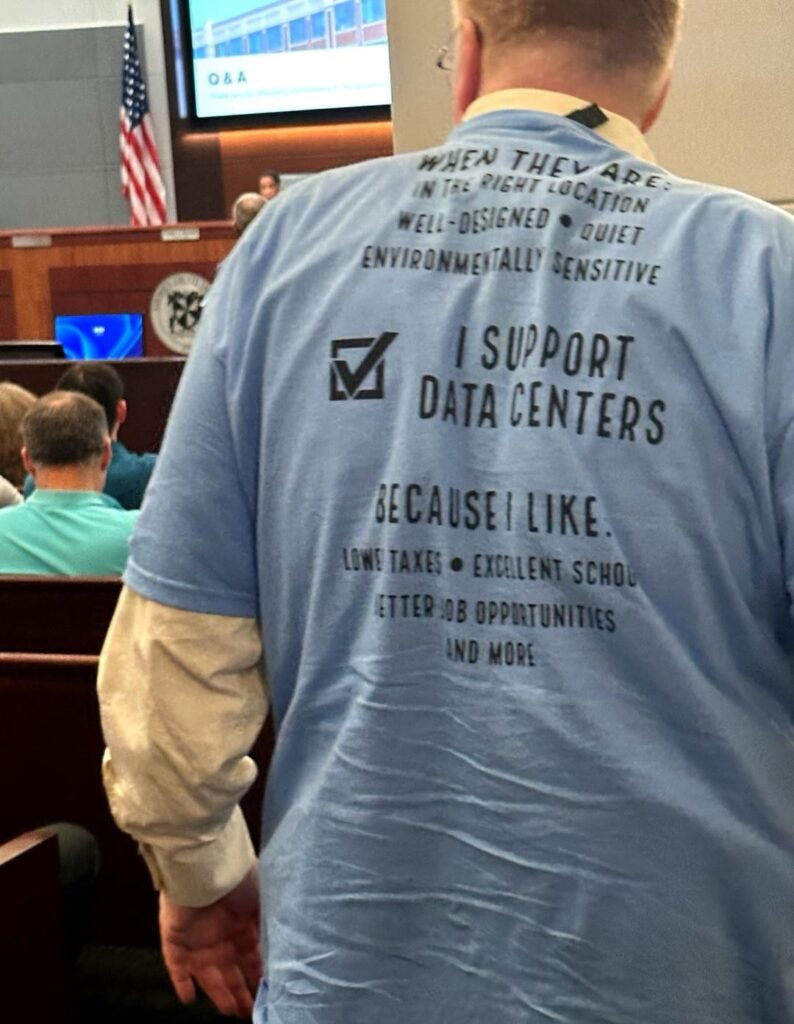
Many wore matching blue shirts bearing the words “I Support Data Centers.” When the doors opened, they entered first, filling most of the available seats before many residents impacted from neighborhoods surrounding existing data centers had a chance to get inside.
As those residents continued to arrive, the overflow room quickly filled to capacity. Large numbers of residents left after finding no seats available, while others remained in the lobby. Over 300 were watching online.
Before the first presentation began, the evening had already reflected the central issue many residents say they face—struggling to have their voices heard as decisions about data center growth continue to move forward.
For many residents, however, the history of Loudoun County’s data center industry was not the reason they came. They came hoping to once again describe what they say are the day-to-day realities of living beside data centers—persistent noise, the constant hum of cooling equipment, diesel generators, transmission infrastructure, and other impacts they believe have gone largely unaddressed despite years of raising concerns with county leaders.
The concerns many residents hoped to raise at the town hall were already evident in the days leading up to the meeting. Comments posted on Randall’s Facebook town hall announcement reflected frustration over years of data center approvals and expansion—while others voiced concerns about noise, transmission infrastructure, environmental impacts, and the changing character of their communities.
One resident wrote, “Would have loved a town hall before you approved a rezoning from residential to data center right in my backyard in Ashburn. Now I live in the middle of an industrial park.”
Others questioned whether county leaders would take meaningful action. One resident urged county officials to “Stop the Ashbrook Commons Data center! Turn off the generators!” adding, “You all have no idea the political wave coming for any Board member that does not stop with the excuses and work with us to stop the destruction.”
One resident described returning to Ashburn after moving away, writing, “What sheer devastation. These data centers have foisted in a once beautiful community.”
Another, identifying as an environmental attorney, wrote, “I cannot believe that no one analyzed the cumulative impacts of putting all of those data centers into such a confined area as our county.”
Several residents also questioned the impact of the proposed North Valley Link transmission project, expressing concerns about its effect on homes, farms, historic properties, and rural viewsheds while asking county leaders how those communities would be protected.
During her presentation, Randall traced the County’s emergence as the world’s largest concentration of data centers, describing how the industry grew from the arrival of AOL and the expansion of fiber-optic infrastructure in the late 1990s and early 2000s. She also explained that data centers were permitted “by right” after a 2000 zoning interpretation classified them as office uses in certain zoning districts.
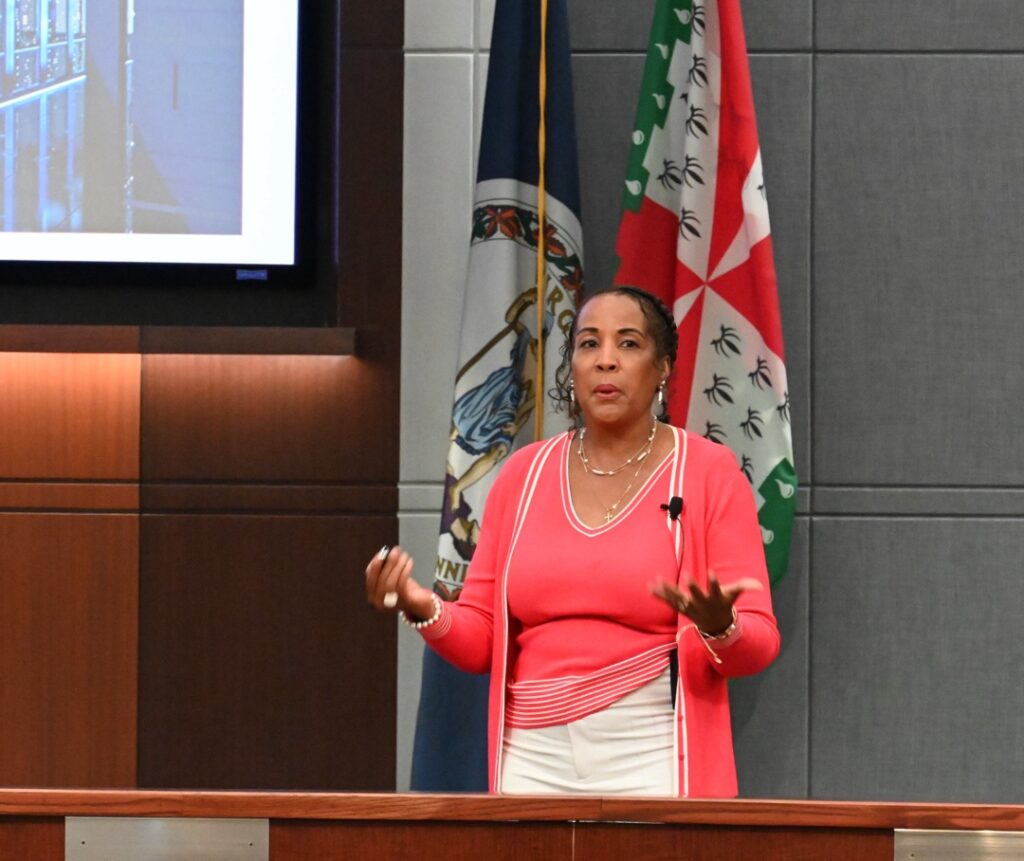
Randall also sought to reassure residents concerned about western Loudoun County, saying data centers are not permitted there under current zoning. “That has never happened. That will never happen,”she said.“There’s no zoning for that out there.”
However, county zoning records show that an undeveloped 18-acre property on St. Francis Court in Purcellville, (PIN 452-25-4770-0000) was rezoned in 1993 to Planned Development–General Industry (PD-GI), a zoning district in which data centers are a permitted by-right use. Since then, the zoning designation has remained unchanged.
That by-right use could be changed if the Board of Supervisors chose to rezone the property.
Randall highlighted the economic impact of the data center industry, noting that the county’s largest commercial taxpayers are data centers. She said the industry supports at least 12,000 jobs, and has become a significant source of county tax revenue through real property and personal property taxes on data center equipment.
She also noted that data center revenue has helped support reductions in the county’s real property tax rate over time.
Randall said the Board cannot deny a data center application based solely on electric power availability under current state law.
The Board does, however, retain its authority over zoning decisions, including rezonings and amendments to the Zoning Ordinance.
Acknowledging that county leaders had not done enough to communicate with residents about data center policies, Randall said she wished the conversations had begun sooner. “We haven’t communicated enough. And I’m sorry about that.”
She also said the county has adopted additional regulations in recent years, including enhanced buffering and screening requirements and changes to the approval process, in an effort to slow the pace of data center development while responding to residents’ concerns.
Randall said that all data centers approved through 2025 were by-right developments. However, according to Emily Johnson, Land Use Field Representative with the Piedmont Environmental Council, in her July 2 article, Data Centers in Loudoun: A Primer, the Board of Supervisors has approved 38 rezonings specifically for data centers and 36 additional rezonings where data centers are a permitted use.
In the past year alone, the Board approved the Cross Mill Center rezoning in Leesburg and the Arcola Grove rezoning in Dulles, she wrote.
According to her article, previous data center approvals include True North in 2018, Ashburn Corporate Center in 2019, JK Technology Park 1 in 2020, both Brambleton South Industrial rezonings, and JK Technology Parks 2 and 3—to name a few.
The True North rezoning was approved despite opposition from Randall and former Supervisors Geary Higgins, Ralph Buona, and Tony Buffington, who voted against the application.
Each speaker was given one minute and the first speaker John McWilliams, a Belmont Country Club resident with more than four decades of experience in military and aerospace quality management, said he was not opposed to data centers but questioned how they are developed alongside established communities.
He urged the county to require “independent long-term monitoring of noise, water, environmental impacts,” with the results made publicly available.
Paul Serrano, a 14-year Ashburn resident who lives across from the DataBank facility on Ashburn Village Boulevard, said his experience has been different from many of the residents who spoke. He described the facility as “silent,” “clean,” and “a good neighbor,” adding that he believed some complaints about data center noise were “unfounded.”
Mark Bayliss, a technical advisor to the FCC and co-chair of the Loudoun County Broadband Committee, emphasized the importance of data centers to communications infrastructure and the nation’s digital connectivity. He said discussions about power availability should consider the different roles and value of various types of data centers.
Rachel Sisk, a lifelong Loudoun County resident who now works for a data center company, said she believes the industry can benefit the community. She praised the county’s efforts to share information and said data center companies want to work with communities and build sustainably.
Nene Spivy, CEO of the Northern Virginia Science Center Foundation and an Ashburn resident, highlighted the benefits she believes data centers have brought to the county, including funding for public services and community investments.
She said the industry has also contributed to the development of the new Northern Virginia Science Center.
Steve Jolly, a Loudoun resident and employee of Amazon Web Services, said the data center industry provides career opportunities for local workers and supports partnerships with Loudoun County Public Schools, Northern Virginia Community College, and George Mason University.
He acknowledged that residents have legitimate concerns about data centers but said the industry is working to address those concerns while continuing to create jobs.
Lindsay McAree spoke in opposition to further data center expansion, saying the industry and related infrastructure have transformed communities throughout the county.
She raised concerns about the cumulative impacts of data centers, substations, and high-voltage transmission lines, including what she described as potential health and environmental impacts associated with living near the infrastructure.
“Just because we have 250 does not mean we need 251,” she said.
Ken Kukovich, a homeowner in Loudoun’s EcoVillage community, raised concerns about the connection between data center growth and proposed high-voltage transmission lines in western Loudoun County.
He said residents in his community are concerned about the impact of the proposed Valley Link transmission project, including its potential effects on environmentally sensitive areas and existing communities.
Kukovich said the proposed lines could reach heights of up to 175 feet, which he compared to the height of a 12-story building.
“You can’t talk about data centers without talking about transmission lines, particularly in western Loudoun,” Kukovich said.
Randall responded, “We will, we will fight that route that is being discussed today.”
Tony Howard, CEO of the Loudoun County Chamber of Commerce, emphasized the economic impact of the data center industry, saying it has created jobs in Loudoun County in areas including construction, cybersecurity, information technology, and operations.
He said these are high-paying career opportunities that contribute to the county’s quality of life.
Nusheen Farahani raised concerns about the impact of data center development on Belmont’s historic corridor, which includes African American burial grounds, the original Manor House, the Belmont Chapel ruins, and historic graves at St. David’s.
Farahani said residents are concerned that growth could come at the expense of historic resources and asked the county to help protect the area’s history. “Once it is lost, it cannot be restored.”
Zach Mattoa, a Leesburg resident, questioned whether campaign contributions from data center and development interests influence elected officials’ decisions.
He said residents can feel powerless when they believe the industry has significant political influence and asked how they can trust leaders to represent community concerns.
Jenny Marza, a Belmont resident, small business owner, and CEO of a family-owned company, said she has struggled to find affordable warehouse and office space as a small business competing with large data center and development interests.
She questioned what protections exist for small businesses and called for greater consideration of their needs as the county continues to grow.
Miriam Wardak urged county leaders to better understand the long-term effects of data centers on nearby communities before approving additional facilities. “I want to make sure that we understand truly what the impact is before we add more concentration of these data centers in our near vicinity to our homes where our children are being raised,” she said.
Dan Vargas, who leads the digital infrastructure practice at a landfill and engineering firm and is a Loudoun resident, said his experience working with data center clients differs from the perception that the industry is focused only on profit.
He said newer facilities are being designed to improve efficiency, reduce water use, and address noise concerns through design and technology.
When Randall was asked what would happen when data centers are no longer viable, she said she once watched a Walmart building “come down in a day” because “it’s just a big square building.” She said that, absent the servers, data centers are also “big box” buildings and that when they “are no longer viable … these buildings that they’re in come down. It’s just that simple.”
One resident who lives approximately 150 yards from Vantage Two described the impact of ongoing noise from gas turbine engines, saying the sound has affected his family and neighbors for more than a year.
The noise penetrates homes, disrupts sleep, and has caused headaches for some residents, he said.
He criticized the county’s enforcement efforts, saying officials have not considered other legal options for addressing the issue. He also raised concerns about potential air pollution and health impacts, saying some residents have experienced respiratory problems and other health issues.
He said he has personally gone to the emergency room twice, citing dry eye symptoms he believes are related to the data center operations.
Vicky Hu, one of the many residents who arrived early but did not get a seat in the board room, said she would like Randall to host another town hall focused specifically on residents. “The data centers are already here; they don’t need a voice.”
Hu said, “I’m disappointed that residents were blocked from participating because the room was full of data center reps.”
In response to concerns about participation, Randall said she would like to hold another town hall on data centers and said a virtual option could be considered to allow more residents to take part.
Following the meeting, Randall was asked whether anything could be done immediately to address residents’ concerns about noise from the Vantage data center.
She said she had spoken with Supervisor Koran Saines, who represents the Sterling District, and was told Vantage had installed additional sound mitigation measures, including changes to the facility’s fenestration, that reduced the noise by about half. Randall said the issue, however, has not been resolved.
Randall said she was frustrated because when Vantage was approved, the expectation was that the facility would connect to the electric grid rather than rely on gas turbines. She said she did not believe the company had been “completely upfront” and called the facility “not a very good neighbor.”
She added that more needs to be done to address not only noise concerns but also residents’ complaints about dry eyes, coughing, and other health concerns they associate with the gas turbines operating around the clock.
Continue reading in this news section
Comments
Any name-calling and profanity will be taken off. The webmaster reserves the right to remove any offensive posts.
e-edition