



Consultant Outlines Utility Rate Approach at Purcellville Work Session
By Valerie Cury
At a March 24 work session, the Purcellville Town Council heard a presentation from David Hyder, senior principal with Stantec Financial Services Group, on recommended water and sewer utility rates for the FY27 budget.
Hyder explained that the town maintains water and sewer enterprise funds. “What that means,” he said, “is the town operates the systems like a business. The revenues that are generated need to cover the expenses of the utility.”
Hyder said his analysis uses a 10-year projection period. “The process we use is to first identify what it costs to operate and maintain the water and sewer systems, and that is identified in the revenue requirements,” he said.
Those revenue requirements include “your operating expenditures, a forecast of capital investments—meaning what you need to spend in the future—as well as paying off any debt service you might have incurred in the past,” Hyder said. That analysis, he added, provides “the forecast of what you have spent in the past,” while Stantec also projects future revenues.
“We anticipate—what is our demand going to be in terms of revenues, and are our revenues in line with our expenses? Are we falling within our reserve target? Are we able to maintain adequate reserves in the system?” Hyder said.
Hyder said the analysis also considers whether additional debt service will be required. “It is a cash flow analysis. We are looking out over a 10-year projection period,” he said.
To develop that projection, Hyder noted that assumptions must be made. “We have to do some assumptions,” he said, explaining that Stantec evaluates financial stability in part by maintaining reserve targets.
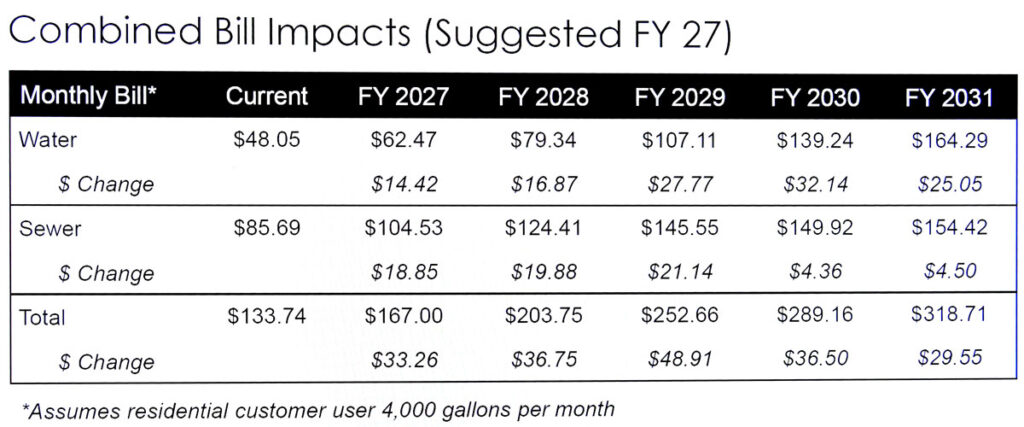
Hyder said the firm aims for a minimum reserve equivalent to nine months, or approximately 75% of a 12-month target. He added that usage assumptions are also factored into the model, with typical residential consumption estimated at 8,000 gallons per two-month billing cycle, or about 4,000 gallons per month.
Hyder said the analysis assumes that meals tax contributions from the General Fund will end after FY27. “So that is included in the FY27 budget,” he said.
Based on historical trends, Hyder said Stantec projects a continued decline in water usage of about 1% per year. “We’re still assuming you are continuing to see the reduction in use going forward,” he said, adding, “Customers are using less and less water.”
For future capital investments in the system, Hyder said the town would need to rely on borrowing. He noted that projections assume 30-year loans at an interest rate of 5%.
“Rate increases gets you additional revenues given your current rates and demand on the system,” Hyder said. He explained that a 1% increase in water rates would generate approximately $25,000 annually, while a 1% increase in sewer rates would generate about $38,000 per year.
Hyder added that one of the primary drivers in the financial planning process each year is the scale of planned capital projects.
Hyder said the town’s long-term planning is driven in large part by its capital improvement needs. “We are looking at a Fiscal Year 27–37 capital improvement plan that the town has identified necessary and essential CIP for the water system of $65 million, and on the sewer side—it’s $13 million,” he said.
“Given the condition of the utilities, we are anticipating that borrowing is going to be necessary for each of these capital projects.”
Hyder said rising costs are also a factor in the town’s rate considerations. “We are seeing a doubling of the cost to operate the water system,” he said.
Comparing Purcellville’s proposed rates to nearby localities, Hyder noted that for a customer using 4,000 gallons per month, “you would be right in line with Middleburg” under the suggested combined water and sewer rates.
Mayor Chris Bertaut asked Hyder to compare the capital improvement project forecasts used in FY25, FY26, and FY27 and how they differed. Hyder said he did not have that information available.
Liz Krens said she would need to research those figures. She added that capital improvement costs are increasing each year as the town identifies new projects.
Krens also noted that the town’s fiscal policy sets a reserve balance target at 100%, while the Stantec models assume a 75% reserve level.
Krens said the town has consulted with Davenport & Company, its financial advisor, regarding reserve targets. She said the town would prefer to maintain its 100% reserve policy, “with the understanding that we are probably going to dip below that for a period of time while we increase the rates—while we get our revenues to the point where you have a self-sustaining system.”
Council Member Erin Rayner said the town’s current situation reflects years of underpricing utility rates. “We have been undercharging for years and not doing the right thing for 10 years. We have not raised rates appropriately and this is what we have now,” she said. “So every bill our citizens get—yes, they are very high. We are complaining, but we are undercharging by almost $20 under our operating costs.”
Council Member Kevin Wright said the rates are not terrible “especially when you look at the other towns.” He added, “I hate to say it, but the sooner we start collecting what we are supposed to be collecting—the better off we’re going to be.”
CIPs and their associated costs are inherently subject to change. Long-term municipal estimates— particularly over a 10-year horizon—are not fixed and may evolve due to shifting community needs, regulatory changes, and advancements in technology that could reduce future costs.
The estimates for capital improvement projects do not factor in potential grant funding and are instead based on loan financing.

Comments
Any name-calling and profanity will be taken off. The webmaster reserves the right to remove any offensive posts.