

The public and Board members testify on Greenway toll increases
By Reed Carver
The owners of the Dulles Greenway (Toll Roads Investors Partnership II, or “T.R.I.P.”) have requested of the SCC to raise the rate of tolls from $5.80 to $8.10 during rush hours, and up from $5.25 to $6.40 during other hours. The rush hour change would be one of 40%. The off-hour change would be a 22% difference. These are the rates for 2-axled vehicles. The company also asked that “the Commission specifically authorize a streamlined process to consider and to approve future increases under § 56-542 D to reduce the lag between increases in the tolls on the Dulles Greenway,” according to the SCC’s Order for Notice and Hearing.
The Order summarized the company justification for the increase: “the proposed tolls are the minimum necessary to permit TRIP II to meet its financial obligations and to reach a point in the future where it will be able to earn a reasonable return on the capital invested in the Dulles Greenway.”
The question of raising rates requires an interpretation of law, because a Virginia code, (§ 56-542 D) requires that Greenway toll rates do not “materially discourage” use of the road, according to a Loudoun press release.
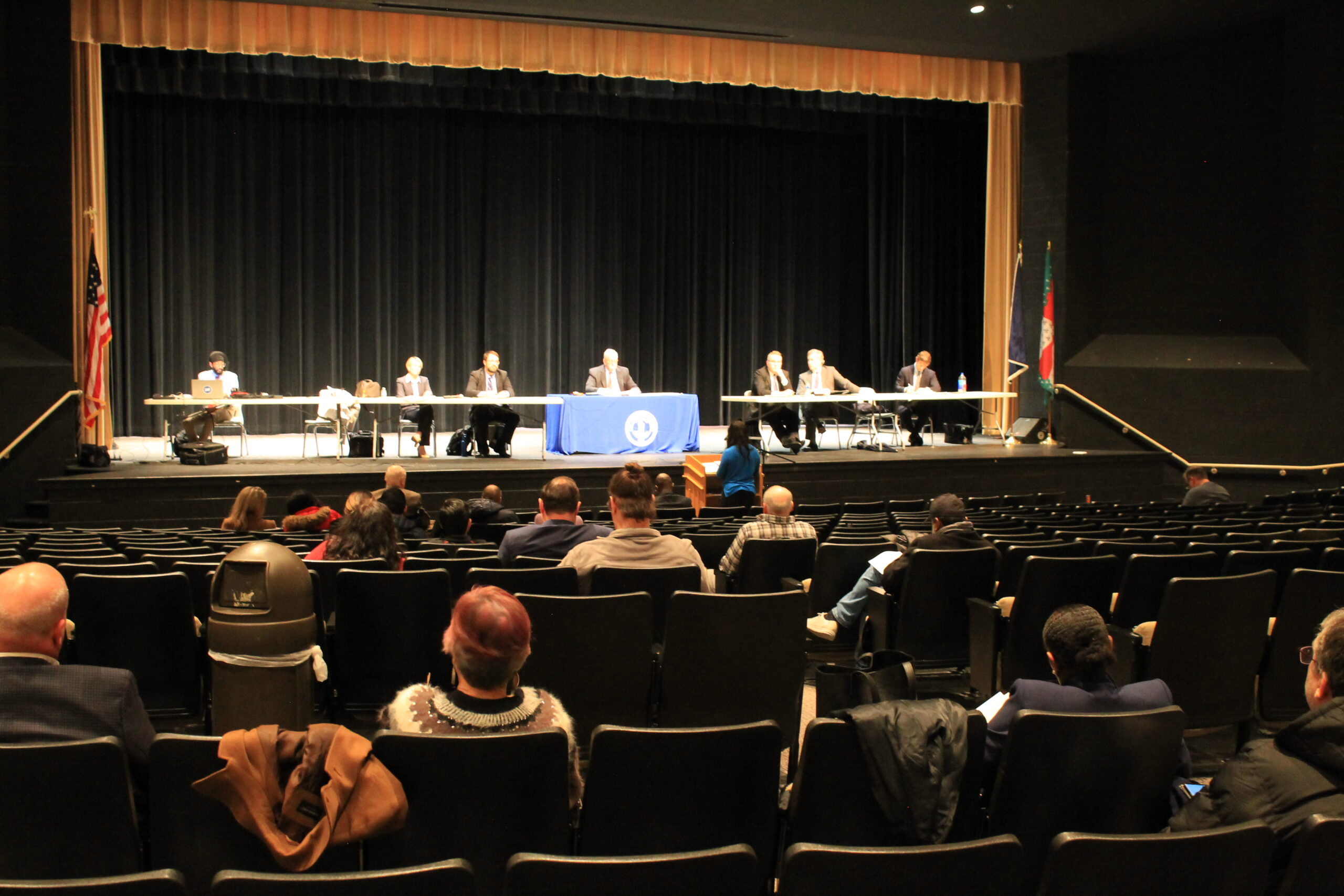
A hearing took place on Jan. 9, that the State Corporation Commission hosted to receive public testimonies. It was in the Freedom-South Riding High School auditorium, 25450 Riding Center Drive, in Chantilly, Virginia. Heavy rain pounded on the roof of the school theater as the meeting began during a record rainstorm.
State Senator Suhas Subramanyam (D-32) spoke first, saying that some will be forced to choose between avoiding the Greenway, leading to less time with their families, and paying the hundreds of dollars per month in tolls.
The Office of the County Administrator, in a press release, said “Loudoun County continues to oppose toll rate increases.” Several members of the Board re-enforced their opposition at the meeting.
“Income is not the same as wealth,” Chair Phyllis J. Randall (D-At Large) said, pointing out that for many in Loudoun, money is tight and avoiding the Greenway would be roughly equal to two house payments a year. She thought that the company’s plans, if carried out, would only damage themselves more.
Koran T. Saines (D-Sterling) brought statements from the public testifying that higher rates would drive them away.
Matthew F. Letourneau, (R-Dulles) said that the company is still in serious debt due to a bad business model, and higher prices would bring “tumbleweeds on this road instead of cars.”
Ridership is already down, said Caleb A. Kershner, (R-Catoctin) and if the tolls increase, more traffic will clog county roads and stress its’ infrastructure.
Laura A. TeKrony, (D-Little River) said that she has data from 15,000 people from her campaign work who all say they avoid the toll road as it is.
Juli E. Briskman, (D-Algonkian) added that there are hidden costs that follow more volume on county roads, like a lower quality of life which impacts health. Loudoun treasurer Henry Eickelberg made the point that rate increases will landlock nearby homes, decreasing their value.
According to the Loudoun press release, use of the Greenway is already down. Trip II statements in the application agree. Mike Clancy suggested lowering the tolls to 2 dollars, which would increase traffic for the company.
Mitchell Turner observed that overpasses built on county roads cost billions, and they were built to deal with the greater volume of traffic, in part caused by high prices on the toll road. Those public works in turn cost the residents more via taxes.
Fred and Jill Ferares said they only take the road for approximately one mile, so it doesn’t make sense to apply a flat rate. “I haven’t used the Greenway in over 14 years, said Karen Olsen. It’s not worth it to her as a working class person, she added. “I make it a point not to use the Greenway,” said Mary Ellis, a 9-year resident. “It’s prohibitive,” she said, referring to the cost.
Richard Johanson said that though he could afford to use the Greenway, “It would be an irresponsible use of my money.” He supported distance-based tolling, but for now, “I avoid the Greenway like the plague,” he said. “It’s a barrier not a bridge,” said John Hancock, “it’s unaffordable.”
Todd Rogers said the transfer of traffic from toll to public roads was passing private debt along to citizens who pay for the public roads. He also pointed out that this increase has bi-partisan opposition in a polarized age.
Danny O’Brian said it would have cost him $3,300 to $3,400 if he took the toll road to take his daughter to ballet. He also questioned how, if the road was built for $350 million, the Company was over $1 billion in debt. “If it [the toll] was slightly less than it is now, I would be a regular user,” he said.
Anthony Russo said not using the toll road would amount to paying for two to three dinners a week, so the significant costs of the toll road were clear to him. Several others called the management of the Company into question, since it had accrued so much debt.
Distance-based tolling was repeatedly discussed, combined with lowering toll rates. Russo, in his comments, pointed out that it has been an option for ten years, yet the company still has not adopted it. Micheal Thomas, who is hearing the case said that the company has cited a lack of technology as an inhibitor, but that he will advocate for distance based tolling in his evidentiary hearing with them.
The Company,Trip II sent their application to raise tolls on July 11, 2023. In their application, the company argued that since, “projected growth factors” like population and employment will continue in 2024, the toll increase would not cause a tangible drop in annual traffic.
They also made arguments that the Greenway is faster, safer, more reliable, and stresses vehicles less.
They said that, “Over the past few years, TRIP II has invested more than $20 million in significant improvements to the east and west ends of the Greenway to improve the flow and safety of traffic from the Greenway to the Dulles Toll Road, Leesburg local roads, and to the Leesburg Bypass.”
The Greenway’s completion was on Sep. 29, 1995. By that point it had cost $315 million to build. The CEO of Trip II explained that the company’s problems with debt began when the road’s use did not meet expectations in the nineties. They restructured their debt multiple times, but by Dec. 2022 they had a debt of $1.121 billion.
They explained that most of the debt is in the form of zero-coupon bonds which do not pay interest to the holders upon purchase, but instead, interest accrues until the bonds reach maturity. The debt was structured this way to match the projected growth in both tolls and traffic. So, the Company is under pressure from bond holders and bond insurers to increase toll revenue, in order to eventually reward their investment.
Operating costs, taxes on land, as well as the improvements to public routes have also damaged Trip II’s revenue because traffic is diverted by the increased quality of other routes. The company stated their motivation in the application. “[To] meet our debt obligations and that will eventually allow us an opportunity to earn a reasonable return,” concluded Renee Hamilton, the CEO.
The SCC is considering the application.
Continue reading in this news section
Comments
Any name-calling and profanity will be taken off. The webmaster reserves the right to remove any offensive posts.