



CHIPS Summit examines Virginia’s semiconductor industry goals
By Tabitha Reeves
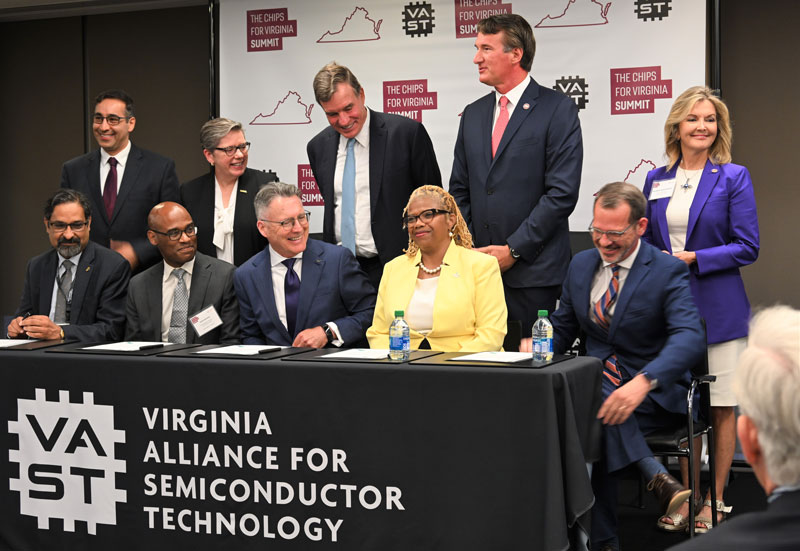
Though differing in political affiliation and economic ideology, state politicians, semiconductor
experts and higher education professionals gathered on July 18 at Northrop Grumman
headquarters in Falls Church to attend the CHIPS for Virginia Summit. There, they expressed
their support for the Commonwealth of Virginia to become a leader in the semiconductor
industry.
From cell phones and rice cookers to solar panels and military-grade weapons, semiconductor
chips are widely used as the physically-small components that enable crucial technologies to
function.






Since the technology is greatly necessary and ever-evolving, the semiconductor industry is
predicted to become a trillion dollar industry by 2030, and countries continue to race for
influence via chip research, development, manufacturing and distribution.
“In my opinion, there’s an opportunity for the Commonwealth [of Virginia] to really assert itself
and become home to more than its fair share of the [semiconductor] industry’s ecosystem,”
Kevin Crofton, speaker at the conference with over 30 years of professional experience in the
field, said.
Given Virginia’s natural resources, healthy economy, well-ranked higher education institutions
and willing government, the state has the capacity to “set the international standard for what the
semiconductor industry can be and will be,” according to Virginia Gov. Glenn Youngkin (R),
who also spoke at the summit.
“[The United States is] engaged in an economic challenge of our lifetime, particularly vis-à-vis
the People’s Republic of China,” Virginia Sen. Mark Warner (D) said. “National security is
really about who is going to maintain technology dominance.”
Warner said that in the 1990s, the U.S. produced 37% of chips annually, dominating the industry.
Now, the U.S. has been surpassed by Taiwan, South Korea and Japan, producing only 12%.
The speakers were in agreement that a competent and educated workforce is vital to growing the
chip industry both in Virginia and nationally.
On July 25, the Semiconductor Industry Association and Oxford Economics published a a study
that estimated the U.S. will be short roughly 67,000 workers by 2030.
The study concludes that to have enough semiconductor technicians, engineers, and computer
scientists, the country needs more people to obtain degrees in those fields. Otherwise, the U.S.
will not be able to expand the technology sector as much as it plans to and risks losing the
semiconductor chip race to international adversaries.
The Virginia Alliance for Semiconductor Technology, or VAST, intends to strengthen the talent
pipeline from education to corporation, as explained by the organization’s founder, Masoud
Agah, at the conference.
It will do so by producing “over 50,000 hours of hands-on semiconductor … training, 5,000
STEM degrees and 500 semiconductor fast-track workforce certifications,” according to the
organization’s own goals.
“It has been my sincere belief that we can create transformational impacts and changes … when
we join our creative minds, when we exchange our expertise and when we share our advanced
infrastructures for [research and development] and workforce development,” Agah said. “None
of us can do it alone.”
VAST facilitates collaboration between leading technology corporations, such as Northrop
Grumman, Boeing and Amazon, as well as various Virginia education institutions, including
Virginia Tech, the University of Virginia and George Mason University.
“[We are] all here recognizing that the academic collaboration, when it comes together in
partnership, accelerates,” Youngkin said. “This will feed the ecosystem with research and
capabilities that allow us to take giant steps, not small ones.”
Not only does a larger degree-holding workforce benefit the domestic chip industry as a whole,
but the necessary education occurring at Virginia’s universities and colleges benefits the state’s
economic well being, explained Crofton. He reasoned that states with better technology
programs tend to incentivize semiconductor companies to move nearby, as has happened on the
West Coast.
“This country is investing in the semiconductor industry to rebuild our preeminence,” Kathy
Warden, Northrop Grumman president and CEO, said. “And it is an exciting time to think of the
role that the Commonwealth can play in that industry.
Excitement around Virginia as the ideal location to increase U.S. influence in the semiconductor
industry followed Congress’s passage of the federal CHIPS and Science Act, introduced by
Warner and passed last August.
The bipartisan act approved an investment of $280 billion to strengthen the nation’s capacity for
chip research, development, production and employment. Ultimately, it was passed to boost the
U.S.’s ability to compete and innovate alongside foreign nations.
Virginia Tech president Timothy Sands said that the state has recently been growing upward in
its economic health and technological influence, as demonstrated by Amazon’s headquarters
moving to Virginia just this year and the presence of organizations such as VAST.
“We are someplace that other states aspire to be,” Youngkin said.
According to Younkin, when ranked amongst the 50 states, Virginia places No. 1 in education,
workforce development and site selection, as well as No. 4 in access to capital, top five in job
growth and No. 10 in infrastructure. Though impressive already, he expressed his desire to
achieve first place overall.
“As we ascend, we are witnessing momentum build in such a tangible way,” Younkin said. “We
watch our job numbers, we watch companies move, we watch graduating classes, credentials
offered through our community college system, high schools adapting to the next generation of
education. We’re watching it happen in real time, and those puzzle pieces come together and
form the future.”
Comments
Any name-calling and profanity will be taken off. The webmaster reserves the right to remove any offensive posts.