



Loudoun’s data centers: What citizens need to know
By Robert A. Pollard
As they proliferate across our county, it’s worth asking if data centers are truly manna from heaven—or is Loudoun living its own version of The Little Shop of Horrors? In the 1986 movie, a little plant mutates into a carnivorous monster shouting “Feed me!” as it thirsts for more and more sacrificial blood. Likewise, the first few data centers in Loudoun appeared harmless when they popped up some 15 years ago, but now there are well over 100 countywide—each silently chanting “Feed me, feed me!” ever more electric power, land, and labor.
To be sure, Loudoun’s data centers have an upside—surging tax revenues, good jobs, a vibrant high-tech infrastructure. They are politically popular, too, as they use up less land and services than housing while helping to lower real estate taxes.
But there are costs to this “free lunch.” Data centers are energy hogs, burning the equivalent of small cities. Their expected doubling requires construction of massive new electric pylons and substations. With their size, noise, and proximity to residential areas, they threaten many citizens’ quality of life.
Meanwhile, data centers crowd out local business by sharply raising the price of land, labor, and other resources. Overdependence on a single industry for revenues and growth is also risky; a downturn could saddle residents with higher taxes, cutbacks in services, and layoffs.
The question is, how many data centers are too many, and how can we offset their ill effects?
–––––––––––––––––––––––––
Dominion is racing ahead with building the needed infrastructure, but that means new pylons and substations on an industrial scale. At 135-150 feet high, the new towers will absorb an enormous swath of land 150-225 feet wide from side to side, helping tear up what little remains of eastern Loudoun’s once bucolic landscape.
The shocking announcement by Dominion Energy in September 2022 that it could not fulfill the energy needs of Northern Virginia’s new data centers raised alarms about the industry’s future, notably whether the power gap might erode investment in this vital sector.
Welcome to the local grid
Dominion is racing ahead with building the needed infrastructure, but that means new pylons and substations on an industrial scale. At 135-150 feet high, the new towers will absorb an enormous swath of land 150-225 feet wide from side to side, helping tear up what little remains of eastern Loudoun’s once bucolic landscape.
Dominion plans to build two main corridors. The Wishing Star-Mars corridor, which Virginia’s State Corporation Commission (SCC) recently approved, will stretch for 3.55 miles from the Dulles airport area to Ashburn, costing $715 million. A second major corridor, Aspen to Golden (see Fig. 1), twice as long and expensive ($1.5 billion), will connect Data Center Alley to Dominion’s 500-kilovolt trunkline. Though some oppose Dominion’s preferred pathway along Route 7, the Board of Supervisors lacks legal or regulatory power to block it if the SCC decides this is the best alternative.
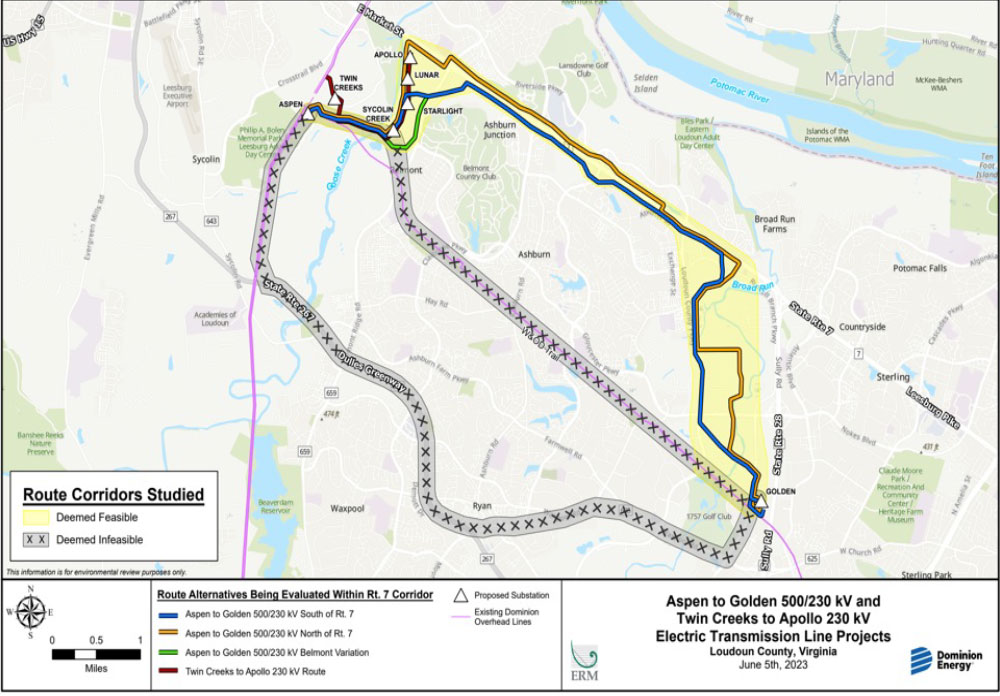
Those two projects, costing $2.2 billion, are just the beginning; even more corridors are in prospect as data centers multiply.
Why not hide the unsightly power lines by sinking them underground? Engineers claim that would cost 7 to 10 times as much and disturb more natural resources than towers. So why can’t Dominion make data centers foot the bill? Because that’s the law: it must provide the power its clients demand and then pass the costs on to all Dominion customers, no matter where they live, via higher electric bills.
Good neighbors?
As the county has aggressively rezoned property to accommodate data centers, new ones are springing up in backyards of suburban neighborhoods. Homeowners complain of a continuous droning noise—like a lawnmower or a helicopter—up to a mile away. With Loudoun’s meager setback of 100 feet, the tall buildings sometimes block the skyline (see Fig. 2).
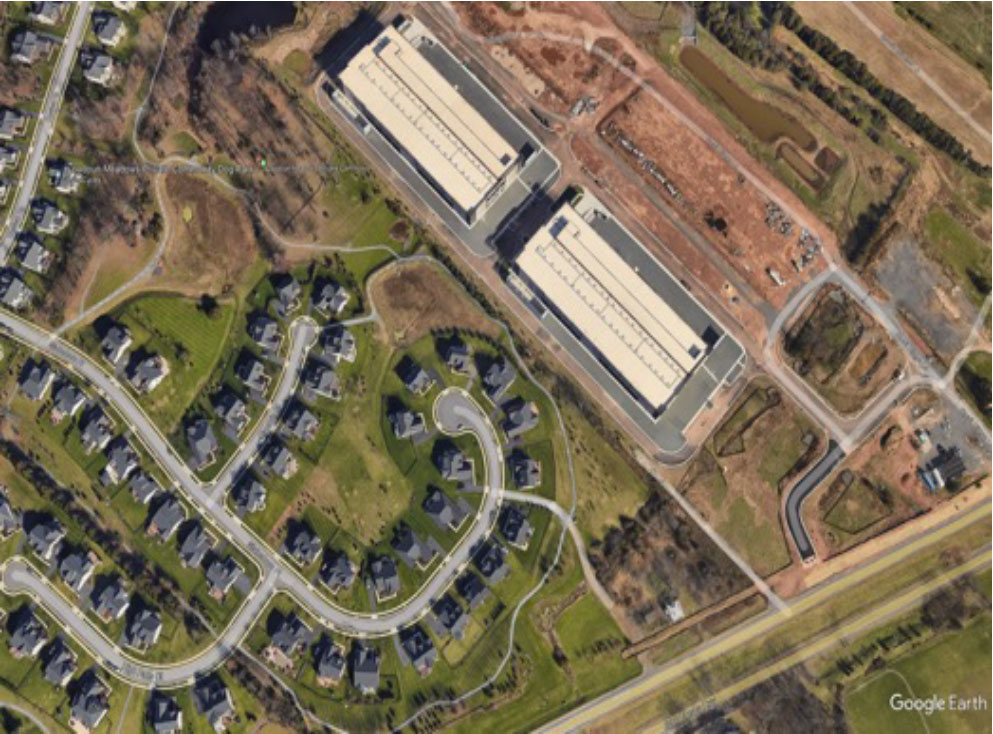
Citizens groups are lobbying to change Loudoun’s zoning rules.[1] Top priorities are wider setbacks and measures to reduce noise, cut energy and water use, and improve building design. They want industry to set voluntary best practices, but so far there has been no progress.
Energy and environmental concerns
While looking like bland warehouses on the outside, data centers are more like steel or cement mills in the vast quantities of energy they consume—about 30 megawatts for each of the 100+ existing ones, and 60-100+ megawatts for newer ones.[2]
To feed them, Dominion must find an extra 3.5 gigawatts.[3] The first wave of data centers in Northern Virginia (80 percent in Loudoun) required power equivalent to 400,000 residences—2.8 times more than in Loudoun. The next wave from 2023–2028 may require even more electricity. Add rising usage by other consumers, and where will all the electricity come from?
Data centers’ needs alone far outstrip what Dominion can generate from renewable energy sources by 2028. It may buy “green” energy from independent solar or wind producers, but those facilities take time and capital to build.[4] Local renewables won’t help much; even the immense solar arrays proposed around Dulles airport would only take care of two large facilities. Going off the grid is not an option, in other words.
Much of Dominion’s power comes from “clean” nuclear plants, but since new ones take years to plan and build, naturalgas andthe grid must fill the gap.[5] Locally, the $2 billion Panda Stonewall plant on 101 acres outside Leesburg (see Fig. 3) generates up to 778 megawatts, but then it, too, does so by pumping in and burning tons of gas.
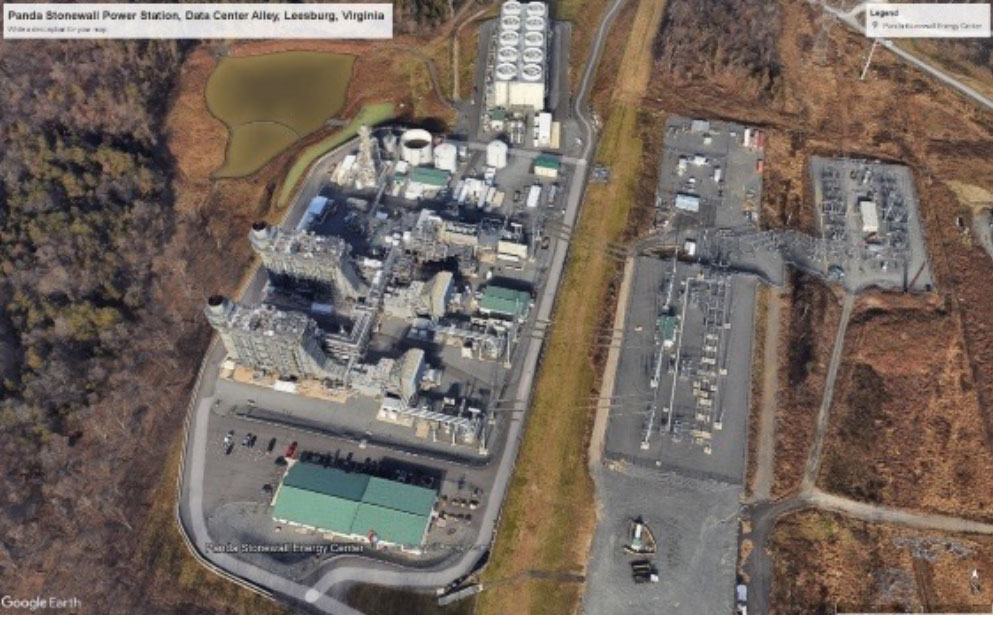
Loudoun’s “smokestack” industry
In short, Loudoun is importing massive quantities of energy and exporting a huge quantity of emissions to neighboring states and the planet as a whole. In this sense, Loudoun is no “cleaner” than many industrial localities.[6] For those who don’t take climate change seriously—or who argue “data centers have to go somewhere, so why not here?”—this may not matter. But it certainly should concern citizens worried about our carbon footprint and its impact on posterity.
The budget and financial risk
In addition to the energy shortfall, Dominion’s news set off alarms about the county budget. Slower data center growth could mean fewer tax receipts, forcing cuts. The episode also highlighted our mounting addiction to data centers for tax revenues—already over one-third of the total and certain to grow as the facilities double in number (see Fig. 4).[7]
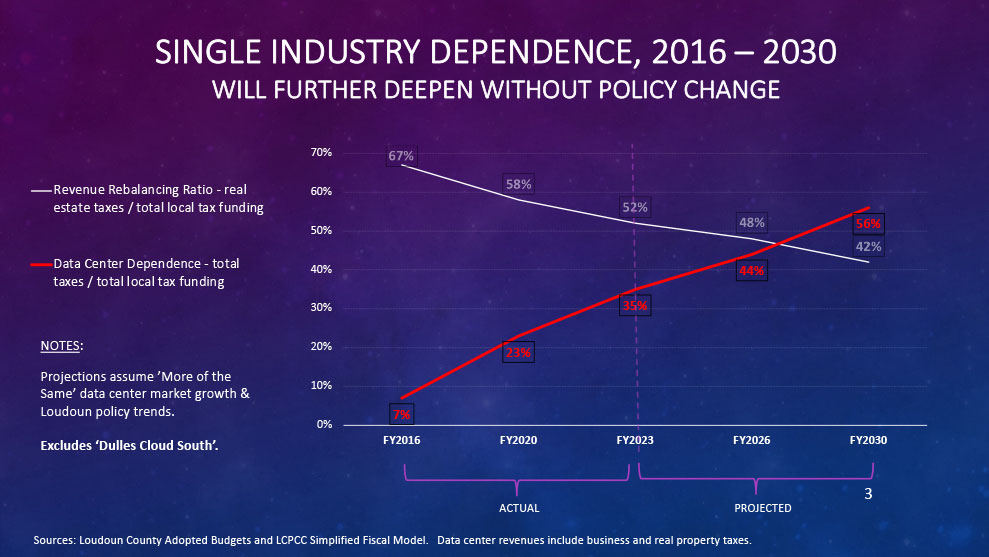
population growth. Then communities are suddenly stuck with a pile of liabilities, making it hard just to maintain current services.[8]
A bust in Loudoun is unlikely in the near term. So long as “latency” (speed of transmissions over the internet) plays a critical role in their location, data centers should thrive in Northern Virginia. Yet technology is rapidly changing, and the county should take steps to protect against a downturn.
How many data centers are too many?
In retrospect, we may wish the county had situated data centers far away from residential areas, but clearly, they are here to stay. The local Data Center Coalition contends the status quo benefits everyone by fattening the county’s coffers and generating a lot of jobs.[9] With time, moreover, the industry is expected to boost efficiency, if nothing else to cut its utility bills.
Yet how many more are desirable? They have raised the price of everything from real estate to haircuts while squeezing out local business. Their carbon footprint is immense. Dependency on data centers poses financial risk.
What can be done?
Options today are limited since planners failed to anticipate the industry’s enormous growth. Still, the following are worth pursuing:
- Approve no data centers that require rezoning of land that is out of compliance with the Loudoun 2019 Comprehensive Plan. Don’t convert properties to data center use, don’t permit special exceptions for larger buildings, and don’t allow them in the west.
- Set performance standards (in zoning and other regulations) that increase setbacks from residential areas, limit noise and light pollution, and cut energy and water use.
- In cooperation with Dominion Power, develop land use corridors to reduce the impact of future high voltage towers, power lines, and substations.
- Reduce dependency on data centers revenues and insure against a downturn by curtailing spending, tilting the balance back toward real estate taxes, and diverting surplus funds into a “rainy day” reserve fund.
These modest objectives could mitigate the ill effects of data centers without driving industry out of the county. Given all the benefits that data centers derive from their location here, it is not unreasonable for Loudoun’s citizens to ask for constraints on their unbridled growth.
Too often, we hear the refrain, “There’s nothing you can do.” Let’s hope that’s not the case because it would mean Loudoun has no control over its own future—surely, an unacceptable legacy for succeeding generations.
––––––––––––––––––––––––––––––
Robert A. Pollard is a former Senior Foreign Service Officer with extensive international experience in trade and macro-economic analysis, counterterrorism, and nonproliferation. He currently serves as chairman of the Loudoun County Heritage Commission. The opinions expressed in this article are entirely his own.
[1] E.g., see Data Center Working Group to the Loudoun County Planning Commission, March 15, 2023, at Data Center Use Standards – Loudoun County Preservation and Conservation Coalition (loudouncoalition.org)
[2] The advent of artificial intelligence (AI) is expected to dramatically increase the energy intensity of data centers.
[3] This report focuses on Dominion since it is the pivotal player in Loudoun and Virginia as a whole. PJM, the regional grid coordinator, radically raised its “load forecast” for Dominion last year, saying it will more than double between 2023 and 2040. Data centers are a major factor in the revision.
[4] In 2022, Virginia stood in the middle of the pack in generating renewable energy—just 4.74 Gigawatt-hours, compared with 136 GWh by Texas, the leader. Although some offshore windmills are being built, solar is the most viable source of green energy in Virginia.
[5] Natural gas usage releases 40-50 percent less greenhouse gases than coal but emits a lot of NOx, or nitrogen oxides, which contribute to respiratory disease.
[6] Data center owners contend they offset some emissions with projects around the country.
[7] See reports of the Budget and Finance Work Group: County Fiscal Vision – Loudoun County Preservation and Conservation Coalition (loudouncoalition.org) . The author serves on the Work Group.
[8] Volatility is a special problem. County planners had to scramble when the forecast for data center revenues in FY 2024-2026 dipped by several hundred million dollars. But as more power comes on line, revenues from data centers are expected to resume their relentless growth and, with it, county dependency on them.
[9] Job numbers are difficult to calculate, but estimates that data centers account for 40,000 jobs, or 10 percent of Loudoun’s entire population, may be inflated. Many are construction jobs that will disappear once data centers are fully built out. It also incorrectly assumes that there were few IT jobs in Loudoun before the boom, or that the number of such jobs would not have grown without the data centers. Few people actually work in the facilities. And insofar as they crowd out other potential employers in the county, the true net gain may be smaller still.

Comments
Any name-calling and profanity will be taken off. The webmaster reserves the right to remove any offensive posts.

When I first moved here to Loudoun County I was dismayed to see the huge, ugly, faceless edifices lining up both sides of Loudoun Cty Parkway. No attempt to set them back or require earth berms or landscaping, just blocking out any nature or beauty. Then I was told to appreciate them because they provide tax relief to residents. Now people waking up to the truth..they are costing much more by threatening our environment, making demands on our infrastructure and gobbling up land to expand and change this place for their own needs. Jobs? I have been inside one last year and there were two employees. They don’t require large staffs or provide employment. They are gobbling up our way of life and what beauty we have. Virginia is not for lovers…it is for greedy people who don’t care to preserve anything!
A thoughtful and comprehensive picture of the current situation and likely future developments. What concerns me is the possibility that years of large tax revenues from the server farms will lead Loudoun to run up large debts through bond issues. We should be careful about creating a debt load that may not be sustainable a decade or so down the road. There are also important environmental concerns. What makes economic sense may not make environmental sense unless we carefully monitor development.