

Beckwith, Subramanyam Find Common Ground—and Sharp Differences in Debate
By Valerie Cury
After nearly an hour of debating the pressures facing Northern Virginia—from data centers and power lines to housing costs, artificial intelligence and the changing workforce—the final question posed to the two candidates for Virginia’s 10th Congressional District was strikingly simple.
What did each admire about the other?
Republican challenger Dave Beckwith pointed to Democratic incumbent Rep. Suhas Subramanyam’s family and their immigrant story.
“I think his story, his parents’ story, the American dream they came here to achieve,” Beckwith said. “They came here for a better life, to make sure the kids had great education, could get a great salary, could buy a house, could have a great career, and raise a family.”

He called it “an amazing story” and said he wanted children throughout the 10th District to have the opportunity to build lives better than those of the generation before them.
Subramanyam responded by recognizing Beckwith’s three decades of service in the U.S. Air Force and his subsequent career at the Department of Defense.
“I have so much admiration for anyone who serves our country,” Subramanyam said. “I’m sure he could have done so many other things with his life, but he decided to serve his country.”
He connected Beckwith’s story to a district filled with federal employees, military veterans and others who have spent their careers in public service.
“Whether it’s Democrat or Republican, there’s just so many people in our community who do so many amazing things,” Subramanyam said.
It was a gracious conclusion to a debate in which the candidates often disagreed sharply about how government should respond to some of Loudoun County’s most difficult challenges.
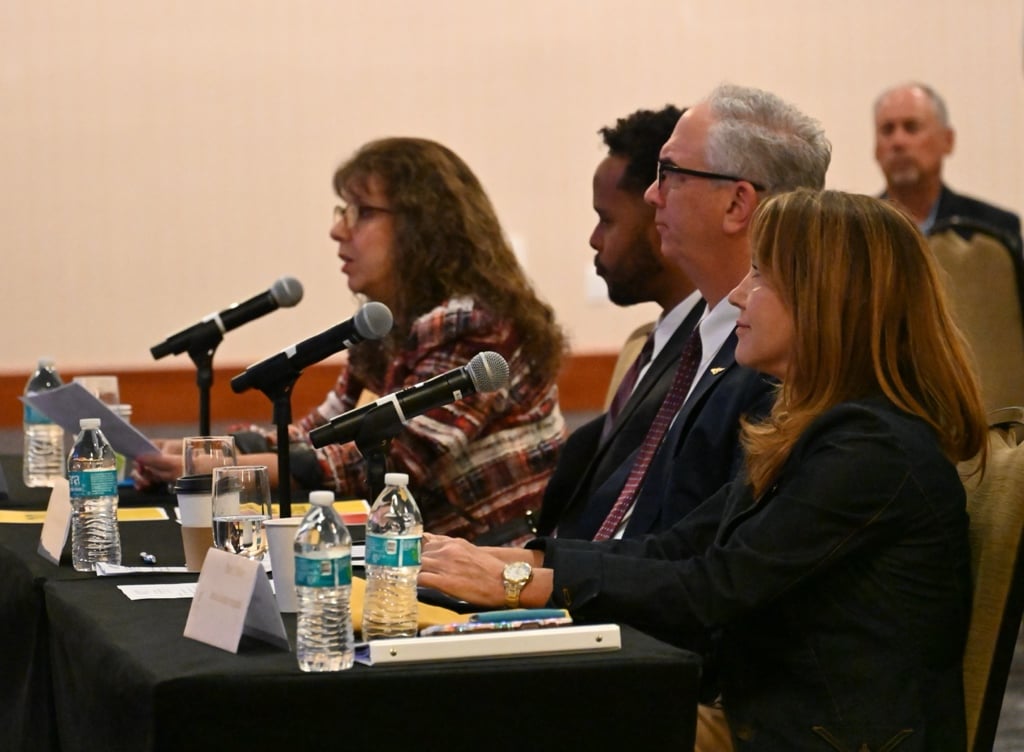
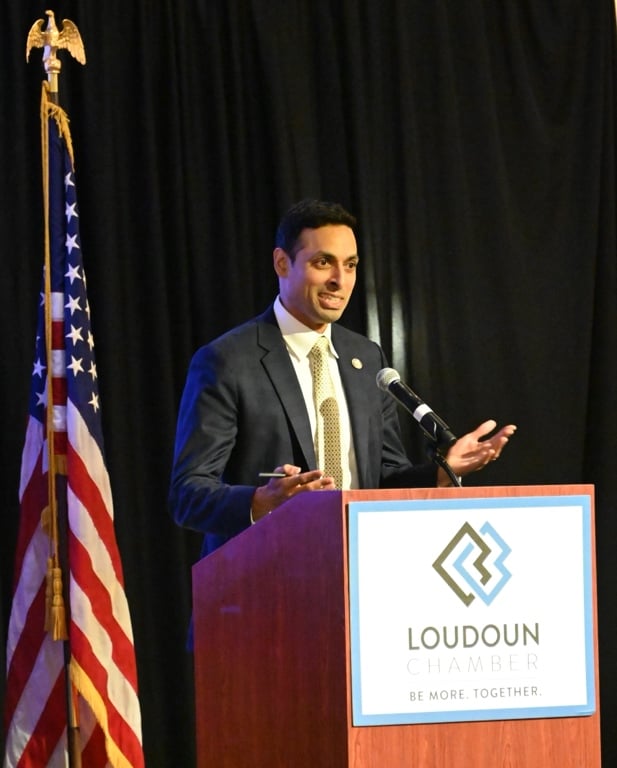
The Sept. 22 debate, hosted by the Loudoun Chamber of Commerce at the National Conference Center in Leesburg, brought Beckwith and Subramanyam together as early voting is underway for the Nov. 3 election. Subramanyam was elected to Congress in 2024 after serving in the Virginia Senate and House of Delegates. Beckwith is a retired Air Force colonel who served for 30 years and later as a deputy assistant secretary of defense.
Data centers—and the communities living beside them
Some of the most distinctly Loudoun issues emerged when the candidates were asked about data centers, the enormous power demand accompanying them and the transmission infrastructure needed to serve that demand.
Subramanyam said he recently introduced legislation calling for a national plan for data center development.
“We shouldn’t be building all the data centers in Loudoun County at this point,” he said, adding that future facilities should be located where the electric grid can accommodate them and that residents should not see their utility bills rise dramatically to pay for the infrastructure they require.
Beckwith focused on residents already living with the consequences of development close to their homes.
“I’ve been out to see these neighborhoods where data centers have been put right behind their fences, and you hear that low hum of the fans. That’s 24/7,” he said.
He called for federal setback standards to prevent data centers from being built immediately adjacent to homes and proposed tax relief for residents living within two miles of a data center to help address impacts to their properties.
The candidates also addressed another issue increasingly familiar to Loudoun residents: transmission lines.
Beckwith said that Virginia needs more power generation closer to where electricity is consumed, saying additional in-state generation could reduce dependence on electricity imported from outside Virginia and the need for new long-distance transmission infrastructure. He specifically cited opposition to proposed transmission lines affecting western Loudoun and Loudoun Valley Estates.
Subramanyam said permitting reform should eliminate unnecessary and duplicative regulations, but cautioned against using faster permitting to override communities affected by major infrastructure.
“What I do not like is that permitting reform sometimes has been a way of basically steamrolling communities,” he said.
The American dream—and its price tag
Housing affordability brought the debate back to something both candidates described in personal terms—whether younger generations can still afford the life their parents expected for them.
Beckwith spoke about his own children struggling to buy homes in a market where a single property could attract dozens of bids. He proposed allowing homeowners with low-interest mortgages to take—or “port”—those mortgages to a new home, arguing that doing so could encourage people who feel locked into their current houses to sell and increase the number of homes on the market.
“That’s not the American dream. That’s not how we want people to have to live their lives,” he said.
Subramanyam pointed to housing legislation enacted this year that he said eliminated duplicative regulations and expanded the use of community block grants for housing. He also proposed a dedicated savings account to help first-time homebuyers accumulate money for a down payment and other costs.
“The average first-time home buyer now has gone from late 20s to early 40s,” Subramanyam said, arguing that housing affordability requires action at the federal, state and local levels.
The changing workforce produced one of the clearer areas of agreement.
“No longer can you work at the same company for 40 years and have the same job and same title. At this point now, we’re looking at a future of work that’s changing,” said Subramanyam.
Both candidates questioned the long-standing assumption that a four-year college degree should be the default path for every young person.
Subramanyam called for greater flexibility in using 529 education savings accounts for skills training and professional certifications as workers increasingly change careers during their lifetimes.
Beckwith emphasized apprenticeships, licensing and career and technical education, particularly in trades such as electrical and plumbing work where employers are struggling to find workers.
And on one idea, Beckwith explicitly agreed with his opponent: expanding the use of 529 accounts for trade schools and retraining.
Governing a technology that is moving faster than government
The candidates also agreed on the need for a federal role in regulating artificial intelligence, although they approached the issue differently.
Beckwith warned that a patchwork of state and local requirements could become difficult for businesses operating across jurisdictions. He supported federal standards intended to protect consumers while allowing the technology to continue developing.
Subramanyam pointed to his bipartisan Frontier Act, which he said would establish guardrails for advanced AI models and provide for independent verification of their safety. He also raised concerns about children’s growing exposure to AI and said parents need greater protections as the technology becomes embedded in everyday life.
For all their differences, the debate ended not with another disagreement, but with each candidate being asked to recognize something of value in the person standing at the other podium.
Beckwith returned to Subramanyam’s family and the American dream.
Subramanyam returned to Beckwith’s military service.
For a district shaped by immigration, military and federal service, extraordinary technological growth and the struggle to preserve quality of life amid that growth, their answers also reflected much of the community they are asking to represent.
Comments
Any name-calling and profanity will be taken off. The webmaster reserves the right to remove any offensive posts.