

Kaine’s Two Loudoun Visits Highlight Public Service
By Valerie Cury
Two days, two very different destinations and a common thread—the enduring importance of public service.
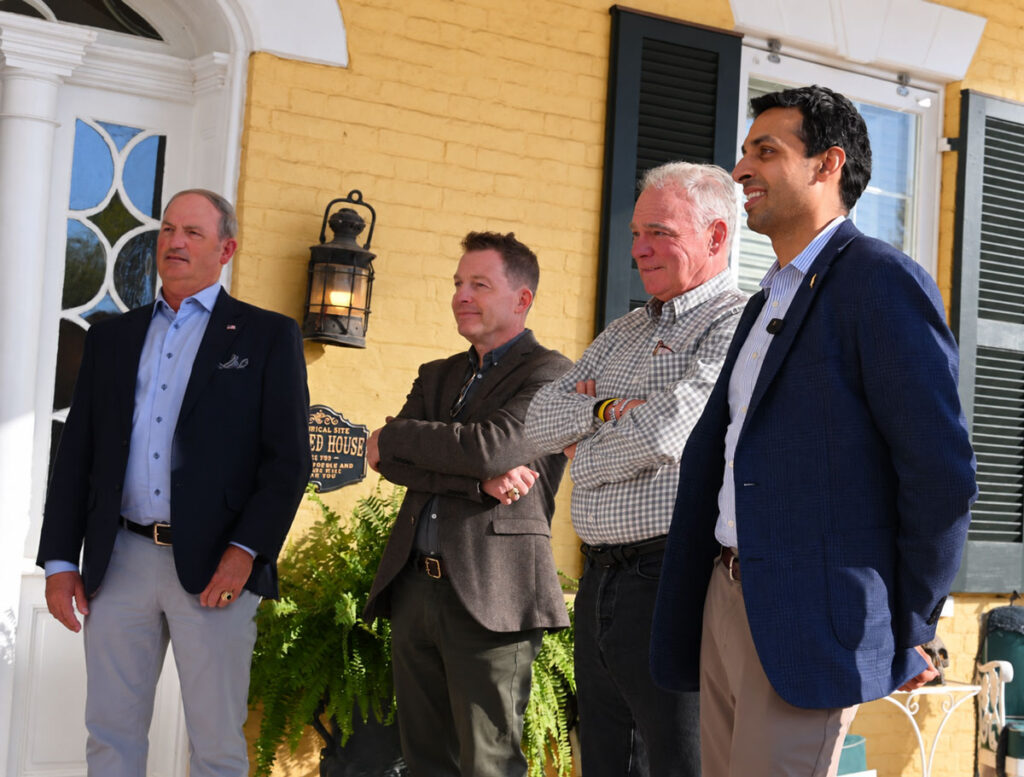
On Wednesday, Oct. 21, U.S. Sen. Tim Kaine (D-VA) visited Dodona Manor in Leesburg, the former home of Gen. George C. Marshall, to celebrate its new affiliation with the National Park Service and explore how that recognition could strengthen its preservation and educational mission.
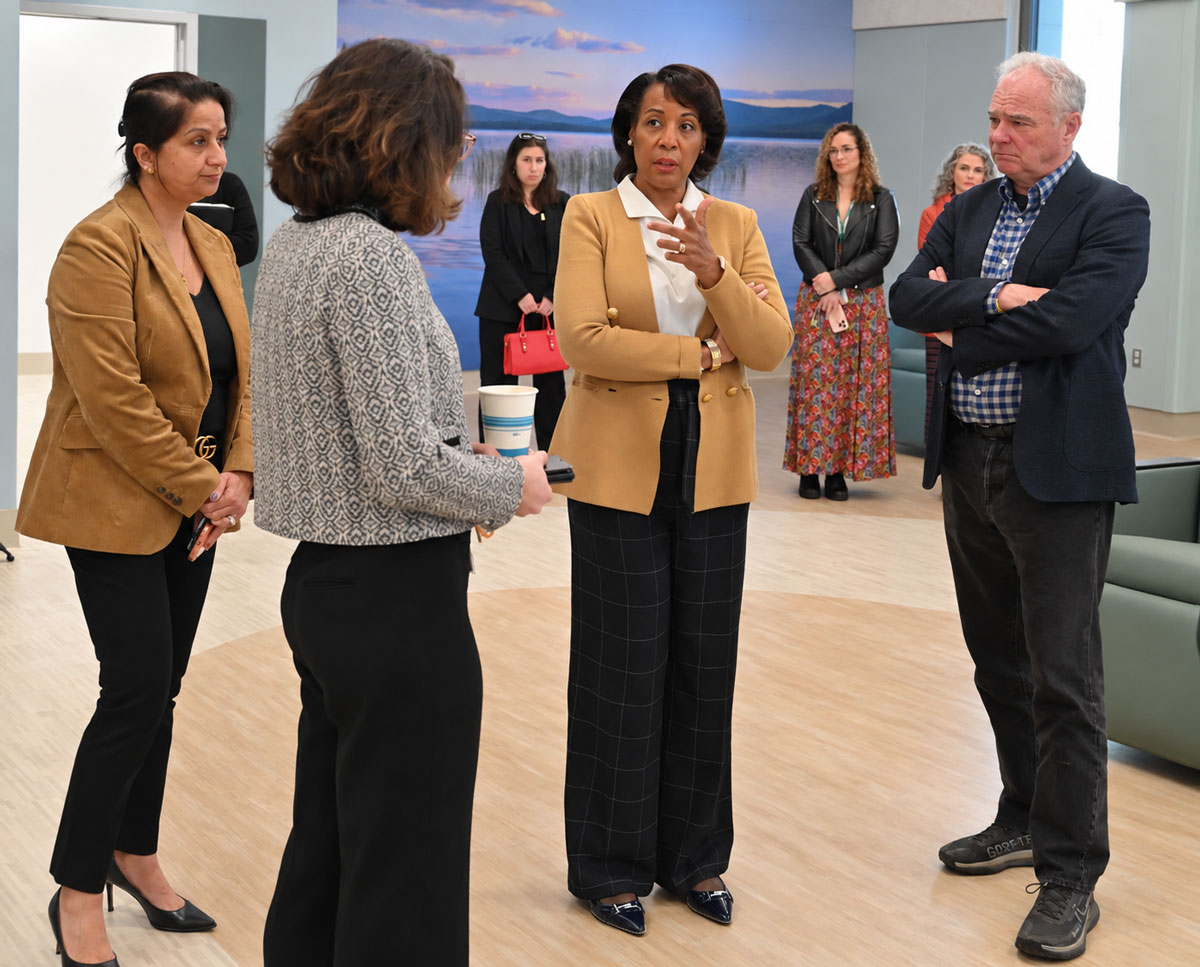
The following day, Kaine toured Loudoun County’s new $21 million Crisis Receiving and Stabilization Center, designed to provide immediate mental health and substance-use crisis care while easing the burden on hospital emergency rooms and law enforcement.
One visit looked back at a remarkable American life. The other looked ahead to a different way of caring for people in crisis.
At Dodona Manor, Kaine and U.S. Rep. Suhas Subramanyam (VA-10) joined leaders of the George C. Marshall International Center for a tour of the historic home and discussions about its future.
The National Park Service affiliation follows years of work by Virginia’s congressional delegation, beginning with efforts launched in 2019 by former Rep. Jennifer Wexton, Kaine and Sen. Mark Warner.
Subramanyam described the persistence required to secure the designation, recalling how he approached a House committee chairman directly and continued pressing for action on the legislation.
Although the designation has been secured, its practical benefits are still being explored.
“I don’t think I’ve worked on helping somebody become a National Park Service affiliate,” Kaine said. “So, like, exactly what does that mean? What does that give the Marshall House that it didn’t have already?”
Executive Director Valerie Beaudoin explained that the affiliation could provide access to National Park Service expertise in education, preservation and conservation, along with greater visibility through its website and promotional materials.
The designation could also introduce Dodona Manor to a much wider audience. Inclusion in National Park Service maps, publications and online resources may encourage visitors who might otherwise overlook the Leesburg landmark to discover the home of one of America’s most influential military and diplomatic leaders.
For the Marshall Center, that recognition represents an opportunity not only to preserve history but to bring Marshall’s extraordinary legacy to new generations.
During the visit, graduates of the Center’s ethical leadership program shared lessons they had drawn from Marshall’s life.
One recalled Marshall’s willingness to challenge Gen. John J. Pershing during World War I, even at considerable personal risk. Another spoke of Marshall’s concern for the soldiers under his command.
Kaine was especially interested in Marshall’s ability to lead while also recognizing when another person needed him to serve in a supporting role.
“Sometimes being a good leader means recognizing somebody else’s leadership and accepting that,” Kaine said.
The tour also revealed the more personal side of the celebrated general.
Visitors learned how Catherine Marshall discovered the Leesburg property and reportedly left a $10 deposit before her husband had even seen it. She also hid the for-sale sign in the bushes, hoping to prevent another buyer from discovering the house.
Much of the home’s furniture and personal belongings remain connected to the Marshalls, giving visitors an unusually intimate glimpse into their lives.
The stories included President Harry Truman’s visits, Marshall’s reluctance to seek recognition and his repeated willingness to interrupt retirement when his country called.
The following day, the setting was entirely different.
At Loudoun’s Crisis Receiving and Stabilization Center, the conversation turned from the lessons of history to the immediate needs of people facing mental health emergencies.
The facility, operated by Connections Health Solutions, was developed to offer an alternative to situations in which people experiencing psychiatric crises wait in emergency rooms or become involved with law enforcement because appropriate treatment is unavailable.
Kaine, who helped secure $4.1 million in federal funding for the project toured the center with Board of Supervisors Chair Phyllis Randall (D-At Large), and healthcare providers.
Following the tour, Kaine praised both the facility and the coordinated approach to treatment.
“I’m very impressed with this facility,” he said. “The county has put a lot of time into it. The design is impressive, and it’s going to be a real benefit to people who need services and their families.”
He emphasized that the benefits would extend beyond patients.
“So often because we don’t have the appropriate services for mental health, that burden gets put on law enforcement’s shoulders,” Kaine said. “It gets put on the shoulders of emergency room staff in hospitals.”
The new center is designed to change that.
Its three components include behavioral health urgent care, a crisis receiving area with 16 recliners and a crisis stabilization unit with 10 beds for people requiring additional short-term treatment.
The facility is intended to operate around the clock, serving adults from throughout Northern Virginia. Officials described Oct. 22 as a soft opening, with additional services awaiting state licensing.
Providers explained that approximately half of those entering the crisis receiving program are expected to stabilize sufficiently to leave within 24 hours, with referrals and plans for continued care.
Randall, a mental health therapist by profession, described how seemingly simple interventions can make an enormous difference.
She explained that people in crisis may have stopped eating, drinking enough water or taking prescribed medication. A safe place to rest, receive treatment and reconnect with support can help them begin thinking clearly again.
“Sometimes it’s just because when people get in a crisis, they don’t know what to do next,” Randall said.
Randall also emphasized the importance of providing treatment rather than allowing people experiencing mental health crises to become entangled in the criminal justice system. The center offers an opportunity to intervene earlier, connect people with appropriate care and reduce the burden on law enforcement.
The center’s design reflects that understanding. Natural light, calming colors and welcoming spaces were deliberately incorporated into the building.
One official described the light as the “first dose of medicine.”
Kaine highlighted the center’s location alongside other county services, describing the emerging behavioral health campus as an important advantage for individuals and families who may need several forms of assistance.
The need for such facilities intensified during the COVID-19 pandemic, which increased demand for behavioral health services while contributing to workforce shortages.
In comments following the tour, Kaine said the problem extends across Virginia, affecting urban, suburban and rural communities.
“Mental health need increasing, the provider pool not increasing fast enough,” he said, describing the challenge of expanding access to care.
Kaine, a member of the Senate Health, Education, Labor and Pensions Committee, said the experience reinforced the importance of expanding training opportunities and strengthening the behavioral health workforce.
He also discussed his bipartisan PEER Support Act, which would encourage states to reduce certain licensing barriers for qualified peer support specialists—people whose personal experiences with mental illness or substance-use recovery can help others facing similar struggles.
The legislation has not yet passed.
Kaine also expressed concern that federal Medicaid changes could make it more difficult for vulnerable individuals to maintain health coverage, potentially increasing demand for services at facilities such as Loudoun’s new center.
For Kaine, expanding access to treatment means recognizing that mental health emergencies deserve the same urgency as physical illness.
“Mental health crisis is just a health crisis,” he said.
The two visits illustrated very different dimensions of service.
At Dodona Manor, the challenge is preserving the legacy of a leader whose decisions shaped generations. At the crisis center, it is building a system capable of responding with skill, compassion and dignity when people need help most.
One preserves lessons from the past. The other puts the principles of service into practice today.
Comments
Any name-calling and profanity will be taken off. The webmaster reserves the right to remove any offensive posts.