

From “Golden Goose” to “Trojan Horse,” Subramanyam Unveils Data Center Plan
By Valerie Cury
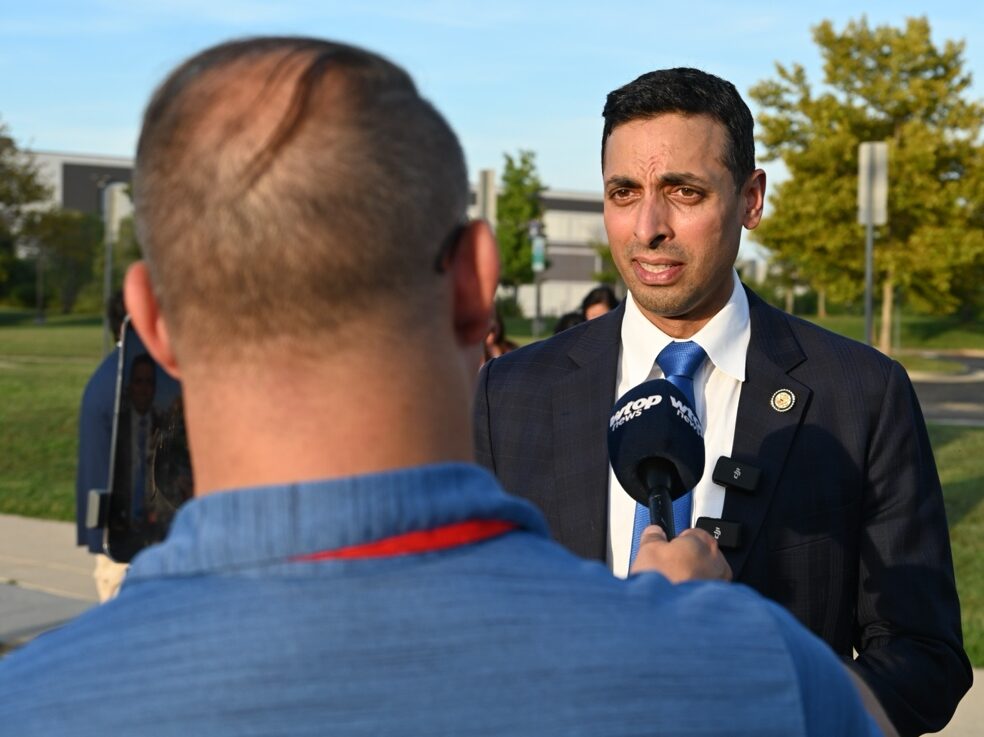
Standing in front of an elementary school in the heart of Data Center Alley, U.S. Rep. Suhas Subramanyam (D-VA-10) delivered a blunt message Tuesday—Loudoun has reached a tipping point.
The location of his Sept. 8 announcement was deliberate.
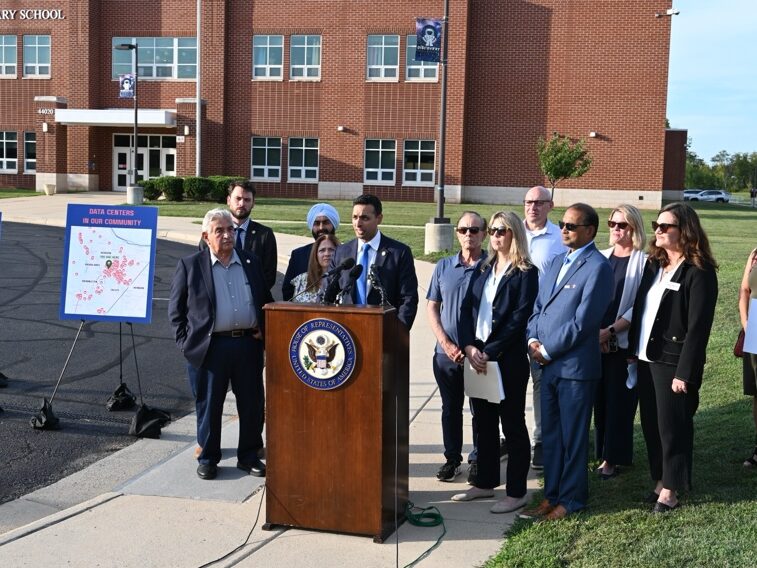
Behind Subramanyam was Discovery Elementary School in Ashburn. Around it are data centers and the power infrastructure needed to serve them—the physical consequences of an industry that has transformed Loudoun County.
“The epicenter of Data Center Alley behind me is not a data center, but actually a school,” Subramanyam said.
He said children can hear data center noise from the playground and described families increasingly frustrated by noise, transmission lines and the costs associated with supplying electricity to the rapidly growing industry.
“We are here today because enough is enough,” Subramanyam said. “We’ve had enough of seeing our utility bills skyrocket to build power infrastructure for data centers. We’ve had enough of seeing massive power lines run through homes, schools, and beautiful land.”
Among those attending were State Sen. Kannan Srinivasan (D-32), Del. JJ Singh (D-26), Del. Marty Martinez (D-29) and Del. John McAuliff (D-30), along with other state and local officials.
Also there were residents of Loudoun Valley Estates in Sterling who have become involved because of the real possibility of massive transmission lines running through their neighborhoods.
Loudoun Valley Estates resident Vicky Hu faces the prospect of a proposed 185-foot-tall transmission structure being constructed just yards from the home where she has lived for decades. Loudoun Valley Estates HOA President Victor Block also attended the announcement.
Then came perhaps Subramanyam’s sharpest description of an industry long promoted for the economic benefits and tax revenue it brings to Northern Virginia.
Subramanyam contrasted the idea of data centers as a “golden goose” with what he sees happening in communities that host them.
“I think they’re becoming a Trojan horse for our community,” he said.
Subramanyam used the approximately 20-minute event to outline his National Data Center Plan. Following the press conference, his office released additional details describing a four-bill legislative package addressing who pays for data center power infrastructure, where facilities are located, how their energy and water use is measured and the national security vulnerabilities created by the concentration of data centers and the infrastructure that powers them.
The most financially consequential proposal may be the Data Center Fair Share Act, which would require states to adopt large-load tariffs intended to make data centers and other major electricity users pay the full cost of grid and generation upgrades required to serve them. States that fail to adopt the tariffs could lose access to federal highway funds.
“Data centers pay for their power. We’ll start there,” Subramanyam told reporters.
His package also includes the Responsible Data Center Siting Act, directing the U.S. Department of Energy to establish best practices for siting data centers while considering electricity and water demands, environmental effects, noise, national security, workforce and tax revenue.
The Data Infrastructure Energy Measurement and Standards Act would establish technical standards for measuring data center energy and water use, while the Data Infrastructure Risk Reduction Act focuses on protecting data infrastructure and surrounding communities from security threats.
But Tuesday’s event was as much about what has already happened in Loudoun as what Congress might do next.
Little River District Supervisor Laura TeKrony said Loudoun is attempting to catch up after allowing data center growth without first establishing an electrical infrastructure plan.
“When I first took office in 2024, I realized we didn’t have an electrical infrastructure plan,” TeKrony said. “No plan to support the data centers, the substations, and the high voltage power lines that are required.”
TeKrony said she has not voted for a data center since taking office in 2024 and believes Loudoun is now “oversaturated.”
“Our community is feeling the quality-of-life impacts,” she said, pointing to complaints from residents about noise, power infrastructure, air quality and impacts to environmental and historic resources.
TeKrony also reiterated her support for reconsidering the County’s 2025 decision to grandfather certain pending data center applications under the previous approval process.
“Do we have to give a three-year grandfathering to billionaires? No,” she said. “We can end the grandfathering now.”
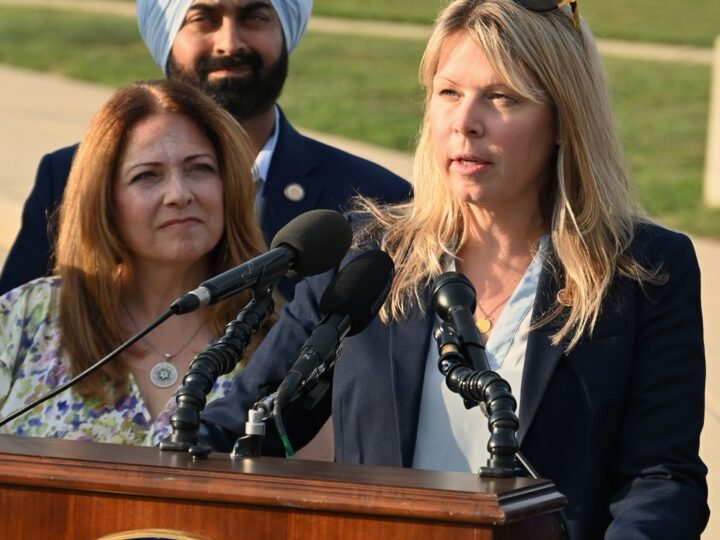
State Sen. Russet Perry (D-31) went further, repeating her call for a statewide moratorium on new data centers until Virginia answers fundamental questions about whether sufficient electricity and water exist, where new infrastructure will go and who will pay for it.
“Before another project goes forward, we need answers to some basic questions—Do we have the power? Do we have the water? Where does all this infrastructure go? Who pays for what, and what happens to the people who already live there?” Perry said.
“If we can’t answer that, we shouldn’t be approving the project. It’s really that simple and straightforward.”
Residents who joined the elected officials put a human face on those concerns.
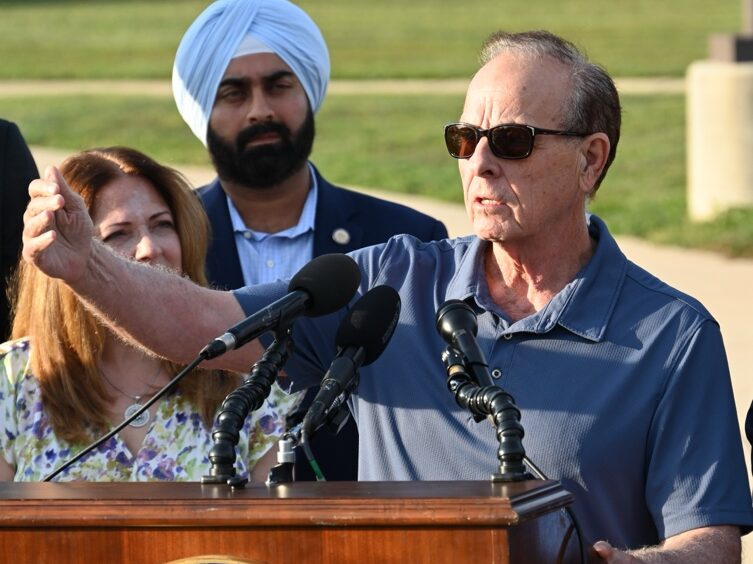
Sterling resident Greg Pirio said he lives about 150 yards from the Vantage VA2 data center and described persistent noise and pollution that he says have affected nearby residents and his own health.
“I had to be taken to the ER on two occasions now because of severe dry eyes,” Pirio said.
Prince William County resident Elspeth McCormick said her neighborhood faces industrial data centers on three sides, some separated from existing homes by only a 100-foot buffer.
“We are not anti-business. We are not anti-technology,” McCormick said. “We are pro-family, pro-environment, and pro-accountability.”
“Our homes are not industrial zones, our schools are not industrial zones, and no one’s community should be collateral damage,” she said.
Subramanyam also raised an issue receiving less attention in the broader data center debate—national security.
He said the concentration of data centers and the electrical infrastructure serving them create vulnerabilities that should be examined at the federal level. Subramanyam called for the Department of Homeland Security to consider helping underground transmission infrastructure, arguing that protecting the buildings themselves without protecting their power supply leaves a significant vulnerability.
The four bills now face the considerably harder journey through Congress.
But Tuesday’s announcement also illustrated how dramatically the conversation surrounding data centers has changed in Northern Virginia.
For years, the debate centered largely on economic development and tax revenue. Standing outside an Ashburn elementary school Tuesday, the conversation was instead about children’s playgrounds, household electric bills, transmission lines, water, noise, private property and national security.
And Subramanyam’s message was that communities that helped build the digital economy should no longer be expected simply to absorb its consequences.
“I want the community to have the power to say no,” he said, “and to stop being steamrolled.”
Comments
Any name-calling and profanity will be taken off. The webmaster reserves the right to remove any offensive posts.