


1M-Sq.-Ft. Industrial Approved in Purcellville JLMA as Water Limits Shape Uses

By Valerie Cury
The Board of Supervisors voted 6-3 at its June 2 business meeting to approve the Valley Commerce Center rezoning application, clearing the way for nearly 1 million square feet of industrial development on land currently zoned for 39 homes.
The decision concludes more than a decade of annexation and rezoning efforts that began under family ownership and later continued under the current owner Chuck Kuhn.
The proposal drew significant public opposition throughout years of review, with area residents citing concerns about the change in land use, scale, location, and its impact on the rural character of western Loudoun County.
Supporters, including business owners and real estate professionals, cited economic development, job creation and the need for additional industrial land in the western part of the county.
Supervisors Caleb Kershner (R-Catoctin), Kristen Umstattd (D-Leesburg), Sylvia Glass (D-Broad Run), Mike Turner (D-Ashburn), Koran Saines (D-Sterling), Matt Letourneau (R-Dulles) voted in favor of the rezoning application. Chair Phyllis Randall (D-At Large), Juli Briskman (D-Algonkian) and Laura TeKrony (D-Little River) voted no.
The 117.07-acre site at 17110 Purcellville Road lies within the Purcellville Joint Land Management Area, just outside town limits.
The proposal seeks to rezone the property from JLMA-3 to Planned Development–Industrial Park, allowing up to 986,000 square feet of industrial development.
Revised plans reduce overall square footage by nearly 289,000 square feet from earlier versions and lower building heights to 32 feet on the western portion of the site and 40 feet on the eastern side. The proposal also includes a 358-foot setback from the nearest residence and a 60-foot reforestation buffer.
The applicant has designated approximately 300,000 square feet—about 30% of the project—for warehouse or storage uses, saying these are intended to reduce overall water demand.
The proposal includes a private water system capable of producing up to 74,880 gallons per day, though state regulations would limit permitted withdrawals to 43,680 gallons per day.
Senior Planner and Project Manager Rachael Iwanczuk said that if the property remained zoned at one dwelling per three acres, estimated water usage would be 13,650 gallons per day. By comparison, if developed at the density of the nearby Mayfair community (five dwelling units per acre), estimated daily water usage would rise to about 204,750 gallons, she said.
Iwanczuk noted that Mayfair Industrial contains 246,299 square feet of industrial space, compared with 12,000 square feet at St. Francis Court, located outside the town limits across Rt. 7.
An additional secondary well could provide an estimated 15,000 to 20,000 gallons per day, and the project would include on-site wastewater treatment.
The applicant has updated its proffers to extend off-site well monitoring for nearby properties to five years, tied to the issuance of certificates of occupancy. Monitoring would begin after at least 300,000 square feet of non-warehouse and storage uses are completed and continue through buildout of up to 493,000 square feet.
The development is projected to generate 3,086 weekly vehicle trips. Iwanczuk said 2030 traffic volumes at Hirst Road and Rt. 690 are projected at 1,090 westbound, 220 northbound, and 870 southbound vehicles without the project.
Iwanczuk said the proposal is inconsistent with the development pattern and land-use guidance for the Purcellville Joint Land Management Area Rural Neighborhood Place Type outlined in the Loudoun County 2019 General Plan.
She said the designation is intended to support low-density, large-lot and clustered residential development, as well as agricultural and rural economy uses. County consultants also found the proposed industrial uses are not adequately mitigated given their proximity to residential areas, and cited a reasonable potential for off-site water impacts.
County staff continued to recommend denial of the application.
The public hearing drew a large number of speakers.
Purcellville Mayor Chris Bertaut said he has heard from residents of Purcellville and surrounding areas that “all are opposed to the project.” He added, “These are the people who will be most affected by this if you approve this project,” and said, “It’s impossible to reconcile approval of this project with the county’s General Plan and the town’s Comprehensive Plan for the area adjacent to the town, which call for less intensive uses that complement the rural character of the area surrounding the town.”
He said a recent survey of residents in surrounding areas showed 93% opposed the project.
“A sextuple increase in the industrial space over that provided inside the Town of Purcellville is simply not needed and will lead to the hollowing out of the commercial areas of the town,” he said.
Council member Susan Khalil said, “Approving this application would disregard the residents who are the foundation of our town.”
She noted that the project is “clearly inconsistent with both the county and Purcellville’s comprehensive plans.”
Khalil also said the risks are “straightforward,” adding that approving the application could put additional strain on the water supply and increase traffic in an area that already presents safety concerns.
Council member Caleb Stought, who on Jan. 8, 2025, voted against ending the annexation process for the Valley Commerce Center, said, “This land is not a suitable location for this type of project.”
He said the Rt. 7/690 interchange should not be used as an excuse to build the Valley Commerce Center, noting that the interchange is being built to address current traffic problems. He said using it as justification would be “trading one problem for another.”
Paul McCullough, chief information officer at JK Moving, said the county has done a good job building the data center economy, but it has put pressure on light industrial space and many businesses around “Data Center Alley” can no longer afford to rent there.
He said the Valley Commerce Center helps fill that gap and called for a balanced approach by supporting the project.
Jamie Emery, a hydrogeologist working on the project, said he has investigated groundwater for the Valley Commerce Center for the past four years and that “the applicant has far exceeded the requirements set forth by both the county and the state.”
He said groundwater use at the Valley Commerce Center can be done in “a safe and sustainable manner.”
Developer Casey Chapman said residents often return to the argument that “this isn’t the right spot.”
“Well, it’s time to choose. The county has an obligation, a duty to provide something there” that is a net benefit—and the JLMA is supposed to be a transition, he said. “I am here as someone who sees the need for this.”
Purcellville resident Michael Parish said county planning staff continue to recommend denial “because it is inconsistent with the comprehensive plan and not adequately mitigated given its proximity to existing homes. This property is designated rural neighborhood intended for low-density residential.”
Parish said, “The issue tonight before the board is not whether industrial space may be needed somewhere in Loudoun County, but whether this location is appropriate under the comprehensive plan.”
He said that “residents rely on the comprehensive plan to understand how their communities would grow.”
Contractor Donald Smith supported the project, saying it will generate tax revenue and create new job opportunities.
Commercial realtor Chase Stewart said there is a lack of available space in the region and that the project would be beneficial for western Loudoun.
Chad Martin, chief operating officer with JK Moving, said the project is a thoughtful and well-planned solution to the shortage of light industrial space in western Loudoun.
Tia Earman, senior land use field representative for the Piedmont Environmental Council, said, “A million square feet of industrial building is an inappropriate use in the JLMA rural place type.”
She said there is a recognized shortage of flex industrial space in the county, but added, “This is a direct product of over proliferation of data centers and frequent rezonings approved in eastern Loudoun.”
“But the answer now is not to undermine the integrity of residential communities by approving inappropriate rezonings on their doorstep in western Loudoun,” she said.
Earman said, “We continue to share the neighbors’ concerns about traffic. It’s not only the volume of traffic added, but the nature of the vehicles likely to be included coming and going from oversized buildings.”
Purcellville resident Lloyd Harting said he had a traffic study conducted on Purcellville Road from 6 to 9 a.m. and 3 to 7 p.m., during which 2,114 vehicles, trucks and school buses were counted.
“If the applicant’s traffic prediction is accurate of 3,500 daily trips, then vehicle traffic on Purcellville Road will reach 5,614 daily trips,” he said.
John Ellis, with Save Rural Loudoun, said, “We are very strongly opposed to the Valley Commerce Center.”
He said professional hydrogeologists who were not “commercially affiliated with the applicant” have reached conclusions exactly the opposite to those presented earlier.
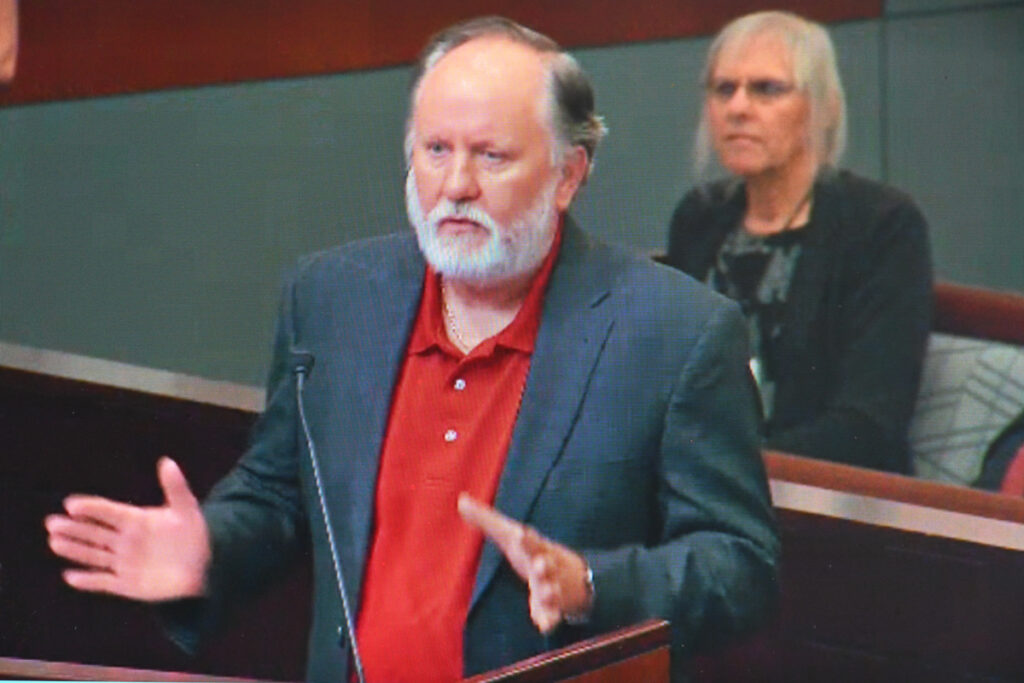
Area resident Richard Pruzina urged the board to vote no on the application. He said his family moved to the United States in 1969 in search of freedom and a better life from then-Czechoslovakia.
He chose Purcellville “as a place to build my life because it represented everything that my father, my family came here for—peace, community and the American dream.”
“With the Valley Commerce Center we don’t just lose water, we lose the very character of western Loudoun,” he said.
As the board began its discussion following public comment, Supervisor Caleb Kershner, whose district includes the property, made a motion to approve the project, saying, “Ultimately I support this application.”
He said there is a significant shortage of flex industrial space in Loudoun County. Kershner said business owners he spoke with at the Small Business Awards were considering relocating to West Virginia, Clarke County or Winchester because comparable space is not available locally.
He said the planned Rt. 7/690 interchange “is going to help a lot.” Kershner also noted that approximately one-third of the project would be used for storage, which he said would reduce traffic impacts.
“Nothing is not going to happen on this property,” he said.
Kershner said the project could generate millions of dollars in revenue for Purcellville “if they are willing to annex it in the future.” He said the town had refused to consider the project.
However, development proposals for the site have been discussed over the past 15 years through Town Council meetings, public hearings and community meetings.
Kershner’s reference to annexation reflected the fact that development on the site is constrained by available groundwater, while access to town water and sewer service could support greater density and more intensive uses.
Chair Phyllis Randall asked whether county staff believed the groundwater studies raised concerns.
Iwanczuk said the county had sent the applicant’s hydrogeologic study to a consultant retained by the county for review, and they found that the study conformed to the Facilities Standards Manual.
However, Iwanczuk said the consultant also concluded that “there is a reasonable potential that there could be an effect” on off-site wells in future years.
Supervisor Kristen Umstattd said, “It’s the board’s duty not just to provide for residents, but for jobs. The business community came out in force.”
Supervisor Juli Briskman said staff had made it clear that the property does not support this type of use.
“It’s not what is envisioned in our General Plan,” she said.
Briskman said repeated rezonings for data centers have reduced opportunities for housing and flex industrial space, pushing those uses into these areas of the county.
“I know we need the use; this is not the right place for the use,” she said.
Supervisor Laura TeKrony said offering land in the western part of the county for industrial use “is not okay” and said approval of the application would set a precedent.
She said the proposal would impact the rural character of western Loudoun County and noted that “93% of neighborhoods oppose the proposal.”
TeKrony said the Town of Purcellville has twice rejected annexation and that the application does not align with the county’s comprehensive plan, which was developed through years of public input.
She also referenced the county’s third-party consultant, who found there would be potential impacts to off-site wells.
Randall said the matter is a land-use issue. “If this were me, I would upzone this to dense housing. I’d put the infrastructure in place first and upzone it to dense housing.”
Following approval, the Board of Supervisors voted to consider removing the Northern Collector Road from the countywide transportation plan.
On Jan. 8, 2025, the Purcellville Town Council voted to remove the NCR from its transportation plan, with Council members Erin Rayner, Kevin Wright and Caleb Stought voting against the measure.
In a statement after the meeting, Chuck Kuhn said,“I’m very pleased with the outcome. It’s a win for small business and the local community they support. We appreciate the vote of confidence from the board and support from the local community, Loudoun Economic Development, and the Loudoun Chamber and its CEO Tony Howard.
“We look forward to moving ahead with this project and will work closely with the Town to make this a win for all.”
Continue reading in this news section
Comments
Any name-calling and profanity will be taken off. The webmaster reserves the right to remove any offensive posts.
1 Comment
e-edition

The Loudoun County Supervisors’ approval of this Kuhn project is a travesty and spells the death knell of any sense of calm and peacefulness of western Loudoun and the town of Purcellville.